
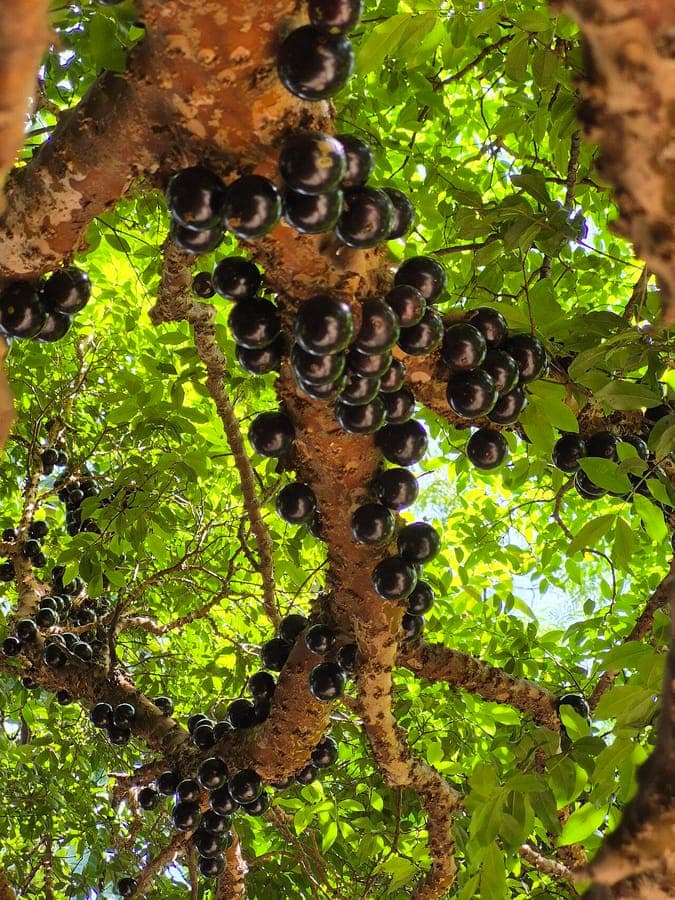
Bageense / CC BY-SA 4.0, via Wikimedia Commons
Plinia cauliflora: complete guide
Plinia cauliflora
¿Quieres ver Plinia cauliflora: complete guide en tu jardín?
1 minuto, sin tarjeta de crédito
Overview
Plinia cauliflora, better known as jabuticaba or Brazilian grapetree, is a fascinating tropical fruit tree native to Brazil. It is one of the world's most visually spectacular fruit trees - producing fruits directly on the trunk and branches, a phenomenon called "cauliflory."
Belonging to the Myrtaceae family, this tree has gained popularity among enthusiasts seeking something truly unique. At gardenworld.app, we help select extraordinary fruit trees for your heated greenhouse or conservatory.
Appearance and bloom
Plinia cauliflora is an attractive tree with glossy green foliage and interesting greyish-brown bark. The tree can reach 10-12 meters in optimal conditions, though indoor specimens typically remain smaller.
Flowers are small, white to creamy, and appear directly on trunk and branches, emitting a pleasant fragrance. After pollination, round dark-purple to black fruits develop, roughly grape-sized - hence the name.
The fruits are edible with a sweet-tart flavor reminiscent of blueberries with subtle tropical notes. They ripen from August to October in the southern hemisphere.
Ideal location
Plinia cauliflora thrives in warm, lightly shaded positions. While requiring substantial light, direct midday sun burns foliage in hot climates. Four to six hours of filtered sunlight is ideal.
The tree requires high humidity. In the Netherlands and Belgium, this works best in a heated greenhouse or conservatory. Protect from strong winds and sudden temperature fluctuations.
Even in warm European regions, this remains a greenhouse plant, as winter night temperatures below 10 degrees Celsius are problematic.
Soil
Plinia cauliflora thrives in moist, nutrient-rich, well-draining soil mix. A blend of peat, leaf mold, sand, and compost (3:2:1:1) works well. The tree prefers acidic to slightly acidic soils.
Incorporate slow-release fertilizer when planting. Regular organic material additions maintain soil fertility. The tree requires substantial nitrogen for optimal growth.
Diseño gratis
¿Quieres ver Plinia cauliflora: complete guide en tu jardín? Crea un diseño gratis ahora.
Watering
This is a tree that loves moist (not waterlogged) conditions. Keep soil consistently moist during the growing season (spring/summer). In winter, as growth slows, allow soil to dry slightly between waterings.
Ensure good drainage to prevent root rot. Regular misting of foliage promotes flowering. Water with soft water when possible - the tree prefers it.
Pruning
Minimal pruning is needed. Remove only dead or diseased branches. For more compact growth, gently prune tips during the growing season.
The tree responds well to shaping and can be trained as an espalier specimen. Prune in early spring or after fruit season.
Maintenance calendar
January to March: Winter dormancy. Reduce watering. Monitor for pests.
April to May: Growth begins. Water more. Apply fertilizer.
June to August: Full growth and flowering. Regular watering. High humidity.
September to October: Fruit ripens. Start frost protection.
November to December: Prepare for winter dormancy. Monitor temperature.
Winter hardiness
Plinia cauliflora is absolutely not winter hardy. Temperatures below 10 degrees Celsius are problematic, and frost severely damages or kills the tree. This is exclusively a greenhouse plant in the Netherlands and Belgium.
In warmer regions of southern France, northern Italy, or northern Spain, it might survive outdoors with south-wall protection, but this is not recommended.
The tree thrives better in controlled greenhouse conditions with constant warm temperatures (15-25 degrees Celsius year-round is ideal).
Companion plants
In a greenhouse/conservatory environment:
Understory: Shade-tolerant plants like ferns and begonias.
Nearby: Other tropical trees like mango or avocado sharing the same temperature requirements.
Climbers: Passiflora can grow against support near the tree.
Conclusion
Plinia cauliflora is not for everyone - it demands demonstrable greenhouse capacity and commitment. But for gardeners willing to provide this, the rewards are spectacular: unique trunk-grown fruits and a fascinating tropical addition to your garden.
¿Quieres ver Plinia cauliflora: complete guide en tu jardín? Crea un diseño gratis ahora.
Sube una foto, elige un estilo y obtén un diseño fotorrealista con lista de plantas en menos de un minuto.
Más de 10.000 jardines diseñados
Sin tarjeta de crédito


Plantas similares
Flooded gum (Eucalyptus grandis): complete guide
Eucalyptus grandis
Everything about the flooded gum: fast growth, impressive stature and silvery bark. How to plant and care for this eucalyptus in your garden.
Yellow gum (Eucalyptus leucoxylon): complete guide
Eucalyptus leucoxylon
Everything about the yellow gum: showy flowers in winter, compact form and drought tolerance. How to grow and care for this eucalyptus in your garden.
Sydney blue gum (Eucalyptus saligna): complete guide
Eucalyptus saligna
Everything about the Sydney blue gum: extraordinary growth rate, beautiful grey-blue bark and impressive stature. How to plant and care for this eucalyptus.