
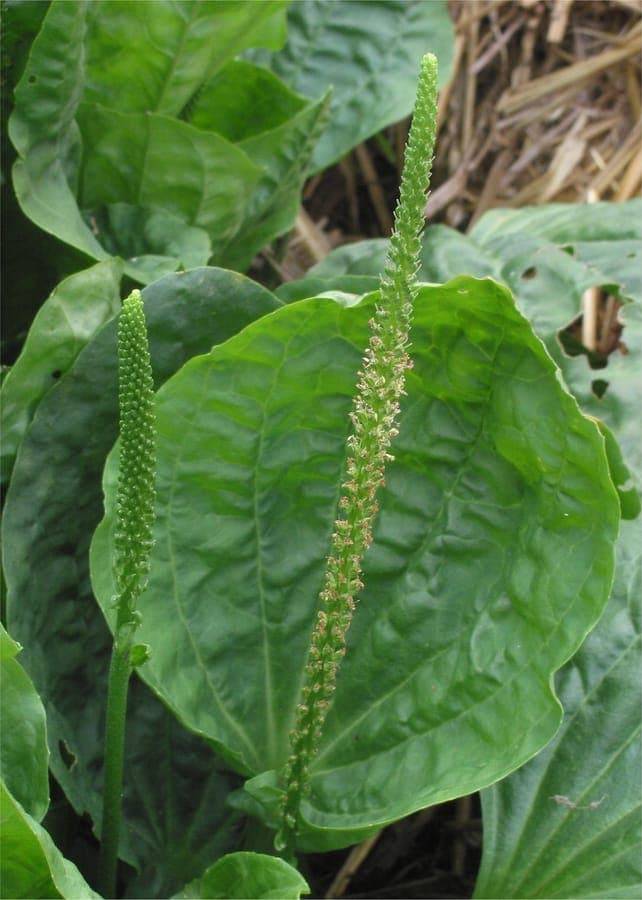
Rasbak / CC BY-SA 3.0, via Wikimedia Commons
Plantago major: complete guide
Plantago major
¿Quieres ver Plantago major: complete guide en tu jardín?
1 minuto, sin tarjeta de crédito
Overview
Plantago major, commonly known as Common plantain, is one of the most ubiquitous native plants in Europe. Despite being often considered a weed, this plant has a rich history of traditional and culinary use. The plant grows almost everywhere, from sidewalk cracks to bird feeders, and is tremendously versatile.
Historically, this plant was widely used in traditional medicine and is still used in some cultures as a food source. Biologically, it is a foodplant for various butterfly species and provides nutrition for birds and other animals.
Appearance and Bloom
Plantago major forms a dense, broad leaf rosette directly on the ground. The leaves are much wider than its relative Plantago lanceolata - approximately 5-15 cm long and 3-8 cm wide. The leaves are thick, green, and feature clearly visible veins radiating from the centre.
Flowers appear from May through October in long spikes above the leaf rosette. Spikes are initially green, later becoming white-yellow to reddish-brown. The plant can reach 30-50 cm tall depending on growing conditions. Insects do not visit the flowers much, so self-pollination is likely.
Ideal Location
Common plantain is extremely adaptable and grows in virtually all light situations. The plant grows in full sun, shade, partial shade - it does not really matter. This makes it an ideal plant for neglected garden corners.
The plant tolerates trampling and compaction damage much better than most other plants. This explains why it is so common in sidewalks and meadows.
Soil
Common plantain grows on practically all soil types without preference. It grows equally well on fertile soils as on very poor ground. This is one of the reasons it is so ubiquitous.
Drainage is not critical - the plant tolerates both dry and wet conditions. pH is not important.
Diseño gratis
¿Quieres ver Plantago major: complete guide en tu jardín? Crea un diseño gratis ahora.
Watering
Common plantain tolerates drought excellently once established. Water is needed only for establishment. This is actually one of the most drought-tolerant plants you can plant.
The plant also tolerates wet conditions well, though it grows less well in full wetlands.
Pruning
Pruning is not necessary or desirable for this plant. The plant grows naturally in a neat, natural form. Allow self-seeding for natural regeneration.
Remove dead leaves in spring for a neater appearance.
Maintenance Calendar
May-June: Flowering begins; insects investigate. July-September: Continuous flowering and seed production. October-November: Seed production completed; plant prepares for winter. December-April: Plant rests; rejuvenates for next season.
Winter Hardiness
Common plantain is completely hardy throughout Europe, even in the coldest regions. This is a perennial plant that can grow for many years without needing replacement.
Companion Plants
Common plantain combines well with other ruderal plants and native wildflowers. Also beautiful with other Plantago species, white clover, and other grassland vegetation.
For formal borders: less suitable, unless you pursue a "wild garden" aesthetic.
Conclusion
Plantago major is the plant for anyone with little time or attention for plant care. With its amazing tolerance for all growing conditions, extreme drought resistance, and ecological benefits, it is a valuable addition to any garden.
For purchase: you can easily collect seed from existing plants. Gardenworld.app helps you design natural, low-maintenance gardens. Gardenworld.app supports sustainable, low-maintenance garden design.
¿Quieres ver Plantago major: complete guide en tu jardín? Crea un diseño gratis ahora.
Sube una foto, elige un estilo y obtén un diseño fotorrealista con lista de plantas en menos de un minuto.
Más de 10.000 jardines diseñados
Sin tarjeta de crédito


Plantas similares
White Beardtongue: complete guide
Penstemon albidus
Discover white beardtongue (Penstemon albidus) - elegant perennial with white to cream flowers. Drought-resistant, perfect for prairie and dry gardens.
Longsepal Beardtongue: complete guide
Penstemon calycosus
Discover longsepal beardtongue (Penstemon calycosus) - beautiful perennial with lilac-blue flowers. For partial shade and moist soil. Ideal for naturalized.
Penstemon cusickii: complete guide
Penstemon cusickii
Discover Cusick's beardtongue, a compact alpine flowering plant with violet-pink blooms. Perfect choice for rock gardens and water-wise landscaping.