
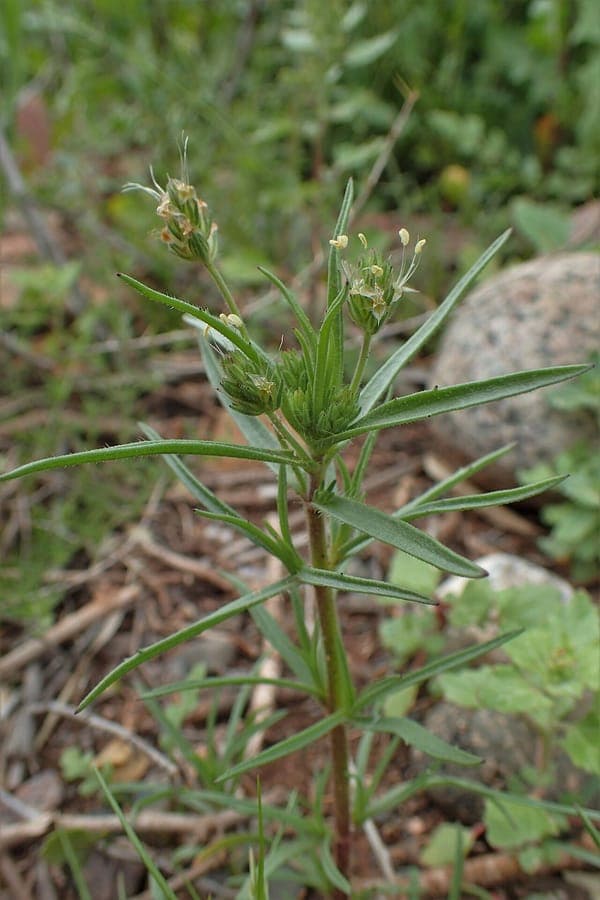
Krzysztof Ziarnek, Kenraiz / CC BY-SA 4.0, via Wikimedia Commons
Plantago afra: complete guide
Plantago afra
¿Quieres ver Plantago afra: complete guide en tu jardín?
1 minuto, sin tarjeta de crédito
Overview
Plantago afra, known as African plantain, is a charming annual plant species native to North Africa and Macaronesia. This elegant plant grows as a compact shrubby form and produces fine, hairy flower spikes that create interesting visual texture in borders and drought gardens. Despite its modest appearance, the plant offers abundance and requires virtually no maintenance.
As a member of the Plantaginaceae family, Plantago afra has a rich history of traditional use, especially in North Africa and Mediterranean regions. The plant itself is non-toxic and is sometimes even used medicinally.
Appearance and Bloom
Plantago afra grows as a compact, upright plant reaching approximately 15-30 cm in height. The plant features linear (thin, line-shaped) leaves growing densely and forming a rosette-like pattern at the base. Foliage is greyish-green, slightly hairy, and gives the plant a soft, matte appearance.
Flowers are tiny and appear in long, slender spikes from April through September. The spikes are hairy and yellowish to reddish-brown in colour. Individual flowers are inconspicuous, but the entire flower spike creates interesting textural effects in the garden. They attract small bees and butterfly species.
Ideal Location
Plantago afra thrives in fully sunny locations. Minimum 6 hours direct sun daily is essential for good growth. The plant tolerates partial shade but will grow less compactly and possibly flower less prolifically.
The plant tolerates considerable wind. In very windy sites, some support or group planting helps. For best results, plant in groups of 3-5 plants close together.
Soil
Plantago afra is not fussy about soil type as long as it drains well. The plant loves poor to moderately fertile soils and grows excellently in sandy or gravelly soils. Actually, it performs better in poor soil - excessive feeding stimulates overgrown growth.
Heavy clay must be amended with sand and gravel for better drainage. A pH between 6-7 is ideal, but the plant tolerates more acidic soils.
Diseño gratis
¿Quieres ver Plantago afra: complete guide en tu jardín? Crea un diseño gratis ahora.
Watering
Once established, Plantago afra is extremely drought-tolerant. It is actually one of the most drought-resistant annual plants you can grow. Water only at planting time and possibly the first 2-3 weeks afterwards.
Under normal rainfall, the plant grows without supplementary watering. Even in very dry summers, this plant needs little extra water. Preferring slightly moist soil is better than waterlogged conditions.
Pruning
Pruning is not necessary. If you remove spent flowers (deadheading), this stimulates continuous bloom until first frost. Leave some flowers to set seed if you want virtually free new plants next year.
The plant naturally forms a neat shape without intervention.
Maintenance Calendar
April-May: Sow directly in situ or plant potted specimens. June-August: Regular deadheading for continuous flowering. September-October: Leave some flowers for seed production. November-December: Plant dies after first frost in most regions. January-March: Replant next growing season.
Winter Hardiness
Plantago afra is not winter-hardy. It is an annual plant that dies after first frost. This means you must sow new seed or purchase new plants each spring. However, this is not a problem since seed is inexpensive.
In milder climates in southern regions, self-seeding may occur, but do not rely on this happening.
Companion Plants
Plantago afra combines well with other drought-tolerant annuals and perennials: Helichrysum, Gazania, Linaria, and Eschscholzia are good partners. With grey-foliaged plants like Senecio or Artemisia it creates beautiful contrasts.
In dry borders mix with Sedum species and low-growing Sempervivum. For colour: purple Sage, yellow Rudbeckia, and orange Calendula.
Conclusion
Plantago afra is a valuable addition to dry, sunny gardens and particularly suitable for those with limited maintenance time. The plant remains attractive throughout the season, flowers abundantly, and attracts beneficial insects. With its modest water and nutrient requirements, it fits perfectly into ecologically responsible garden designs.
For purchase: seek seed from specialized seed companies or plant suppliers. Gardenworld.app helps you design drought-resistant borders for your garden. Gardenworld.app offers advice for climate-change-resilient gardens featuring species like Plantago afra.
¿Quieres ver Plantago afra: complete guide en tu jardín? Crea un diseño gratis ahora.
Sube una foto, elige un estilo y obtén un diseño fotorrealista con lista de plantas en menos de un minuto.
Más de 10.000 jardines diseñados
Sin tarjeta de crédito


Plantas similares
White Beardtongue: complete guide
Penstemon albidus
Discover white beardtongue (Penstemon albidus) - elegant perennial with white to cream flowers. Drought-resistant, perfect for prairie and dry gardens.
Longsepal Beardtongue: complete guide
Penstemon calycosus
Discover longsepal beardtongue (Penstemon calycosus) - beautiful perennial with lilac-blue flowers. For partial shade and moist soil. Ideal for naturalized.
Penstemon cusickii: complete guide
Penstemon cusickii
Discover Cusick's beardtongue, a compact alpine flowering plant with violet-pink blooms. Perfect choice for rock gardens and water-wise landscaping.