
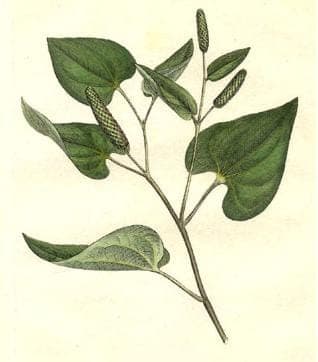
Wikimedia Commons / Public domain, via Wikimedia Commons
Piper longum: complete guide
Piper longum
¿Quieres ver Piper longum: complete guide en tu jardín?
1 minuto, sin tarjeta de crédito
Overview
Long pepper (Piper longum) is a remarkable climbing plant originating from the Himalayas, China, and Southeast Asia. This member of the Piperaceae family is less known than its famous relative (black pepper), yet feels at home in many gardens with a warm spot. Historically, long pepper was far more valuable than black pepper and was a luxury commodity in medieval European kitchens.
The plant grows as a climbing herbaceous vine that loves to twine around support. The leaves are heart-shaped, smooth, and dark green with a leathery texture. The characteristic fruits grow in compact spikes that start green and turn brown-black at maturity.
Appearance and Bloom
Piper longum grows to about 2-3 meters tall in container culture, though in its natural habitat it can climb much higher. The plant has a semi-woody stem that requires supportive structure.
Leaves grow alternately along the stem and can reach 10-15 centimeters in length. They have a glossy, dark green color and feel soft to touch. The texture is distinctly different from many other herb plants - almost leathery.
The flowers of Piper longum are tiny and inconspicuous, grouped into elongated spikes. These inflorescences can be yellow to reddish. The fruit (peppercorn) is larger than black pepper and has a more elongated shape. The aroma is aromatic and mildly pungent - much subtler than black pepper.
Ideal Location
Piper longum loves warmth and humidity. Place the plant where it receives at least 6 hours of indirect sunlight daily. In warm climates it can tolerate direct sun, but in temperate regions filtered sunlight works better.
The plant grows well on a terrace or balcony in a container, provided you don't expose it to strong wind. In areas with mild winters you can keep the plant outside, but in colder regions indoor winter storage is necessary.
Note: Piper longum is not frost-hardy and won't tolerate temperatures below 10 degrees Celsius.
Soil
Long pepper prefers rich, well-draining potting mix. Use a blend of compost, coconut coir, and perlite in roughly 2:1:1 ratio. This provides good nutrition and moisture retention while preventing waterlogging.
The pH should be slightly acidic (6.0-6.5). Regularly add organic matter to existing soil. A mulch layer of coconut fiber on the surface helps reduce evaporation and regulate soil temperature.
Diseño gratis
¿Quieres ver Piper longum: complete guide en tu jardín? Crea un diseño gratis ahora.
Watering
Piper longum loves consistently moist (but not waterlogged) soil. Water regularly, especially during the growing season (spring and summer). In winter, reduce watering somewhat, but don't let soil dry completely.
A good indicator of watering needs is when leaves become slightly limp - that's time to water. However, avoid standing water around roots, which causes root rot. Always water at soil level, not over foliage.
In very hot summers, daily misting to increase humidity is appreciated by the plant.
Pruning
Piper longum can become quite vigorous. Pruning helps keep the plant compact and encourages branching. Pinch off growth tips regularly (once monthly in growing season) for a fuller plant.
Once the plant becomes woodier, you can tolerate deeper pruning. This stimulates more side shoots. Pruning can happen year-round, though it's best during the growing season.
Maintenance Calendar
Spring: Check for pests. Begin regular watering as growth starts. Prune to maintain shape.
Summer: Regular watering and pruning. Feed once monthly with balanced liquid fertilizer.
Autumn: Gradually reduce watering. Last pruning session in September/October.
Winter: Minimal watering. Indoor placement for frost-prone areas. No feeding during this period.
Winter Hardiness
Piper longum is not winter-hardy. It's tropical in origin and cannot tolerate frost. In temperate climates you must bring the plant indoors in winter or protect with fleece.
In Southern Europe (USDA 10+) you can keep it outside in a protected spot. In colder regions, container culture with indoor storage is recommended.
Companion Plants
Piper longum pairs well with other tropical herb plants and heat-loving species:
- Passiflora (passion fruit, also climbing)
- Hoya (wax plant, succulent vine)
- Monstera (Swiss cheese plant, indoor)
- Capsicum (chili peppers, heat-loving)
- Ocimum basilicum (basil, aromatic herb)
Group together in the same warm zone for optimal results.
Conclusion
Piper longum offers more than just flavor - it brings a piece of Himalayan exoticism into your garden or home. The plant is less well-known than its widely-cultivated relative (black pepper), but certainly deserves more attention.
Long pepper is an ideal plant for gardeners who love experimenting with unusual herb plants. Find it at specialized herb nurseries and some online plant suppliers. Start with a small plant and give it warm, humid conditions. Patience pays off with beautiful growth and possibly your own harvest of long pepper!
More plants and gardening tips at gardenworld.app.
¿Quieres ver Piper longum: complete guide en tu jardín? Crea un diseño gratis ahora.
Sube una foto, elige un estilo y obtén un diseño fotorrealista con lista de plantas en menos de un minuto.
Más de 10.000 jardines diseñados
Sin tarjeta de crédito


Plantas similares
Kava: complete guide to growing and care
Piper methysticum
Everything about kava (Piper methysticum): origin, appearance, location, soil, watering, pruning and overwintering outside the tropics.
Guinea Pepper: complete guide
Piper guineense
Guinea pepper is a tropical vine with aromatic fruits used in African cuisine. Learn how to grow this African pepper variant in warm indoor conditions.
Peperomia pellucida: complete guide to man-to-man herb
Peperomia pellucida
Master Peperomia pellucida, a compact herbaceous plant with translucent leaves ideal for indoor gardening and cool garden corners.