
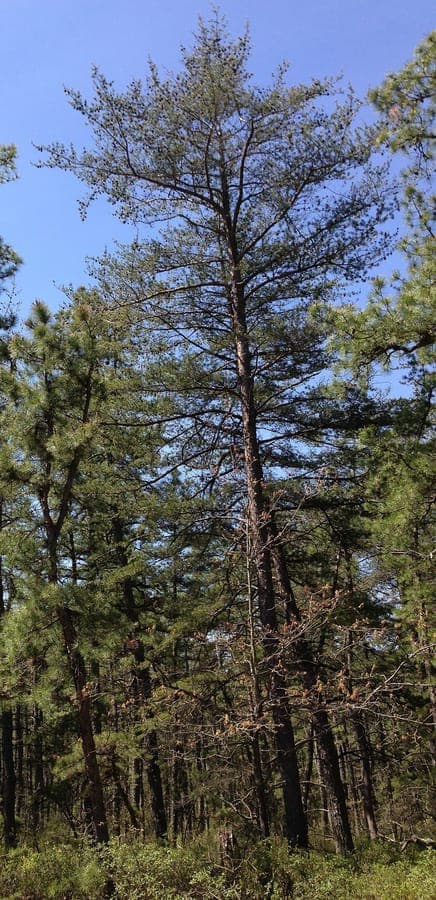
Famartin / CC BY-SA 3.0, via Wikimedia Commons
Pinus virginiana: complete guide
Pinus virginiana
¿Quieres ver Pinus virginiana: complete guide en tu jardín?
1 minuto, sin tarjeta de crédito
Overview
The Virginia pine (Pinus virginiana), also known as Jersey pine or poverty pine, is a North American conifer prized for its remarkable hardiness and adaptability. Growing naturally across southeastern US states, this tree thrives where other species fail, particularly on marginal soils and degraded sites. In modern gardens, Virginia pine serves as a valuable element for naturalistic landscaping and ecological restoration.
Beyond its ornamental value, this pine offers significant ecological contributions. Seed-eating birds including crossbills and nuthatches are attracted to the abundant seeds released throughout autumn and winter. The tree grows rapidly even on infertile soils, providing structural stability and preventing erosion where other plants struggle.
Appearance and bloom
Pinus virginiana develops into a medium-sized tree with a pyramidal to irregular crown shape. The needles are short to moderate (3-8 cm), thin and flexible, giving the tree an overall fine texture. Needle color ranges from deep green to blue-green depending on growing conditions and season.
Flowering is modest but characteristic of pines. Male flowers appear as yellow clusters at the base of young shoots in spring. Female flowers are less conspicuous and develop higher in the crown. Cones mature over two years, reaching 4 to 8 centimeters in length with an irregular shape and yellow-brown to brown coloration.
Ideal location
Virginia pine makes modest demands on planting sites. This is a tree for difficult locations where conventional species fail. It thrives on nutrient-poor soils, acidic sands and even degraded substrates. The plant prefers full sun but tolerates light to partial shade.
In garden design, this pine offers solutions for problem areas and slopes. It grows rapidly on sites prone to erosion, especially steep terrain. The tree also suits coastal gardens exposed to wind, thanks to its robust root system and flexible branches that bend rather than break.
Soil
Virginia pine is remarkably tolerant of diverse soil conditions. The pH range spans from very acidic (4.5) to neutral (7.5), covering virtually all garden soils. This flexibility makes it exceptionally valuable for gardens with challenging soils that have not been amended.
The tree benefits from well-draining soil. Waterlogged areas and heavy clay soils require improvement with sand and organic matter to prevent root rot. A dry to moderately moist regime is ideal. No special fertilization is needed on nutrient-poor soils; in fact, excess fertility can reduce the tree's hardiness.
Watering
Once established, Pinus virginiana is extremely drought-tolerant. Its deep root system allows access to water sources deep in the soil profile. During the first year after planting, regular watering is essential until the tree becomes fully rooted.
In moisture-rich summers, supplemental irrigation is unnecessary. Only during extended droughts exceeding four weeks without rainfall does the tree benefit from additional water. Young trees on slopes may benefit from mulching around the base to improve moisture retention during establishment.
Diseño gratis
¿Quieres ver Pinus virginiana: complete guide en tu jardín? Crea un diseño gratis ahora.
Pruning
Virginia pine requires minimal pruning maintenance. The tree naturally develops an acceptable form and establishes a strong branching structure. Dead branches can be removed year-round. Light pruning of lower branches for clearance may be necessary, but extensive formative pruning is not recommended.
Young trees can be lightly trained by removing weak shoots and maintaining a strong central leader. Once mature, the tree is best allowed to develop its natural form. Pruning living tissue can introduce disease, so minimal intervention is preferable.
Maintenance calendar
February to March: Inspect for dead branches and disease. Remove damaged growth. April to May: Water young trees regularly during active growth. June to July: Monitor for drought stress; irrigate as needed. August to September: Cones ripen visibly. October to November: Seeds disperse naturally. December to January: Winter dormancy; protect young trees from heavy snow with loose burlap windbreaks.
Winter hardiness
Pinus virginiana is exceptionally winter-hardy throughout Europe. The tree grows naturally across regions with severe winters and is adapted to temperatures down to -25 degrees Celsius. In the Netherlands, Belgium and France, Virginia pine experiences no winter damage even in severe seasons.
Heavy snowfall can damage young trees, with branches breaking under snow load. For young specimens, a loose burlap wrap in winter offers protection. Mature trees show no winter-related problems.
Companion plants
Virginia pine combines well with other bird-supporting plants. Shrubs including rowan (Sorbus) and hawthorn (Crataegus) provide attractive understory. Junipers (Juniperus) thrive in the same dry, nutrient-poor environment. For shade beneath the canopy, low shrubs and grasses like feathered grasses (Stipa) provide excellent contrast.
In coastal gardens, pair Virginia pine with other wind-hardy species like sea buckthorn (Hippophae) and elderberry (Sambucus). On slopes and erosion-prone areas, combine with deeply rooted shrubs to enhance slope stability.
Closing
Pinus virginiana is a valuable tree for gardens where conventional species struggle. With minimal care once established, it offers rapid growth, avian benefits and erosion control. This makes Virginia pine ideal for sustainable gardens with challenging sites.
Want to add this beautiful conifer? Nurseries and garden centers carry young specimens. Online plant retailers offer larger specimens if desired. Begin with a nutrient-poor site and watch this robust pine flourish where others fail.
GardenWorld.app provides guidance for difficult garden sites. Discover how to address erosion and integrate bird-friendly plants. Visit gardenworld.app for more guides.
¿Quieres ver Pinus virginiana: complete guide en tu jardín? Crea un diseño gratis ahora.
Sube una foto, elige un estilo y obtén un diseño fotorrealista con lista de plantas en menos de un minuto.
Más de 10.000 jardines diseñados
Sin tarjeta de crédito


Plantas similares
Abies delavayi: complete guide
Abies delavayi
Delavayi fir is an elegant, medium-sized coniferous tree from the Pinaceae family with dark green needles. This Asian evergreen is perfect for alpine gardens and large landscapes.
Taiwan fir: complete guide
Abies kawakamii
Discover the magnificent Taiwan fir, a rare evergreen conifer from Taiwan's mountain regions. Learn growth requirements, care tips, and why this beautiful tree is perfect for collectors of unique garden specimens.
Farges fir: complete guide
Abies fargesii
Discover the majestic Farges fir, an impressive conifer from China's mountains with elegant foliage and columnar form. Ideal for large gardens.