
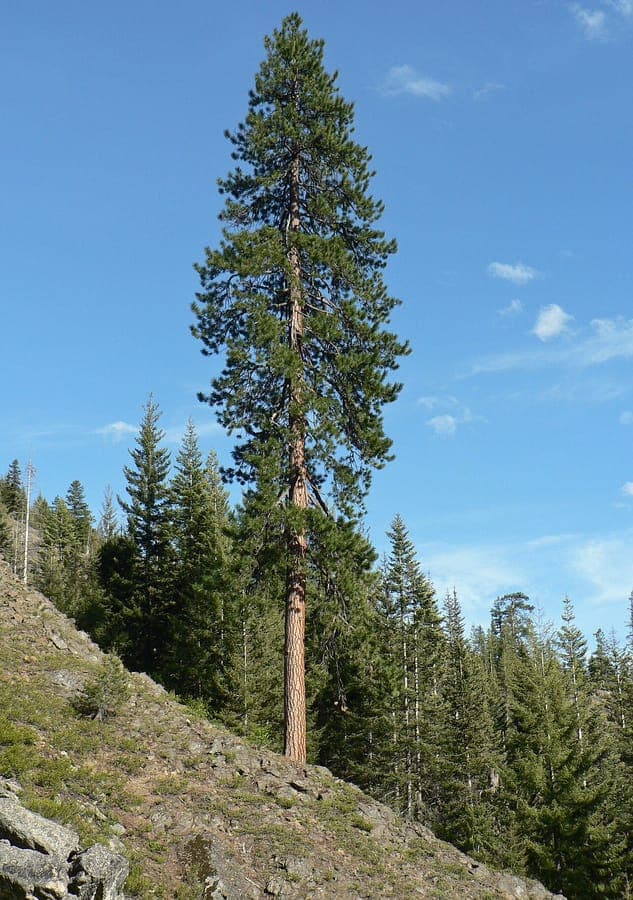
Walter Siegmund (talk) / CC BY 2.5, via Wikimedia Commons
Ponderosa pine: complete guide
Pinus ponderosa
¿Quieres ver Ponderosa pine: complete guide en tu jardín?
1 minuto, sin tarjeta de crédito
Overview
The Ponderosa pine (Pinus ponderosa) is a stately evergreen tree native to western North America, stretching from British Columbia down through the western U.S. and into northern Mexico. In the UK and northern Europe, it's not commonly planted in residential gardens due to its immense size, but for large estates, rural properties, or naturalistic landscapes, it's an outstanding choice. Reaching heights of 25 to 40 meters and spreading 10 to 15 meters wide, this tree demands space-but in return, it delivers year-round structure, rich fragrance, and habitat for wildlife.
On gardenworld.app, you can create a custom garden design that accounts for the Ponderosa pine's long-term growth, root spread, and shade projection, helping you plan your landscape with confidence.
Appearance & bloom cycle
Ponderosa pines have a distinctive, open crown with long, horizontal branches that create a tiered silhouette. Young trees feature dark green needles in bundles of three, each measuring 10 to 20 cm long. These needles emit a pleasant, sweet scent-often described as vanilla or butterscotch-when warmed by the sun.
In late spring, typically April to May, the tree produces small yellow male flowers near the base of new growth. Female cones follow, maturing into large, egg-shaped pinecones up to 15 cm long with a glossy, light brown to amber hue. These cones persist for several years and provide food for birds and small mammals.
The bark is one of its most striking features. Juvenile trees have dark, scaly bark, but as the tree matures (usually after 20–30 years), the bark transforms into thick, puzzle-like plates of bright yellow-orange bark that exfoliate in large chunks-earning it the nickname 'yellow pine'.
Ideal location
Full sun is essential. Plant your Ponderosa pine where it will receive at least 6–8 hours of direct sunlight daily. It thrives in open areas with good air circulation and ample space. Avoid planting within 8 meters of buildings, driveways, or underground utilities-its deep taproot and spreading lateral roots can cause damage over time.
This is not a tree for small urban gardens. It suits large country gardens, woodland edges, or restoration projects. If you're unsure about placement, use gardenworld.app to visualise how the tree will fill your space over the next 25 years using 3D garden modelling tools.
Soil requirements
Ponderosa pine is highly adaptable to soil types, including sandy, loamy, and clay soils-as long as drainage is good. It struggles in waterlogged or compacted soils. The ideal pH range is broad: 5.0 to 9.0, meaning it tolerates both acidic and alkaline conditions.
When planting, avoid amending the soil with compost or fertiliser. This species evolved in nutrient-poor, well-drained soils and often performs worse in overly rich mixes. Simply backfill with native soil and water in well.
Diseño gratis
¿Quieres ver Ponderosa pine: complete guide en tu jardín? Crea un diseño gratis ahora.
Watering
Young trees need consistent moisture for the first two growing seasons. Water deeply once a week during dry spells, applying 10–15 litres per session. After establishment, Ponderosa pines are extremely drought-tolerant thanks to their deep taproot system. Mature trees rarely need supplemental watering, even during prolonged dry periods.
Use a soaker hose or tree watering bag to deliver water slowly to the root zone. Avoid frequent shallow watering, which encourages weak root development.
Pruning
Pruning is rarely necessary. Ponderosa pines naturally develop a strong central leader and symmetrical form. Only remove dead, broken, or crossing branches, and do so in late winter or early spring before new growth begins. Never top the tree-this ruins its natural shape and invites disease.
If you need to raise the canopy, remove the lowest branches gradually over several years, taking no more than 20% of the live crown annually.
Maintenance calendar
- Jan: Inspect for storm damage. Remove any broken limbs.
- Feb: Plant container-grown saplings if the ground isn't frozen.
- Mar: Check for signs of pests. Water if winter has been dry.
- Apr: Male flowers appear. No feeding required.
- May: Female cones develop. Avoid mechanical injury from mowers.
- Jun: Young trees may need extra water during heatwaves.
- Jul: Minimal care. Tree is in mid-season dormancy.
- Aug: Monitor for needle browning-some loss is normal.
- Sep: Leave fallen needles as natural mulch.
- Oct: Clear vegetation from base to reduce fire risk in dry climates.
- Nov: Check tree stability in windy areas.
- Dec: Protect young trunks from rodents with wire guards.
Winter hardiness
Ponderosa pine is hardy in USDA zones 4 to 7 (–34°C to –15°C). It handles cold winters well, though young trees benefit from a 5–10 cm mulch layer to insulate roots. In exposed sites, winter sunscald can damage thin bark-consider wrapping trunks for the first 2–3 winters.
Companion plants
Pair with drought-tolerant, low-growing perennials that won't compete for water. Good choices include: Echinacea purpurea (60–120 cm), Salvia nemorosa (40–80 cm), and Festuca glauca (20–30 cm). Keep a 1–2 meter clear zone around the trunk to prevent root competition and reduce fire hazard.
Closing
The Ponderosa pine is a long-term investment, not a quick fix. But with the right site and minimal care, it becomes a majestic focal point that lasts generations. Buy young trees (80–120 cm) from reputable garden centres offering healthy, container-grown stock. This tree won't thrive in every garden-but for those with space and vision, it's unmatched in presence and resilience.
¿Quieres ver Ponderosa pine: complete guide en tu jardín? Crea un diseño gratis ahora.
Sube una foto, elige un estilo y obtén un diseño fotorrealista con lista de plantas en menos de un minuto.
Más de 10.000 jardines diseñados
Sin tarjeta de crédito


Plantas similares
Abies delavayi: complete guide
Abies delavayi
Delavayi fir is an elegant, medium-sized coniferous tree from the Pinaceae family with dark green needles. This Asian evergreen is perfect for alpine gardens and large landscapes.
Taiwan fir: complete guide
Abies kawakamii
Discover the magnificent Taiwan fir, a rare evergreen conifer from Taiwan's mountain regions. Learn growth requirements, care tips, and why this beautiful tree is perfect for collectors of unique garden specimens.
Farges fir: complete guide
Abies fargesii
Discover the majestic Farges fir, an impressive conifer from China's mountains with elegant foliage and columnar form. Ideal for large gardens.