
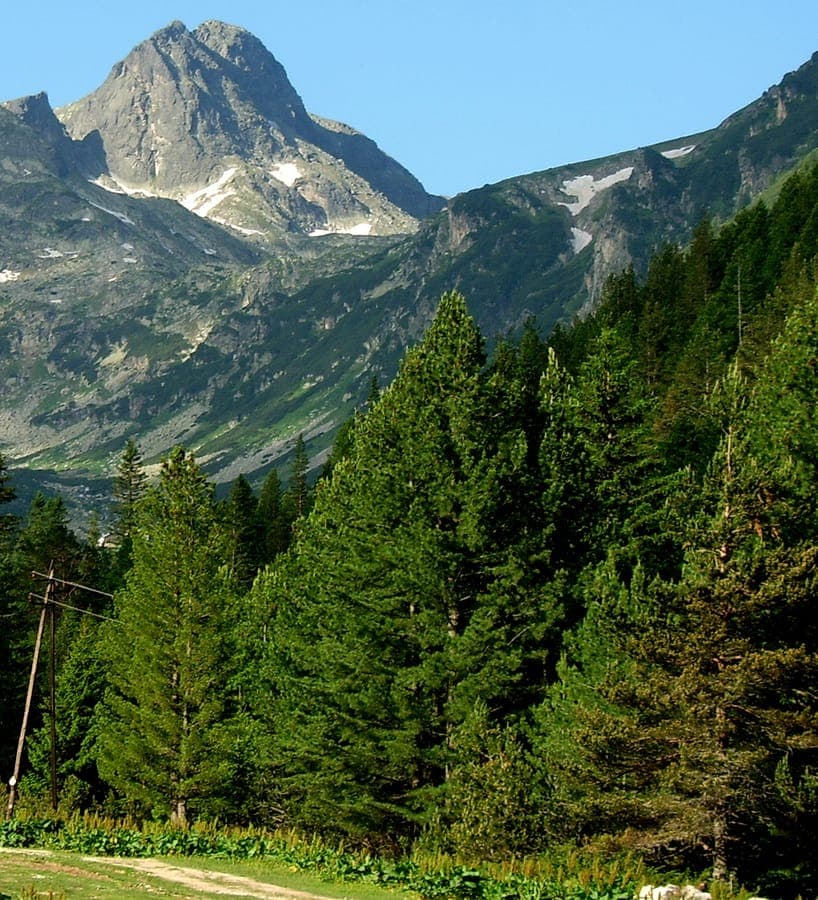
Galliano / Public domain, via Wikimedia Commons
Macedonian pine: complete guide
Pinus peuce
¿Quieres ver Macedonian pine: complete guide en tu jardín?
1 minuto, sin tarjeta de crédito
Overview
The Macedonian pine (Pinus peuce), also called Balkan pine, is an elegant conifer from the Balkan mountains (Albania, Bulgaria, Greece, and Serbia). This tree belongs to the Pinaceae family and is prized for its narrow, pyramidal form and fine needles. The Macedonian pine is relatively rare but increasingly appearing in European gardens as gardeners discover its charm.
In its natural habitat, it grows in mountain forests at moderate to high elevation. In cultivation, it typically reaches 15-25 metres, making it suitable for larger gardens and parks.
Appearance & growth
The Macedonian pine grows with an elegant, upright habit and narrow, pyramidal form. The tree usually reaches 15-25 metres height, occasionally more in ideal conditions. Bark is grey-brown and smooth when young, becoming rougher and deeply furrowed with age.
The needles are distinctly short and fine, approximately 4-8 cm long, clustered in bundles of five (characteristic of five-needle pines). They have a soft, ribbon-like appearance in dark green to grey-green. In spring, new light-coloured growth gives attractive contrast.
Cones are approximately 10-12 cm long, purple-brown, hanging elegantly on branches.
Ideal location
Macedonian pine thrives in full sun with at least 6-8 hours direct daily light. It also grows in part-shade but develops less compact form. Position in a sheltered location against strong winds, though it eventually becomes reasonably wind-resistant.
Provide adequate space for growth. This tree is perfect as a specimen or in groups of three for structural interest.
Soil requirements
Macedonian pine requires little feeding and grows in average soils. A pH of 5.5-7.5 is ideal. It prefers well-draining soil - waterlogging causes problems. Even in dry, sandy soils it grows well, though organic matter helps.
Amend soil with compost at planting to improve structure and drainage. Once established, this tree is very self-sufficient.
Diseño gratis
¿Quieres ver Macedonian pine: complete guide en tu jardín? Crea un diseño gratis ahora.
Watering
Young trees need regular watering during their first growing season. Once established, this pine tolerates reasonable drought. In very dry summers, supplemental water helps, especially for young trees.
Mulch around young trees to conserve moisture and protect roots. Avoid waterlogged conditions, especially in winter.
Pruning
Macedonian pine requires minimal pruning. The natural pyramidal form is attractive and needs no adjustment. Remove only dead or damaged branches. Heavy pruning can deform the tree.
Spontaneous branch growth usually creates attractive form naturally. Minor directional corrections in young years prevent lopsided growth.
Maintenance calendar
April-May: Plant young trees carefully. Water regularly after planting.
June-August: Monitor for drought in very hot periods. Water as needed.
September-October: Check for pests; prepare for winter.
November-March: Minimal maintenance. Protect young trees from heavy snow.
Winter hardiness
Macedonian pine is hardy to USDA zone 5 (-29°C), making it winter-hardy in virtually all temperate European regions. In very hot Mediterranean zones, summer can be too warm and dry, causing stress. This tree is therefore ideal for northern and central Europe.
Companion plants
Macedonian pine works well with:
- Other conifers: Picea, Abies, Larix for variety.
- Shade-tolerant groundcovers: Ajuga, Vinca beneath the tree.
- Shrubs: Sambucus, Salix in moister locations.
The tree usually performs best as a specimen or small grouping rather than mixed with many other plants.
Closing
The Macedonian pine is an elegant, underused conifer deserving greater recognition. With its fine form and ornamental presence, it provides beauty for decades. Use gardenworld.app to find designs featuring ornamental conifers. Plant this tree for your children and grandchildren - it will give generations of enjoyment!
¿Quieres ver Macedonian pine: complete guide en tu jardín? Crea un diseño gratis ahora.
Sube una foto, elige un estilo y obtén un diseño fotorrealista con lista de plantas en menos de un minuto.
Más de 10.000 jardines diseñados
Sin tarjeta de crédito


Plantas similares
Abies delavayi: complete guide
Abies delavayi
Delavayi fir is an elegant, medium-sized coniferous tree from the Pinaceae family with dark green needles. This Asian evergreen is perfect for alpine gardens and large landscapes.
Taiwan fir: complete guide
Abies kawakamii
Discover the magnificent Taiwan fir, a rare evergreen conifer from Taiwan's mountain regions. Learn growth requirements, care tips, and why this beautiful tree is perfect for collectors of unique garden specimens.
Farges fir: complete guide
Abies fargesii
Discover the majestic Farges fir, an impressive conifer from China's mountains with elegant foliage and columnar form. Ideal for large gardens.