
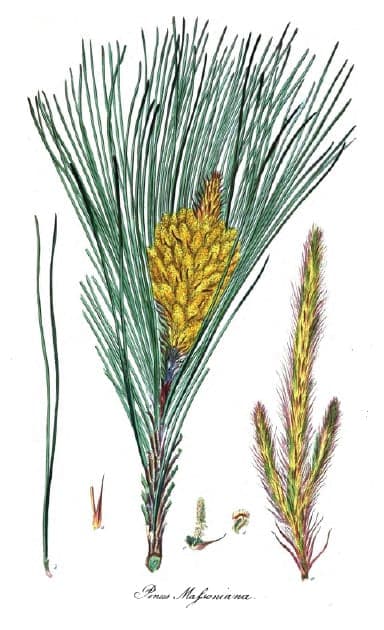
Aylmer Bourke Lambert (1761-1842) / Public domain, via Wikimedia Commons
Masson pine: complete guide
Pinus massoniana
¿Quieres ver Masson pine: complete guide en tu jardín?
1 minuto, sin tarjeta de crédito
Overview
Masson pine, scientifically known as Pinus massoniana, is a medium-sized pine tree native to central and southern China and Taiwan. Also known as Chinese red pine, this tree is highly valued in China for its rapid growth and timber production. In gardens, the tree is appreciated for its interesting form and tolerance to various climates.
Pinus massoniana is less well-known in Europe and North America, but is increasingly recognized as an interesting ornamental tree for gardens with mild climates. The tree can grow quite large and provides shade and privacy.
Appearance and bloom
Masson pine grows into a medium to large tree with regular form. The tree can reach 15-25 meters in height and has a nice pyramidal shape when young. The needles are medium-long, approximately 8-15 centimeters, and usually grow in bundles of two. The needles have a shiny green color.
The flowers are very inconspicuous because pines are wind-pollinated. The male flowers are yellow pollen clusters. The female flowers are small and inconspicuous. The cones are medium-sized, approximately 6-9 centimeters long, and mature in two to three years.
Ideal location
Masson pine thrives best in sunny locations where it receives full sun. The tree can also grow in light shade, although this may slow growth. Position the tree where it has plenty of space to expand.
The tree can tolerate moderate cold and much heat. This makes it suitable for many climate zones. In very cold regions, protection may be necessary.
Soil
Masson pine grows well in various soil types, from sandy to clay soils. The tree thrives in moderately acidic soils but can also grow in neutral soils. The tree is not particularly fussy about drainage, although well-drained soils are better.
The tree is not particularly food-fussy, although supplemental feeding in the first year can promote establishment. Add compost or organic matter for better growth.
Diseño gratis
¿Quieres ver Masson pine: complete guide en tu jardín? Crea un diseño gratis ahora.
Watering
Masson pine requires regular water in the first year for thorough rooting. Water thoroughly and regularly to encourage deep root growth. Thereafter, the tree is relatively drought-tolerant.
During dry periods, water deeply but not frequently. Ensure the soil dries somewhat between waterings. A mulch layer of 5-10 centimeters helps retain moisture.
Pruning
Masson pine usually requires little pruning as it naturally assumes a beautiful form. Remove only dead, damaged or diseased branches. Pruning is best done in late spring or early summer.
If the tree becomes too large, you can lightly prune the outside. Avoid heavy pruning as this causes large wounds that heal poorly.
Maintenance calendar
Spring: Prune dead wood, add compost. Summer: Water regularly during dry periods. Autumn: Check tree health. Winter: Minimal maintenance, protect young trees in very cold regions.
Winter hardiness
Masson pine is hardy to approximately -10 to -12 degrees Celsius. In milder gardens, protection is unnecessary. In colder regions, protection for young trees can be beneficial, especially in the first few winters.
Companion plants
Masson pine grows well with other Asian plants. The tree forms a beautiful background for smaller garden plants. The tree can also be planted alone as a solitary specimen.
The tree provides good shelter for birds and helps support biodiversity.
Conclusion
Masson pine is an interesting and beautiful choice for gardeners seeking something different than common pines. With regular care in the first year, you can enjoy this beautiful tree for a long time. Available at specialized garden centers. More information at gardenworld.app/en.
¿Quieres ver Masson pine: complete guide en tu jardín? Crea un diseño gratis ahora.
Sube una foto, elige un estilo y obtén un diseño fotorrealista con lista de plantas en menos de un minuto.
Más de 10.000 jardines diseñados
Sin tarjeta de crédito


Plantas similares
Abies delavayi: complete guide
Abies delavayi
Delavayi fir is an elegant, medium-sized coniferous tree from the Pinaceae family with dark green needles. This Asian evergreen is perfect for alpine gardens and large landscapes.
Taiwan fir: complete guide
Abies kawakamii
Discover the magnificent Taiwan fir, a rare evergreen conifer from Taiwan's mountain regions. Learn growth requirements, care tips, and why this beautiful tree is perfect for collectors of unique garden specimens.
Farges fir: complete guide
Abies fargesii
Discover the majestic Farges fir, an impressive conifer from China's mountains with elegant foliage and columnar form. Ideal for large gardens.