
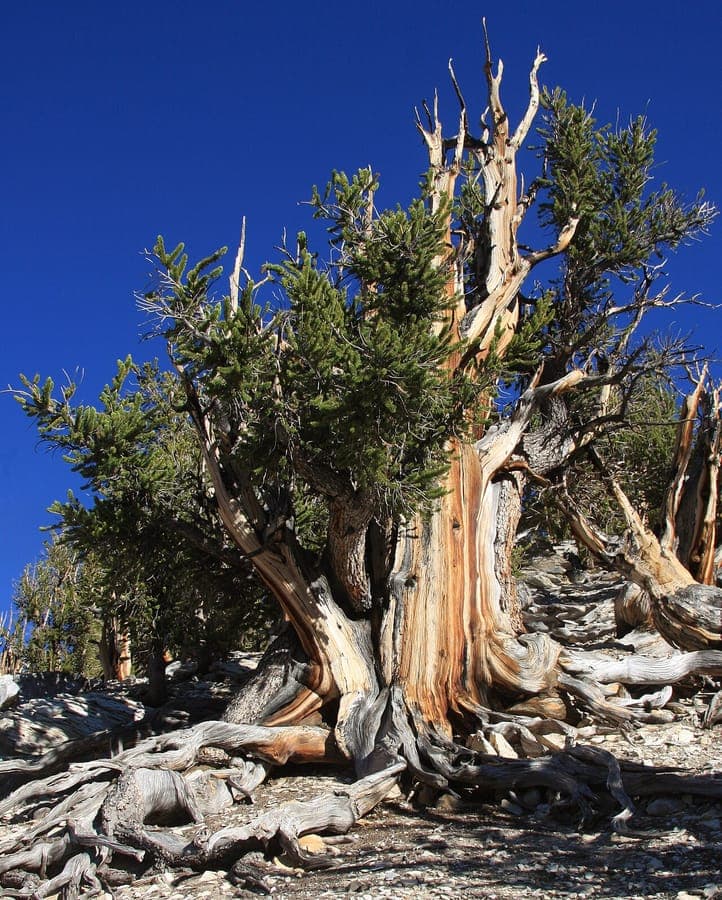
Dcrjsr / CC BY-SA 3.0, via Wikimedia Commons
Pinus longaeva: complete guide
Pinus longaeva
¿Quieres ver Pinus longaeva: complete guide en tu jardín?
1 minuto, sin tarjeta de crédito
Overview
The Great Basin Bristlecone Pine (Pinus longaeva) is among the world's most remarkable conifers. This species is renowned for its extraordinary longevity - some specimens exceed 5,000 years of age. This makes it a living testament to resilience and endurance. The tree naturally inhabits the highlands of California, Nevada, and Utah, where it has adapted to extreme environmental conditions.
The branches of Pinus longaeva display characteristic long needles in bundles, explaining the "bristle" in its name. The needles possess a waxy, grayish appearance. Unlike many other pines, this species remains relatively compact and slow-growing. The bark is thick and furrowed, weathered into deep gray tones.
Appearance and Bloom
The Great Basin Bristlecone Pine typically reaches heights between 1-5 meters, though some monumental specimens reach 20 meters. Growth is extraordinarily slow - merely 1-2 centimeters annually.
The needles grow in bundles of five, measure approximately 2-4 centimeters long, and display characteristic curved forms. These needles can remain living for up to 40 years - unique among conifers. Coloring ranges from green to dark green with whitish resin-canal lines.
Male flowers are small and yellow, while female flowers may appear reddish to purple. These emerge in spring. Female flowers develop into characteristic cones approximately 3-8 centimeters long, with distinctly protruding bracts (prickly scales).
Ideal Location
Pinus longaeva thrives in mountain settings with abundant direct sunlight. Select a location where the tree receives a minimum of 6-8 hours of full sun daily. This proves essential for the tree's health and structural integrity.
The higher and drier the location, the better. This tree flourishes in rugged terrain and feels at home on slopes where many other trees cannot survive. A windy site actually proves ideal - the tree exhibits exceptional adaptation to strong mountain winds.
Soil
The Great Basin Bristlecone Pine demonstrates remarkable soil flexibility. In its native habitat, the tree grows on rocky, stony ground with minimal organic matter. This makes it perfect for poor soils where other trees would fail.
Essential, however, is excellent drainage. Heavy clay or waterlogged terrain can lead to root rot. Sandy, gravelly, and similar mineral soils prove ideal. The tree prefers neutral to slightly acidic pH (6.0-7.0).
While Pinus longaeva requires minimal feeding, you may apply a mulch layer the first year after planting to enhance moisture retention. However, avoid heavy organic mulch against the tree base.
Diseño gratis
¿Quieres ver Pinus longaeva: complete guide en tu jardín? Crea un diseño gratis ahora.
Watering
Once this tree is established, it needs remarkably little water. In fact, it thrives in areas receiving only 30-50 centimeters of annual precipitation. This makes it ideal for dry climates and xeriscape gardens.
During the first growing season after planting, water regularly - roughly weekly, depending on rainfall frequency. Allow soil to dry somewhat between waterings.
Once established (after 2-3 years), Pinus longaeva requires virtually no supplemental water. In fact, excessive water proves harmful and may cause root rot. In drier climates, you might water only during prolonged droughts.
Pruning
The Great Basin Bristlecone Pine needs minimal pruning. The tree naturally develops an attractive form and becomes dense and full without intervention.
When pruning proves necessary, do so in late winter or early spring. Remove only dead, damaged, or diseased branches. Pruning healthy branches may unnecessarily damage the tree.
The tree recovers slowly from wounds, so wound dressing proves unnecessary and potentially counterproductive.
Maintenance Calendar
Spring: Check for winter damage. Provide extra water to young trees if dry weather arrives.
Summer: Monitor drought stress in the first year. Established trees need no further care.
Autumn: No specific maintenance required.
Winter: This tree requires no special protection, even in harsh mountain winters. This is precisely its strength!
Winter Hardiness
Pinus longaeva proves extremely winter-hardy to USDA zone 3 (-40°C). Many specimens grow at elevations exceeding 3,600 meters and tolerate extreme temperature fluctuations.
It thrives in snow and freezing conditions that would kill other plants. The tree slows growth to adapt to short growing seasons.
Even in temperate regions, this tree can thrive outdoors, especially in elevated areas or mountain gardens with well-draining soil.
Companion Plants
Given the minimalist nature of Pinus longaeva, ideal companions are other drought-tolerant plants adapted to sparse soil nutrition:
- Juniperus species (other conifers with similar needs)
- Festuca glauca (blue fescue grass)
- Sempervivum (houseleek, extremely hardy)
- Artemisia (mugwort, drought-tolerant)
- Sedum (stonecrop)
Avoid moisture-loving and nutrient-hungry plants. Instead, group according to "dry mountain climate" themes.
Conclusion
Pinus longaeva represents far more than decorative planting - it is a monument to patience and resilience. Though slow-growing (which may frustrate some), it promises decades, likely centuries of beauty and stability in your garden.
This tree suits gardeners with patience seeking something truly exceptional. In temperate regions, find it through specialized tree nurseries and some larger garden centers. Given its rarity and slow growth, consider starting with a young specimen.
The Great Basin Bristlecone Pine is an investment in the future - for you, your children, and possibly many generations beyond. A true heirloom tree for your garden! Discover more landscaping tips and plant inspiration at gardenworld.app.
¿Quieres ver Pinus longaeva: complete guide en tu jardín? Crea un diseño gratis ahora.
Sube una foto, elige un estilo y obtén un diseño fotorrealista con lista de plantas en menos de un minuto.
Más de 10.000 jardines diseñados
Sin tarjeta de crédito


Plantas similares
Abies delavayi: complete guide
Abies delavayi
Delavayi fir is an elegant, medium-sized coniferous tree from the Pinaceae family with dark green needles. This Asian evergreen is perfect for alpine gardens and large landscapes.
Taiwan fir: complete guide
Abies kawakamii
Discover the magnificent Taiwan fir, a rare evergreen conifer from Taiwan's mountain regions. Learn growth requirements, care tips, and why this beautiful tree is perfect for collectors of unique garden specimens.
Farges fir: complete guide
Abies fargesii
Discover the majestic Farges fir, an impressive conifer from China's mountains with elegant foliage and columnar form. Ideal for large gardens.