
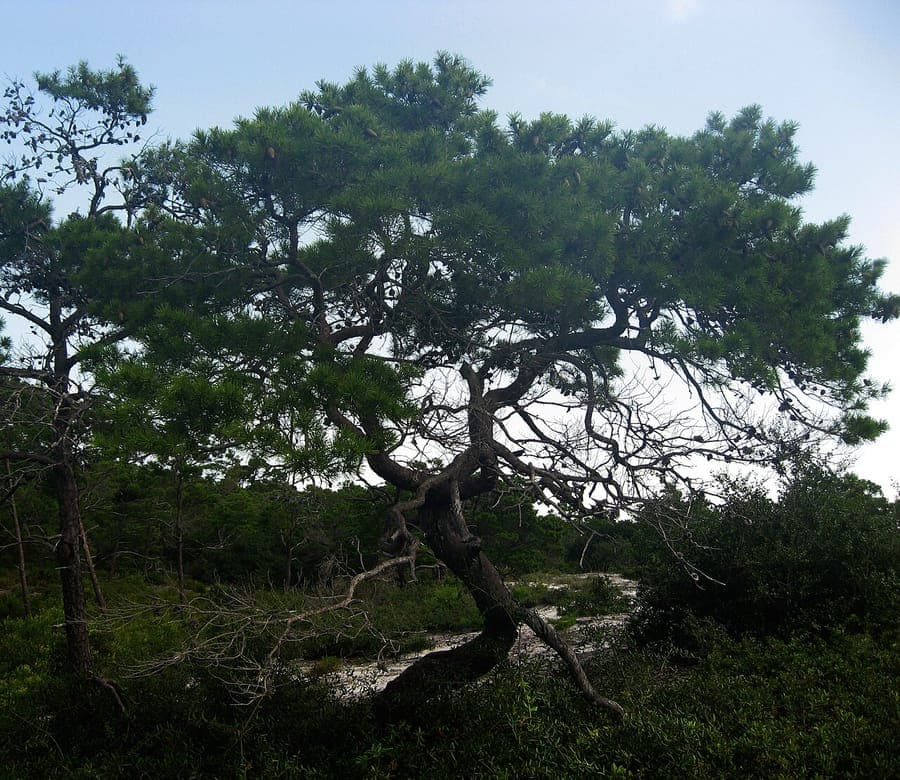
Mason Brock (Masebrock) / Public domain, via Wikimedia Commons
Sand pine: complete guide
Pinus clausa
¿Quieres ver Sand pine: complete guide en tu jardín?
1 minuto, sin tarjeta de crédito
Overview
The Sand pine or Florida Spruce Pine (Pinus clausa) is a remarkable conifer native to the southeastern United States, particularly Alabama and Florida. This tree thrives on sandy, nutrient-poor soils where most other trees struggle. With extremely slow growth and a compact form, it fits perfectly into gardens with specific soil conditions. Though not winter-hardy in northern Europe, it offers an intriguing alternative for warm-climate gardeners seeking something distinctive.
Pinus clausa is especially valued for its ability to flourish where sand dominates and nutrients are scarce. The tree is highly adapted, meaning it withstands extreme conditions exceptionally well. This makes it an excellent choice for experimental gardeners in mild climates who want to try something unique and challenging.
Appearance and Bloom
The Sand pine is a slender upright conifer typically reaching 5 to 9 meters tall, though under ideal conditions it can grow to 12 meters. The tree features a very fine root system with short, thin needles arranged in bundles of two, typical of Pinus species. The needles are green to gray-green in color and persist year-round on the branches.
The bark is relatively thin with a reddish-brown to gray appearance and large scales that gradually peel away. This gives the tree, especially as it matures, a characteristically bleached appearance. The flowers are highly inconspicuous - male flowers appear as reddish catkins, while female flowers remain small and green.
Seeds are contained within compact, rounded pine cones measuring 4 to 6 centimeters in length. These cones are brown and persist on the tree for an extended period before releasing seeds. The tree flowers in May, when the male organs shed their pollen via wind.
Ideal Location
Sand pine requires very strong sunlight. Plant it in a location receiving at least 6 to 8 hours of direct sun daily. In partial shade, it will grow slowly and may develop disease and pest problems. This is a tree for the sunniest corners of your garden.
The tree is extremely wind-resistant and tolerates heavy winds and sea winds exceptionally well, making it an excellent choice for windy coastal areas or open terrain. It does not grow well in shaded forests or beneath other trees.
For location preference: plant it in open, sunny positions away from dense wooded areas. This is a tree for gardens with abundant light and air circulation.
Soil
The Sand pine performs best on very sandy, well-draining soils with a low pH between 4.2 and 5.5. This is an extremely acid-loving tree. The tree thrives on soils that are too poor for most other plants - it actually prefers low-nutrient substrates.
Soil structure preference: sand and gravel are its favorite textures. Heavy clay soils are completely inappropriate and will cause root rot. If you have such soil, you must incorporate at least 30 to 40 centimeters of sand before planting.
The tree tolerates very dry conditions because its roots penetrate deeply into sand. Water does not remain in sandy soils, so waterlogging is not a concern for this species. Nutrients are limited in sand, so fertilizers are usually unnecessary and can even be harmful.
Diseño gratis
¿Quieres ver Sand pine: complete guide en tu jardín? Crea un diseño gratis ahora.
Watering
Once established (after 2 to 3 years), the Sand pine is extremely drought-tolerant. During the first year after planting, however, you must water regularly - at least once a week during dry periods. Keep the soil moist but not waterlogged.
The tree develops a deep root system that expands quickly into sand. This means that when mature, it withstands drought lasting weeks or even months. Overwatering is a much greater problem than underwatering.
During very hot summers, occasional careful watering during extended dry periods can be helpful, but always ensure the soil drains well. Use drip irrigation or soaker hoses rather than overhead sprinklers, which can promote leaf disease.
Pruning
The Sand pine requires very little pruning work. The tree grows naturally into a neat, slender upright form. Dead branches can be removed any season, and light structural pruning helps maintain symmetry.
Avoid heavy pruning, as this can distort the natural form. Pine trees respond less favorably to severe pruning than other species. Trim only dead or damaged portions.
Gentle maintenance pruning once every two years (in late winter before new growth begins) helps keep the tree healthy and controlled. Never remove more than 20 to 25 percent of the canopy in a single year.
Maintenance Calendar
FEBRUARY-MARCH: Inspect for winter damage. Prune dead branches. Conduct soil pH test. APRIL-MAY: Flowering and wind-borne pollen dispersal. Growing season begins. JUNE-AUGUST: Full growing season. Monitor soil moisture during dry periods. SEPTEMBER-OCTOBER: Seed maturation in cones. Growth slows. NOVEMBER-DECEMBER: Winter dormancy. Minimal maintenance. Frost preparation.
Winter Hardiness
The Sand pine is hardy only to approximately -10 to -12 degrees Celsius and is therefore unsuitable for typical Dutch winters. In USDA hardiness terms, this is a zone 8b to 9 plant, suitable only for very mild climates such as coastal areas or southernmost regions.
In colder climates, container growing and greenhouse overwintering is possible, though this limits growth. The tree is sensitive to frost-thaw cycles.
For northern Netherlands and much of Belgium, this is not a practical permanent outdoor plant. In southern Netherlands and Belgium, it may be possible in very protected microclimates, but this requires substantial frost protection measures.
Companion Plants
The Sand pine pairs well with other sand-loving plants:
- Beach grass (Ammophila) - suitable for coastal gardens
- Bergenia - tolerant of sandy soils
- Rosemary - drought-tolerant and sand-friendly
- Sea-buckthorn - for windy coasts
Avoid planting with heavy feeders such as hydrangeas or rhododendrons, which require moister, more nutrient-rich soils.
Closing
The Sand pine (Pinus clausa) is a highly specialized tree for gardeners in warm-temperate climates with sandy soils. Though not suitable for everyone, it represents a fascinating choice for those with ideal growing conditions. For sandy gardens in southern Netherlands or Belgium, it may be worth considering.
For trees and expert advice, we recommend visiting local garden centres. On gardenworld.app, you will find many more specialized conifer guides. Enjoy creating your dream sandy garden with gardenworld.app!
¿Quieres ver Sand pine: complete guide en tu jardín? Crea un diseño gratis ahora.
Sube una foto, elige un estilo y obtén un diseño fotorrealista con lista de plantas en menos de un minuto.
Más de 10.000 jardines diseñados
Sin tarjeta de crédito


Plantas similares
Abies delavayi: complete guide
Abies delavayi
Delavayi fir is an elegant, medium-sized coniferous tree from the Pinaceae family with dark green needles. This Asian evergreen is perfect for alpine gardens and large landscapes.
Taiwan fir: complete guide
Abies kawakamii
Discover the magnificent Taiwan fir, a rare evergreen conifer from Taiwan's mountain regions. Learn growth requirements, care tips, and why this beautiful tree is perfect for collectors of unique garden specimens.
Farges fir: complete guide
Abies fargesii
Discover the majestic Farges fir, an impressive conifer from China's mountains with elegant foliage and columnar form. Ideal for large gardens.