
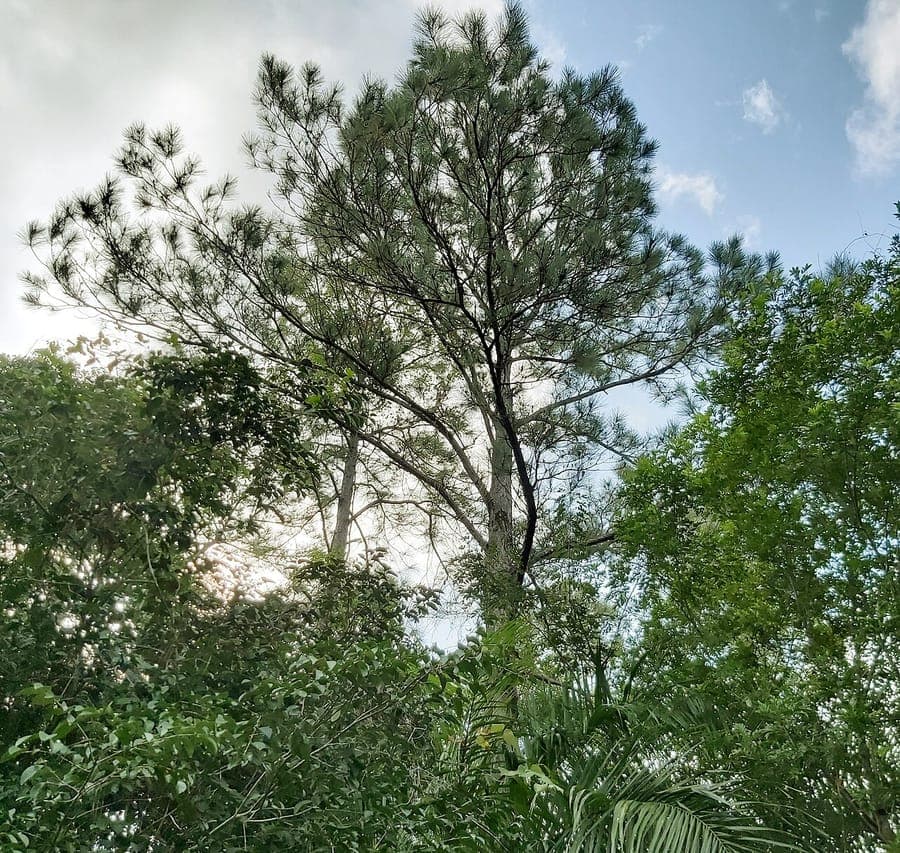
tonyblake / CC0, via Wikimedia Commons
Pinus caribaea: complete guide
Pinus caribaea
¿Quieres ver Pinus caribaea: complete guide en tu jardín?
1 minuto, sin tarjeta de crédito
Overview
Caribbean pine, scientifically known as Pinus caribaea, is a striking conifer native to warm regions from southeastern Mexico through Central America, with natural distribution across Cuba, Honduras, Belize, and Nicaragua. This tree is highly valued in warm climates for its rapid growth, elegant form, and valuable timber production. In Europe, Caribbean pine can only be cultivated in the warmest regions, but for gardeners in southern areas, this species offers spectacular possibilities.
Appearance and bloom cycle
Pinus caribaea is a stately tree with a regular, conical form that can reach 30-35 meters tall in ideal conditions. The needle-like foliage is shiny green, lengthy (15-20 cm), and grows in bundles of two to three, giving the tree a characteristic, dense appearance. The bark is dark gray to brownish, forming distinctive deep furrows. The cones are reddish-brown and approximately 8-10 cm long, appearing during summer months. The flowers are small and inconspicuous, typical of pines.
Ideal location
This species requires full sun to grow optimally. Ensure a location with at least 6-8 hours of direct sunlight daily. The tree is highly wind-resistant and tolerates coastal winds well, making it suitable for seaside areas. Avoid shaded spots entirely, as insufficient light will cause the tree to lose its form quickly and develop weakly.
Soil requirements
Pinus caribaea is not particularly fussy about soil composition but thrives best in well-draining, sandy or sandy-loam soil. The pH can range from neutral to slightly acidic (pH 5.5-7.0). Avoid waterlogging absolutely; roots cannot tolerate wet feet. In gardens with heavy, compacted soil, it is advisable to work the planting hole well with sand and organic matter to improve drainage.
Watering
Once established in warm climates, Pinus caribaea is quite drought-tolerant. However, regular watering is essential in the first two years after planting, particularly during dry periods. Water deeply and thoroughly, but ensure water never pools around the base. In Mediterranean or subtropical climates, an established tree usually needs no additional watering except in extremely dry summers.
Diseño gratis
¿Quieres ver Pinus caribaea: complete guide en tu jardín? Crea un diseño gratis ahora.
Pruning
Caribbean pine requires little pruning if allowed to grow on an open spot in full sun. Remove only dead, damaged, or sickly branches. Prune best in early spring, before the growth flush. Avoid heavy pruning, as pines recover poorly from it. The natural conical form is most beautiful and requires no artificial intervention.
Maintenance calendar
- Winter: In colder regions, consider frost protection; young trees are more sensitive.
- Early spring: Check for winter damage. Begin watering gradually as temperatures rise.
- Summer: Ensure regular watering during dry spells. Monitor for pests.
- Fall: Reduce watering gradually. No fertilizer needed for established trees.
Winter hardiness
This is the major limitation of Pinus caribaea in many European gardens: it is not winter-hardy. In regions where temperatures drop below -5 to -10 degrees Celsius, this tree will suffer serious damage or die. It is therefore suitable only for the Azores, southern coast of Spain, southern France, Italy, Greece, and the warmest parts of southeastern Europe. In colder climates, it can only be cultivated in containers and must overwinter in a heated greenhouse.
Companion plants
Caribbean pine works excellently alongside other heat-loving species such as Pinus pinaster (cluster pine), Cupressus sempervirens (Italian cypress), and various Mediterranean shrubs. Combine it with palms and subtropical tree species for an exotic garden. In coastal regions, it fits perfectly between stone pines and eucalypts.
Closing remarks
For enthusiasts of unique, heat-loving trees, Pinus caribaea is an absolute asset. With its rapid growth, graceful form, and practical value in timber production, it deserves its place in southern European gardens. For those in cold climates, container cultivation in a greenhouse is possible, provided you manage the difference between summer and winter temperatures well. Inquire at local garden centers about suitable heat-loving cultivars and see gardenworld.app for more inspiration about exotic tree species. With the right location and climate, you will enjoy this majestic pine for many years.
For more plant and garden advice, visit gardenworld.app and discover how to take your garden to the next level.
¿Quieres ver Pinus caribaea: complete guide en tu jardín? Crea un diseño gratis ahora.
Sube una foto, elige un estilo y obtén un diseño fotorrealista con lista de plantas en menos de un minuto.
Más de 10.000 jardines diseñados
Sin tarjeta de crédito


Plantas similares
Abies delavayi: complete guide
Abies delavayi
Delavayi fir is an elegant, medium-sized coniferous tree from the Pinaceae family with dark green needles. This Asian evergreen is perfect for alpine gardens and large landscapes.
Taiwan fir: complete guide
Abies kawakamii
Discover the magnificent Taiwan fir, a rare evergreen conifer from Taiwan's mountain regions. Learn growth requirements, care tips, and why this beautiful tree is perfect for collectors of unique garden specimens.
Farges fir: complete guide
Abies fargesii
Discover the majestic Farges fir, an impressive conifer from China's mountains with elegant foliage and columnar form. Ideal for large gardens.