
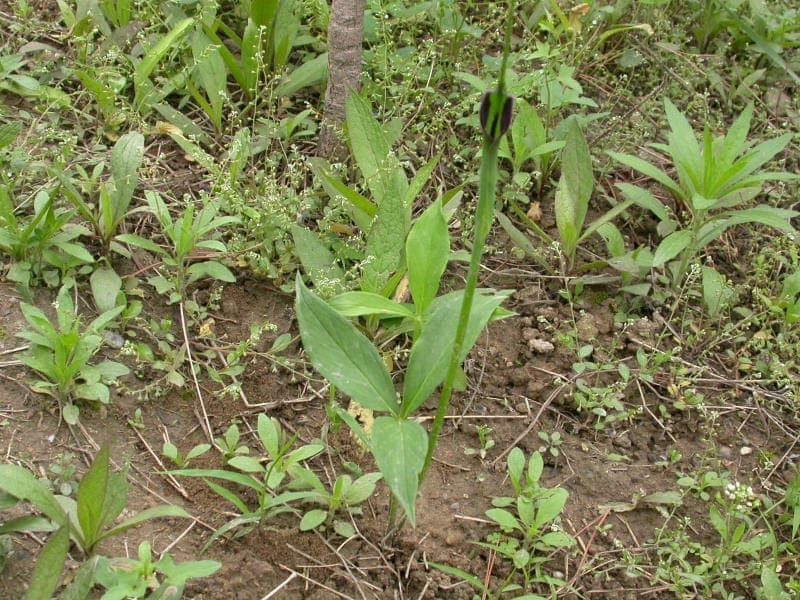
The original uploader was Polyhedron at Chinese Wikipedia. / CC BY-SA 3.0, via Wikimedia Commons
Pinellia: complete guide
Pinellia ternata
¿Quieres ver Pinellia: complete guide en tu jardín?
1 minuto, sin tarjeta de crédito
Overview
Pinellia, scientifically known as Pinellia ternata, is a fascinating Asian plant originating from China, Japan, and Korea. This interesting species is known for its characteristic three-leafed foliage and unusual flowers in mid-summer. At a height of 20 to 40 centimeters with a foot-shaped leaf structure, it makes a striking addition to gardens in temperate climates.
Pinellia ternata belongs to the family Araceae and is related to better-known houseplants such as Alocasia. Although still little known in many gardens, it is becoming increasingly popular with gardeners seeking something special. The plant has a long history of use in traditional Asian medicine and is still valued for its medicinal properties.
In cultivation, this plant grows well when given the right conditions. The plant forms underground tubers that help it survive winter conditions. This makes it interesting for gardeners in temperate zones who want to add an exotic touch to their gardens.
Appearance and bloom
Pinellia has strikingly three-leafed foliage that resembles a foot. Each leaf consists of three separate leaf sections, which together form a very symmetrical and elegant pattern. The leaves are green, sometimes with purple streaks, and measure 10 to 20 centimeters in length. The plant forms underground tubers that help it survive winter conditions.
The flowers appear in July and August in the form of a greenish-yellow spathe (a characteristic flower sheath). This flower structure is very characteristic of the Araceae family and very interesting for plant collectors. After flowering, small red-purple berries form that are attractive. The plant dies back in autumn, with the tubers remaining underground and sprouting again the following spring. This growth cycle is normal and not a sign of death.
Ideal location
Pinellia grows best in a location with partial shade to half-light. It can grow in sunny spots but prefers some protection from intense midday sun, especially in warmer climates. Beneath trees is perfect for this plant.
The plant is fairly flexible regarding location and can grow in borders, under shrubs, and even in pots. It is also suitable for partially shaded front gardens where it provides interesting contrast.
Soil
Pinellia grows best in moist, well-drained soil that is rich in organic matter. The pH can be neutral to slightly acidic (6.0 to 7.0). Adding compost or peat moss helps retain moisture. The plant does not tolerate extremely dry conditions or permanent waterlogging. A soil with good moisture balance is ideal. In clayey soil, some sand or peat moss can help improve drainage. Organic material is very important.
Diseño gratis
¿Quieres ver Pinellia: complete guide en tu jardín? Crea un diseño gratis ahora.
Watering
Pinellia needs regular watering during the growing season (April to September). Ensure the soil remains consistently moist but not waterlogged. In extremely dry periods, supplemental watering may be necessary. After flowering and as autumn approaches, reduce watering gradually. In winter, when the plant is dormant, minimal watering is sufficient. However, ensure the soil does not dry out completely, as this can damage the tubers. A slightly moist environment is better.
Pruning
Pinellia requires minimal pruning. Only remove dead or damaged foliage. The plant naturally dies back in autumn, so no specific pruning is necessary. It is important not to interfere during the growing season, as this may disrupt sprouting. Let the plant follow its natural growth cycle.
Maintenance calendar
March-April: Plant the tubers for the growing season. Ensure regular moisture supply. May-June: The plant grows strongly and develops its three-leafed foliage. Water regularly. July-August: The plant blooms. Keep moisture supply constant. September-October: The plant begins to die back. Gradually reduce watering. November-February: The plant is completely dormant. Water minimally.
Winter hardiness
Pinellia is moderately winter hardy and can tolerate temperatures down to about -10 to -15 degrees Celsius with protection. In mild winters, the tubers can remain in the ground. However, in cold regions, it is advisable to dig up and store the tubers indoors in a cool, dry location. The plant forms underground tubers that can withstand cold better than above-ground parts. A thick layer of mulch can provide protection but is not always sufficient in very cold winters. In very cold regions, digging up is recommended.
Companion plants
Pinellia combines interestingly with other foliage plants with interesting structure, lower ferns, hosta plants and low-growing ground covers. These combinations create interesting texture effects.
Conclusion
Pinellia is a unique and interesting plant that adds an exotic touch to any garden. With its striking three-leafed foliage and peculiar flowers, it forms a true focal point in the summer border. Check specialized garden centers for this special plant. Professional garden design offers perfect designs.
¿Quieres ver Pinellia: complete guide en tu jardín? Crea un diseño gratis ahora.
Sube una foto, elige un estilo y obtén un diseño fotorrealista con lista de plantas en menos de un minuto.
Más de 10.000 jardines diseñados
Sin tarjeta de crédito


Plantas similares
Arrowhead vine: complete guide
Syngonium auritum
Everything about Syngonium auritum, the tropical five-fingers houseplant. Care, location, watering, and pruning explained clearly for beginners and enthusiasts.
Minute duckweed: complete guide to Lemna perpusilla
Lemna perpusilla
Everything about Lemna perpusilla, the minute duckweed: ecology, pond management, water quality and care in garden water features.
Dead horse arum lily: complete guide
Helicodiceros muscivorus
Everything about the dead horse arum lily (Helicodiceros muscivorus): growing conditions, spectacular bloom, thermogenesis, and care for this Mediterranean aroid.