
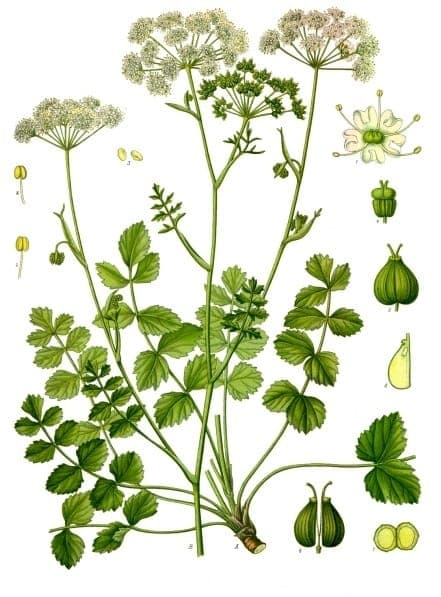
Franz Eugen Köhler, Köhler's Medizinal-Pflanzen / Public domain, via Wikimedia Commons
Burnet-saxifrage: complete guide
Pimpinella saxifraga
¿Quieres ver Burnet-saxifrage: complete guide en tu jardín?
1 minuto, sin tarjeta de crédito
Overview
Burnet-saxifrage (Pimpinella saxifraga), also known as small burnet saxifrage, is a robust perennial herb from the Apiaceae family. Native across Europe to Siberia and Iran, this hardy wildflower has been valued for centuries in folk medicine and cottage gardens. Today, renewed interest in resilient, native plants brings this charming species back into cultivation.
The plant exemplifies the modern shift toward self-sustaining, low-maintenance gardens that support natural ecosystems while providing practical benefits.
Appearance & Bloom
Burnet-saxifrage grows 50-80 cm tall from a basal rosette of finely toothed, moss-like leaves with characteristic ribbing. The foliage is delicate and feathery, creating attractive texture even before blooming.
Flowers appear May through September in abundant, airy umbel clusters of tiny white blooms. These prolific flowers attract butterflies, bees, and beneficial insects continuously throughout the season. The plant typically behaves as a biennial or short-lived perennial, producing foliage the first year then flowering in subsequent years.
After flowering, distinctive ribbed seeds develop and self-sow readily, ensuring reliable reappearance without replanting.
Ideal Location
Burnet-saxifrage thrives in sun to partial shade, requiring minimum five-six hours daily sunlight. The plant is remarkably flexible and tolerates lighter shade well, making it suitable for diverse garden positions.
The species is hardy to wind and performs excellently in exposed, breezy sites. Plant on raised areas or slope gardens to maximize drainage and air movement.
Avoid deep tree shade, though deciduous tree shade is acceptable.
Soil
Burnet-saxifrage is exceptionally tolerant of poor, lean soils - it actually prefers them. In nature, the plant thrives on rocky slopes, chalky hillsides, and degraded ground where competition is limited.
In gardens, neutral to slightly acidic, well-draining soil works ideally. The plant tolerates calcareous soils better than many Apiaceae species. Over-enriched or heavy clay soils often produce weak, disease-prone growth.
Sand, gravel, and grit may be freely added.
Diseño gratis
¿Quieres ver Burnet-saxifrage: complete guide en tu jardín? Crea un diseño gratis ahora.
Watering
Once established, burnet-saxifrage is remarkably drought-tolerant, surviving extended dry periods. Young plants require more frequent watering until deep rooting occurs.
Water seedlings regularly, but mature plants need supplemental water only during severe drought. Waterlogged conditions pose greater risk than drought.
Winter moisture can be problematic. Ensure excellent drainage by incorporating sand and gravel into the top layer.
Pruning
Minimal pruning required. Remove flower stems after seed set if you wish to prevent excessive self-seeding. Allow some plants to set seed for natural regeneration.
In spring, remove dead foliage from the previous season. The plant recovers quickly from minor damage. Pinching growing tips encourages bushier branching.
Gently cultivate around the plant.
Maintenance Calendar
April: Sow seed directly or transplant seedlings. Thin to 30 cm spacing. May-June: Flowering begins. Monitor water for newly transplanted individuals. July-August: Continuing blooms. Seed development begins. September: Harvest and dry seed. October-November: Growth declines. Remove dead stems. December-March: Dormant rosette period. Minimal care needed.
Winter Hardiness
Burnet-saxifrage is exceptionally hardy, surviving temperatures below -25°C. Native to Siberian regions, the plant easily tolerates northern European winters.
Problems arise in warm winters with excessive precipitation. Ensure superior drainage on heavy soils.
Direct-sow seed in autumn outdoors for natural stratification.
Companion Plants
Burnet-saxifrage fits perfectly in wild, naturalistic gardens alongside other European herbs. Combine with sheep's sorrel, bird's-foot trefoil, and mountain thyme.
In herb gardens, pair with dill, fennel, and sorrel. In borders, combine with sedum, saxifraga, and geranium.
Ensure vigorous neighbors don't overwhelm this slower spreader. Position in focal garden islands for visibility.
Closing
Burnet-saxifrage exemplifies the rewards of embracing native, self-sustaining plants. This self-seeding perennial brings authentic European wildflower character with minimal maintenance. Discover more native plants on gardenworld.app. Read our guides for other Apiaceae species. Transform your garden with burnet-saxifrage's elegance and resilience - gardenworld.app provides complete design solutions for naturalistic gardens.
¿Quieres ver Burnet-saxifrage: complete guide en tu jardín? Crea un diseño gratis ahora.
Sube una foto, elige un estilo y obtén un diseño fotorrealista con lista de plantas en menos de un minuto.
Más de 10.000 jardines diseñados
Sin tarjeta de crédito


Plantas similares
Whorled carrot: complete guide
Daucus involucratus
Daucus involucratus is a Mediterranean umbellifer with white flower heads framed by lacy bracts. Growing this gravel garden gem.
Daucus muricatus: complete guide
Daucus muricatus
Daucus muricatus, the spiny wild carrot, grows wild on Mediterranean coasts. Discover sowing, June-July bloom, and wildflower meadow use.
Daucus pumilus: complete guide
Daucus pumilus
Daucus pumilus is a dwarf wild carrot relative with white lacy umbels, thriving on dunes and coastal rock in poor, fast-draining soil.