
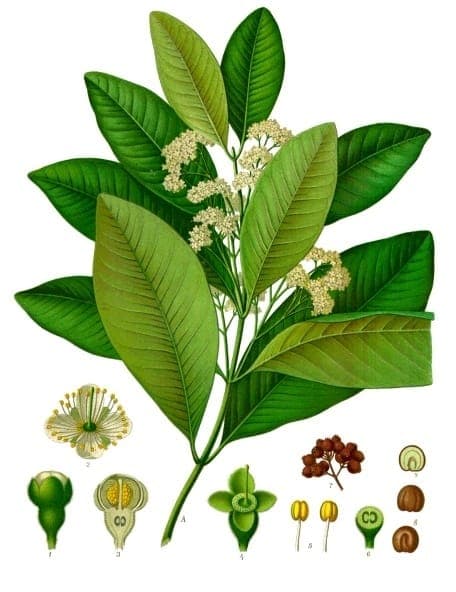
Franz Eugen Köhler, Köhler's Medizinal-Pflanzen / Public domain, via Wikimedia Commons
Allspice tree: complete guide
Pimenta dioica
¿Quieres ver Allspice tree: complete guide en tu jardín?
1 minuto, sin tarjeta de crédito
Overview
The Allspice tree (Pimenta dioica), also known as the Jamaica pepper tree, is a tropical tree native to Mexico and Central America. This tree reaches heights of 7 to 13 meters and is primarily valued for its aromatic berries, commonly called allspice or Jamaican pepper.
Belonging to the Myrtaceae family, this tree thrives in subtropical and tropical climates. The berries have a unique flavor reminiscent of cinnamon, nutmeg, and clove, hence the name 'allspice' in English.
Appearance and growth
The Allspice tree grows as an upright, bushy tree with smooth, grayish-brown bark. Without pruning, the tree develops a wide, spreading crown and substantial girth.
The leaves are glossy dark green, elliptical, and fragrant when rubbed. They reach approximately 5 to 15 centimeters in length. The leaves contain the same aromatic oils as the berries.
The flowers are small, cream-colored clusters appearing in spring through early summer. These fragrant blooms attract numerous bees and butterflies.
The berries are small, round drupes approximately pea-sized. Green when unripe, they turn dark brown to black at full maturity. Each berry contains two seeds with aromatic pits.
Ideal location
The Allspice tree flourishes in warm tropical and subtropical climates. Plant in a location with abundant sunlight, receiving at least six to eight hours daily.
This tree cannot tolerate frost or extreme cold. It suits hardiness zones 9 to 11. In temperate climates, it can grow in greenhouses or as an indoor specimen.
Choose a sheltered location protected from strong winds, as young trees can be fragile.
Soil type
The Allspice tree prefers well-draining, fertile soil rich in organic matter. The pH should be between 5.5 and 6.5.
If your soil is poor, add rich compost and mulch generously around the tree. This helps retain moisture and provide nutrients.
Well-composted soil is essential for good growth and fruit production.
Diseño gratis
¿Quieres ver Allspice tree: complete guide en tu jardín? Crea un diseño gratis ahora.
Watering
During the growing season, the Allspice tree requires regular watering. Water when the top 5 centimeters of soil feel dry.
Provide the tree with 2.5 to 4 centimeters of water weekly during growth. Ensure consistent moisture, especially for young trees.
In winter, when growth slows, reduce watering. However, avoid complete drying out.
Avoid overhead watering on foliage, as this encourages fungal issues.
Pruning
Pruning helps maintain the Allspice tree's shape and promotes productivity. Prune outward-growing branches to encourage a spreading crown.
Remove thorny, weak, diseased, or dead wood. Prune trees as needed in spring.
Limit heavy pruning to the first year or two. Mature trees need minimal pruning.
Maintenance calendar
Spring (March-May): Apply balanced fertilizer monthly. Prune winter-damaged branches.
Early summer (June-July): Water regularly. Monitor for pests. Refresh mulch as needed.
Mid to late summer (July-August): Stop nitrogen feeding. This promotes earlier blooming.
Autumn (September-October): Lower fertilizer. Prepare tree for rest.
Winter (November-February): Minimal care in cooler areas. In tropical climates, growth continues.
Winter hardiness
The Allspice tree is frost-sensitive and cannot tolerate temperatures below 10 degrees Celsius. It suits hardiness zones 9 to 11.
In temperate climates, the tree must be overwintered indoors or grown in a greenhouse. Young trees are especially cold-sensitive.
Companion plants
The Allspice tree pairs well with:
- Other tropical fruit trees like papaya and mango
- Aromatic herb plants like basil and oregano
- Flowering hedge plants like ixora and lantana
- Summer-green understory plants for layering
Closing thoughts
The Allspice tree is an excellent choice for gardens in warm climates. With its aromatic berries and attractive foliage, it is both practical and decorative.
This tree can be purchased from tropical and subtropical garden centers. We recommend searching for specialized nurseries in your region.
Visit gardenworld.app/en for more garden advice. See also gardenworld.app/nl for tips in Dutch.
¿Quieres ver Allspice tree: complete guide en tu jardín? Crea un diseño gratis ahora.
Sube una foto, elige un estilo y obtén un diseño fotorrealista con lista de plantas en menos de un minuto.
Más de 10.000 jardines diseñados
Sin tarjeta de crédito


Plantas similares
Flooded gum (Eucalyptus grandis): complete guide
Eucalyptus grandis
Everything about the flooded gum: fast growth, impressive stature and silvery bark. How to plant and care for this eucalyptus in your garden.
Yellow gum (Eucalyptus leucoxylon): complete guide
Eucalyptus leucoxylon
Everything about the yellow gum: showy flowers in winter, compact form and drought tolerance. How to grow and care for this eucalyptus in your garden.
Sydney blue gum (Eucalyptus saligna): complete guide
Eucalyptus saligna
Everything about the Sydney blue gum: extraordinary growth rate, beautiful grey-blue bark and impressive stature. How to plant and care for this eucalyptus.