
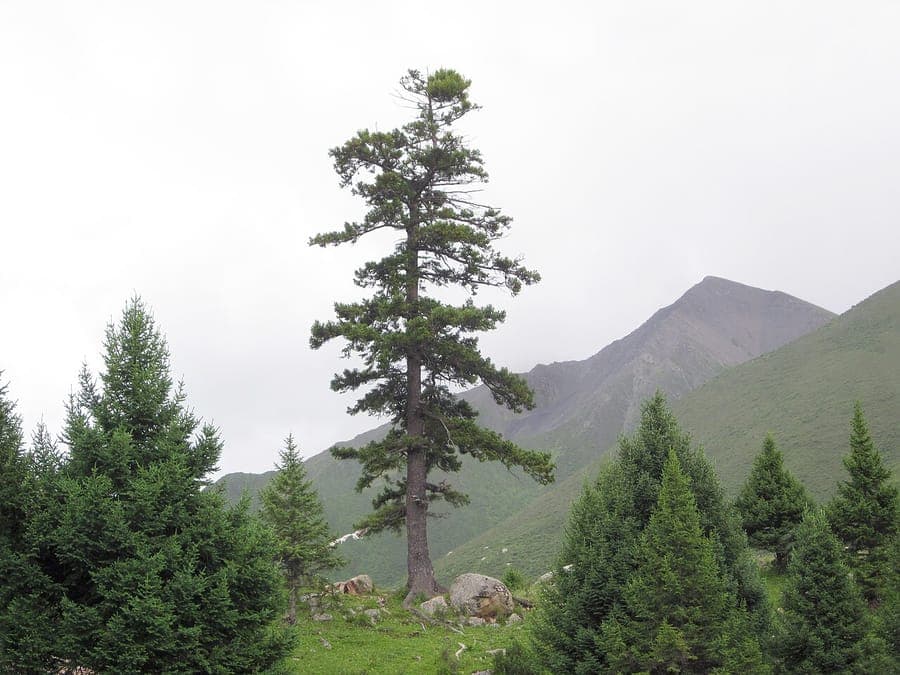
Ken Marshall from Taipei, Taiwan / CC BY 2.0, via Wikimedia Commons
Purple spruce: complete guide
Picea purpurea
¿Quieres ver Purple spruce: complete guide en tu jardín?
1 minuto, sin tarjeta de crédito
Overview
The Purple spruce (Picea purpurea) is an impressive coniferous tree originating from the mountains of central China. This elegant evergreen reaches heights of 20 to 30 meters at full maturity and is admired for its striking purple cones and neat pyramidal form.
Belonging to the Pinaceae family, this tree is hardy in temperate climates. The Purple spruce provides year-round beauty to landscapes, offering interesting texture and color in every season.
Appearance and growth
The Purple spruce grows in a neat, pyramidal to conical shape. The tree typically reaches 8 to 12 meters tall and 4 to 6 meters wide at full maturity in gardens.
The needles are small, blunt, and densely arranged around the branches. They display a dark green color that shimmers in sunlight. The branches spread horizontally, creating a smooth, layered silhouette.
The most characteristic feature is the striking purple cones. These upright cones grow approximately 6 to 8 centimeters long and appear in rich purple tones when young, gradually turning brown as they mature. They develop predominantly at the tree's upper portions.
Ideal location
The Purple spruce grows best in cool, mountainous settings. Plant in full sun to light shade. The tree does not thrive in hot, dry climates.
Choose a location sheltered from strong, desiccating winds. This tree prefers a moderate oceanic climate with consistent moisture. In continental climates with large temperature fluctuations, the tree may struggle.
This tree suits hardiness zones 5 to 7. In warmer regions, it may suffer from heat stress.
Soil type
The Purple spruce prefers well-draining, moist, acidic soil. The pH should range between 5.5 and 6.5 for optimal growth.
If your soil is heavy, add sand, perlite, or compost to improve drainage. This tree cannot tolerate standing water or waterlogged soil.
Mulch at the base of the tree helps retain moisture and keep roots cool.
Watering
During the first and second growing years, the Purple spruce requires regular watering. Water when the top 5 centimeters of soil feel dry.
Provide the tree with approximately 2.5 to 4 centimeters of water weekly, depending on rainfall. Water slowly and deeply to reach the roots thoroughly.
Once established (after 2-3 years), the tree needs less frequent watering, although consistently moist soil remains preferable.
Avoid watering the needle foliage, as this can encourage fungal issues.
Diseño gratis
¿Quieres ver Purple spruce: complete guide en tu jardín? Crea un diseño gratis ahora.
Pruning
Minimal pruning is needed for healthy Purple spruces. Remove only dead, broken, or diseased branches.
This tree naturally forms an attractive shape, so drastic pruning is unnecessary. If you wish to control form, prune only during the growing period (May through August) and with care.
Remove conflicting branches that grow inward or rub heavily against each other.
Maintenance calendar
Spring (March-April): Apply slow-release evergreen fertilizer. Remove dead branches from winter damage.
Late spring (May-June): Water regularly. Ensure mulch remains 7-10 cm deep around the trunk.
Summer (July-August): Water during dry periods. Monitor for diseases and pests.
Autumn (September-October): Reduce watering as season progresses. Add autumn mulch.
Winter (November-March): Minimal care. Protect from heavy snow and icy frost. Add winter mulch in very cold areas.
Winter hardiness
The Purple spruce is hardy to approximately -20 to -25 degrees Celsius. This tree performs best in areas with mild winters.
In extreme winter regions, the tree may suffer from freezing and dry wind damage. Add extra mulch and protect from harsh winter winds.
Young trees are more vulnerable than mature specimens. Provide protection during the first season.
Companion plants
The Purple spruce pairs well with:
- Other conifers like Tsuga and Picea for variation
- Shade plants like Astilbe and Brunnera for understory
- Shrubs like Rhododendron for color contrast
- Ground covers like Liriope for base softening
Combine with low-growing plants that enjoy moist, acidic soil.
Closing thoughts
The Purple spruce is an excellent choice for gardens in cool, temperate climates. With its beautiful purple cones and neat form, it is a true showstopper.
This tree can be purchased from specialized tree nurseries. We recommend checking with local conifer specialists for availability.
Visit gardenworld.app/en for more garden advice and design support. See also gardenworld.app/nl for tips in Dutch.
¿Quieres ver Purple spruce: complete guide en tu jardín? Crea un diseño gratis ahora.
Sube una foto, elige un estilo y obtén un diseño fotorrealista con lista de plantas en menos de un minuto.
Más de 10.000 jardines diseñados
Sin tarjeta de crédito


Plantas similares
Abies delavayi: complete guide
Abies delavayi
Delavayi fir is an elegant, medium-sized coniferous tree from the Pinaceae family with dark green needles. This Asian evergreen is perfect for alpine gardens and large landscapes.
Taiwan fir: complete guide
Abies kawakamii
Discover the magnificent Taiwan fir, a rare evergreen conifer from Taiwan's mountain regions. Learn growth requirements, care tips, and why this beautiful tree is perfect for collectors of unique garden specimens.
Farges fir: complete guide
Abies fargesii
Discover the majestic Farges fir, an impressive conifer from China's mountains with elegant foliage and columnar form. Ideal for large gardens.