
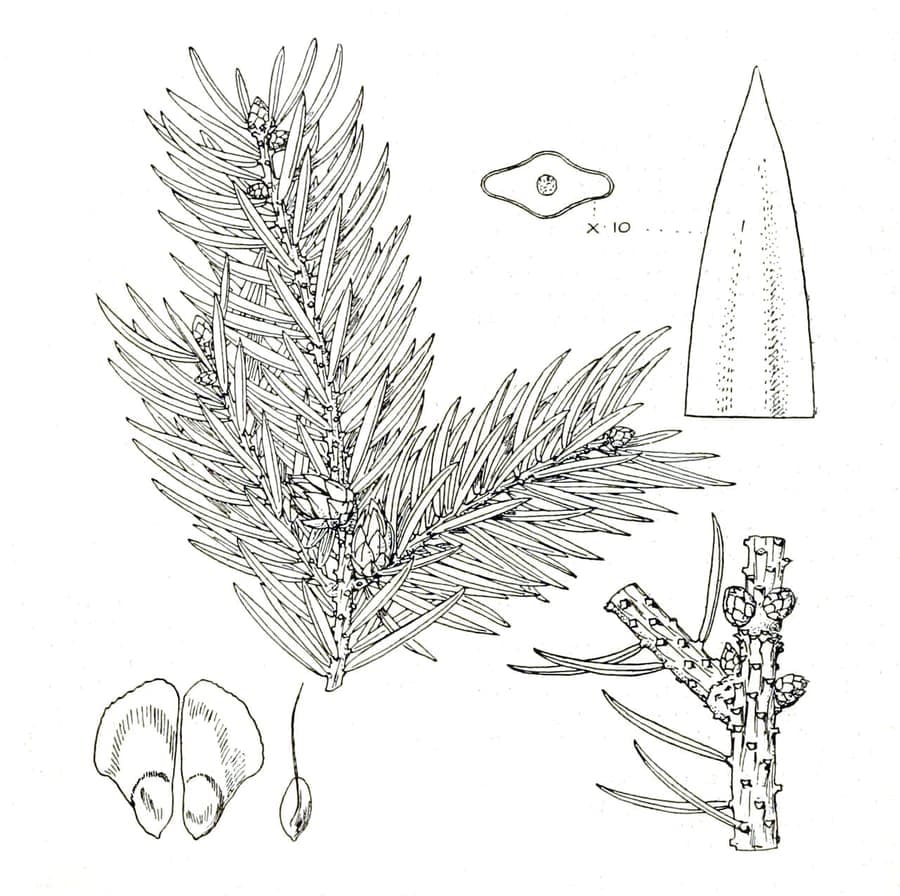
Gardeners' Chronicle / Public domain, via Wikimedia Commons
Veitch's Spruce (Picea neoveitchii): complete guide
Picea neoveitchii
¿Quieres ver Veitch's Spruce (Picea neoveitchii): complete guide en tu jardín?
1 minuto, sin tarjeta de crédito
Overview
Veitch's Spruce, scientifically known as Picea neoveitchii, is an impressive coniferous tree from the Picea genus. This evergreen originates from central-southern China, where it naturally inhabits mountainous regions. With its stiff, lustrous needles and elegant upright form, this spruce represents a beautiful addition to gardens in temperate climates.
The tree is named after John Gould Veitch, a celebrated Victorian plant collector. First scientifically described in 1903, it has since become a valued ornamental specimen for those seeking something distinctive and textually interesting.
Appearance and bloom
Veitch's Spruce develops a compact, pyramidal crown with densely arranged branches. The needles are dark green, stiff, and sharp-pointed, creating fine texture and elegant presence. Unlike many other spruces, these needles lack a pleasant fragrance when crushed.
Male flowers appear as small red catkins, while female flowers are greenish. Following pollination, characteristic hanging cones develop, typically greenish-grey to reddish-brown. These cones may reach 5-10 centimeters long and bear numerous scales with thin wings containing seeds.
The tree grows relatively slowly, with annual increments of 15-25 centimeters. Mature specimens can reach 15-25 meters tall and 5-8 meters wide, though many garden forms remain more compact.
Ideal location
Select a position with full sun or very light partial shade for Veitch's Spruce. The tree requires at least six hours of direct sunlight daily for optimal growth and needle coloration.
The location should provide some protection from strong winds, particularly in young years. The tree is somewhat vulnerable to windburn on branch tips. In exposed, windswept sites, sheltered garden positions become particularly important.
Avoid areas with stagnant air or moisture accumulation, as these promote fungal infections and diseases. Good air circulation proves essential for plant health.
Soil
Veitch's Spruce thrives in well-draining, moderately moist soil with slightly acidic to neutral pH (5.5-7.0). The tree is not particularly fussy about soil composition, provided drainage is excellent.
Heavy clay soils should be improved through addition of compost or horticultural peat to enhance permeability. A 5-10 centimeter layer of mulch around the base helps retain moisture and protect roots from temperature fluctuations.
The tree cannot tolerate waterlogged conditions and will experience root problems in persistently wet soils. Ensure raised beds or improved drainage if your garden soil is heavy.
Diseño gratis
¿Quieres ver Veitch's Spruce (Picea neoveitchii): complete guide en tu jardín? Crea un diseño gratis ahora.
Watering
Picea neoveitchii requires regular watering, especially during the growing season. Maintain consistently moist (but not waterlogged) soil, particularly in dry periods.
In the first years after planting, regular watering is critical for root establishment. Provide deep watering at least twice weekly, more frequently in hot, dry conditions.
From May through September, supplementary watering may be necessary. Mulch improves moisture retention and protects roots from temperature extremes. In winter, established trees require significantly less water.
Pruning
Veitch's Spruce requires minimal pruning. The natural form is elegant and pyramidal, so best left undisturbed.
Remove only dead, diseased, or severely damaged branches in late winter or early spring. Avoid pruning in summer or autumn, as this may stimulate new growth susceptible to frost damage.
If growth control becomes necessary, carefully thin some top shoots in spring, though this should remain minimal and judicious.
Maintenance calendar
January-February: Inspect for snow or ice damage; carefully remove damaged branches if needed.
March-April: Begin light feeding with slow-release conifer fertilizer.
May-September: Water regularly during dry spells; maintain mulch layer.
October-November: Monitor moisture retention; prepare for winter conditions.
December: Check for diseases; avoid pruning unless absolutely necessary.
Winter hardiness
Veitch's Spruce is highly winter hardy, tolerating temperatures to -25 degrees Celsius. This makes it an excellent choice for most European regions.
Under exceptional circumstances, young foliage may experience frost burn. This typically results in needle browning but causes no permanent damage.
Snow and ice accumulation can stress heavy branches. Carefully removing snow from branches prevents unnecessary damage.
Companion planting
Veitch's Spruce combines well with other conifers of similar stature, such as Abies or Larix species. For greater interest, add low evergreen shrubs nearby, including Buxus sempervirens or Taxus baccata.
Flowering structures and heaths like Erica or Calluna create striking contrast with the coniferous texture.
Ornamental grasses such as Miscanthus or Festuca establish attractive groundcover around the tree's base.
Closing
Veitch's Spruce is a fascinating and highly decorative conifer that adds depth and structured interest to any landscape. For conifer enthusiasts and gardeners seeking something distinctive, this Picea species represents an excellent choice.
Find available specimens at specialized tree nurseries and garden centers. For more information about garden design and plant selection, visit gardenworld.app for customized recommendations.
With proper care and appropriate location, Veitch's Spruce will provide decades of elegance and structural beauty to your garden.
¿Quieres ver Veitch's Spruce (Picea neoveitchii): complete guide en tu jardín? Crea un diseño gratis ahora.
Sube una foto, elige un estilo y obtén un diseño fotorrealista con lista de plantas en menos de un minuto.
Más de 10.000 jardines diseñados
Sin tarjeta de crédito


Plantas similares
Abies delavayi: complete guide
Abies delavayi
Delavayi fir is an elegant, medium-sized coniferous tree from the Pinaceae family with dark green needles. This Asian evergreen is perfect for alpine gardens and large landscapes.
Taiwan fir: complete guide
Abies kawakamii
Discover the magnificent Taiwan fir, a rare evergreen conifer from Taiwan's mountain regions. Learn growth requirements, care tips, and why this beautiful tree is perfect for collectors of unique garden specimens.
Farges fir: complete guide
Abies fargesii
Discover the majestic Farges fir, an impressive conifer from China's mountains with elegant foliage and columnar form. Ideal for large gardens.