
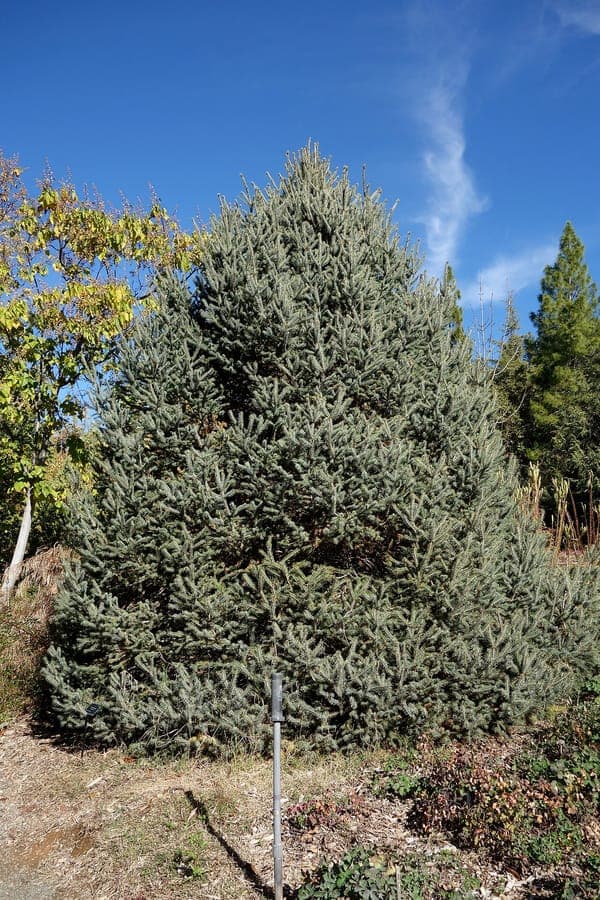
Daderot / CC0, via Wikimedia Commons
Picea likiangensis: complete guide
Picea likiangensis
¿Quieres ver Picea likiangensis: complete guide en tu jardín?
1 minuto, sin tarjeta de crédito
Overview
Picea likiangensis, also known as Lijiang spruce or Likiang spruce, is an impressive conifer from the eastern Himalayas and mountain regions of south-central China, with distributions in Bhutan, Sichuan, Yunnan and the Tibetan plateau. This spectacular spruce grows at significant elevations in a mild mountain climate with regular precipitation.
In European gardens this spruce is appreciated for its elegant form and deep green needlework. Though less widespread than many other Picea species, it represents a valuable addition for enthusiasts of Asian conifers.
Appearance and growth
Lijiang spruce grows as a slender, regularly pyramidal tree with compact branching and dense needlework. The needles are green to very dark green, finer than in many other spruces. The dark brown bark often features small exfoliating strips.
Under optimal conditions the tree can reach 20-40 meters in height, though in full growth, especially in European cultivation, it remains considerably smaller. Growth is moderate to rapid for a mountain tree species.
The female cones are reddish-brown to deep brown, smaller than those of many other spruce species. Seed dispersal occurs via wind.
Ideal location
Lijiang spruce thrives in sunny locations with good air circulation. At least half-day sunlight is necessary for healthy growth.
The tree is exceptionally frost-hardy and suitable for all Dutch, Belgian and German winter climates. Winter temperatures to -25 degrees or lower present no problem.
Provide a sheltered position against summer drought and hot desiccating winds. In temperate climates, some afternoon shade during very hot summers can prove beneficial.
Soil
Picea likiangensis grows in well-draining, slightly acidic to neutral soil. A mixture of garden soil, compost and peat moss (approximately 2:2:1 ratio) works well.
The tree tolerates soils of various textures, provided drainage is excellent. Clay soils can be improved with sand and organic material.
The tree does better in soils with some fertility, though it is not overly particular.
Diseño gratis
¿Quieres ver Picea likiangensis: complete guide en tu jardín? Crea un diseño gratis ahora.
Watering
Like many mountain trees, Picea likiangensis tolerates dry periods well once established. However, young trees during their first years require regular watering.
In open ground rainwater usually suffices. In container cultivation more frequent watering is necessary.
For early winters, particularly with young trees, moisture management is important. Avoid excessive water during winter dormancy.
Pruning
Pruning is rarely needed for Picea likiangensis. The tree naturally grows elegantly formed.
Remove only dead branches or severely damaged parts. Heavy shaping pruning can cause permanent deformation.
Careful trimming of growth tips for form control can be done, but should be kept minimal.
Maintenance calendar
Seasonal focus points:
- Spring: Check damage, monitor growth initiation
- Summer: Water young trees regularly, monitor for pests
- Fall: Prepare for winter
- Winter: Minimal care needed, protection in extreme conditions
Winter hardiness
Lijiang spruce is exceptionally frost-hardy. In its mountain habitat it grows at elevations with long cold winters.
Temperatures to -30 degrees Celsius present no problem. The tree is highly suitable for all European winter regimes.
Young trees can benefit from light protection during their first winters.
Companion plants
Lijiang spruce combines elegantly with other Asian and mountain trees. Abies fabri, Tsuga dumosa and other mountain species create beautiful compositions.
In botanical gardens and conifer collections it represents a valuable addition.
Conclusion
Picea likiangensis is a genuine jewel for enthusiasts of Asian and mountain trees. With well-draining soil, full sun and protection from extreme drought, this impressive Himalayan spruce will provide years of beautiful form and green needlework.
Explore conifer collections on gardenworld.app for inspiration. Learn more about growing Asian mountain trees on gardenworld.app.
¿Quieres ver Picea likiangensis: complete guide en tu jardín? Crea un diseño gratis ahora.
Sube una foto, elige un estilo y obtén un diseño fotorrealista con lista de plantas en menos de un minuto.
Más de 10.000 jardines diseñados
Sin tarjeta de crédito


Plantas similares
Abies delavayi: complete guide
Abies delavayi
Delavayi fir is an elegant, medium-sized coniferous tree from the Pinaceae family with dark green needles. This Asian evergreen is perfect for alpine gardens and large landscapes.
Taiwan fir: complete guide
Abies kawakamii
Discover the magnificent Taiwan fir, a rare evergreen conifer from Taiwan's mountain regions. Learn growth requirements, care tips, and why this beautiful tree is perfect for collectors of unique garden specimens.
Farges fir: complete guide
Abies fargesii
Discover the majestic Farges fir, an impressive conifer from China's mountains with elegant foliage and columnar form. Ideal for large gardens.