
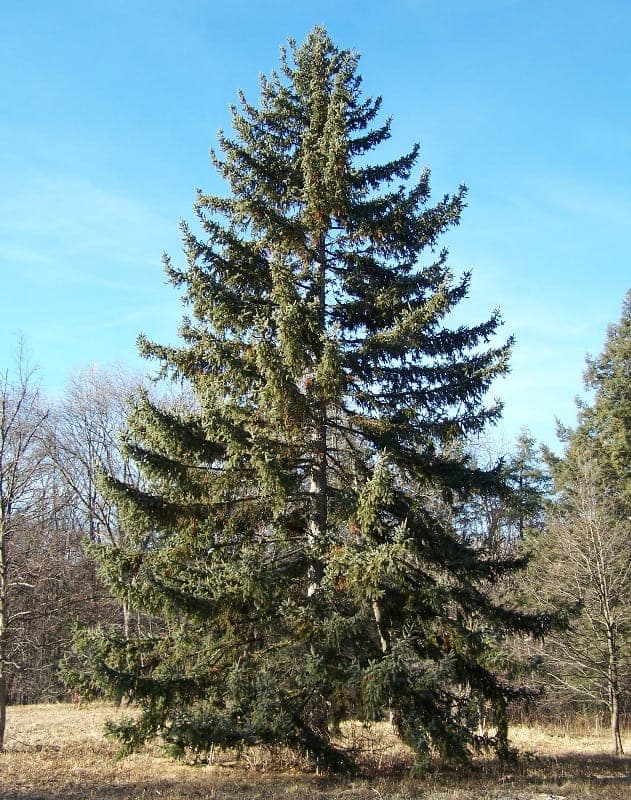
Bruce Marlin / CC BY-SA 3.0, via Wikimedia Commons
Picea koyamae: complete guide
Picea koyamae
¿Quieres ver Picea koyamae: complete guide en tu jardín?
1 minuto, sin tarjeta de crédito
Overview
Picea koyamae, known as Koyama Spruce, is an elegant conifer native to the Yatsugadake Mountains in central Japan. This relatively uncommon spruce forms an attractive columnar shape and is gaining popularity among rare conifer enthusiasts. The tree grows to moderate height with dense, regular branching and fine foliage that provides year-round ornamental value.
Appearance and growth pattern
Koyama Spruce develops a neat, compact pyramidal form with stiffly ascending branches. Bark is gray and smooth, becoming slightly flaked with age. Needles are dark green to gray-green, densely and regularly arranged. New growth appears lighter, almost yellowish-green. The tree reaches mature heights of 15-20 meters with spreads of 5-8 meters.
Ideal location
Picea koyamae thrives best in cooler, elevated locations with abundant light. Provide at least 6 hours of direct sunshine daily. In warmer climates, afternoon dappled shade helps prevent heat stress. The tree tolerates windy locations well. Avoid low-lying, waterlogged sites where drainage is poor. A north-facing slope in temperate climates is ideal.
Soil requirements
Koyama Spruce grows on acidic to slightly acidic soil. A pH of 5.5 to 6.5 is preferred. Ensure good drainage without stagnation. Add organic matter such as garden compost for improved structure. The tree thrives on mountainous terrain with rocky substrates. In flat gardens, adding sand and grit significantly improves drainage.
Diseño gratis
¿Quieres ver Picea koyamae: complete guide en tu jardín? Crea un diseño gratis ahora.
Watering
Water regularly after planting until the root system is established (6-8 weeks). Thereafter, the tree is fairly drought-tolerant. During hot periods or in very dry soils, provide supplemental water. Young trees tolerate drought less well than established specimens. Excessive water damages roots. Mulch to 5 cm depth helps retain soil moisture.
Pruning
Picea koyamae requires minimal pruning. Remove dead branches in late winter. Optional light pruning of young trees helps establish desired form. Side shoots can be gently cut back to promote density. Avoid heavy pruning as it can damage the tree's shape.
Maintenance calendar
Spring (March-May): Growth period, water regularly. Summer (June-August): Water during dry spells. Autumn (September-October): Reduce watering. Winter (November-February): Dormancy, minimal watering. Check regularly for pests and diseases.
Winter hardiness
Picea koyamae is very hardy and tolerates temperatures to -20 degrees Celsius. In temperate European climates, this tree thrives without protection. Young plants in their first winter may benefit from windscreen. Once established, the tree shows excellent hardiness.
Companion plants
Combine Picea koyamae with other alpine plants such as dwarf Japanese maples or azaleas. The dark green foliage contrasts beautifully with silver-leaved shrubs. Plant with ivy or stone oak for underplanting. Use as a specimen or in groups of similar conifers.
Final thoughts
Picea koyamae is an excellent choice for gardeners seeking a rare, hardy spruce. With its elegant form and fine texture, this tree adds architectural interest to gardens. Most well-stocked nurseries carry Japanese conifers. Plant for lasting garden legacy. Discover more inspiration at gardenworld.app/en
¿Quieres ver Picea koyamae: complete guide en tu jardín? Crea un diseño gratis ahora.
Sube una foto, elige un estilo y obtén un diseño fotorrealista con lista de plantas en menos de un minuto.
Más de 10.000 jardines diseñados
Sin tarjeta de crédito


Plantas similares
Abies delavayi: complete guide
Abies delavayi
Delavayi fir is an elegant, medium-sized coniferous tree from the Pinaceae family with dark green needles. This Asian evergreen is perfect for alpine gardens and large landscapes.
Taiwan fir: complete guide
Abies kawakamii
Discover the magnificent Taiwan fir, a rare evergreen conifer from Taiwan's mountain regions. Learn growth requirements, care tips, and why this beautiful tree is perfect for collectors of unique garden specimens.
Farges fir: complete guide
Abies fargesii
Discover the majestic Farges fir, an impressive conifer from China's mountains with elegant foliage and columnar form. Ideal for large gardens.