
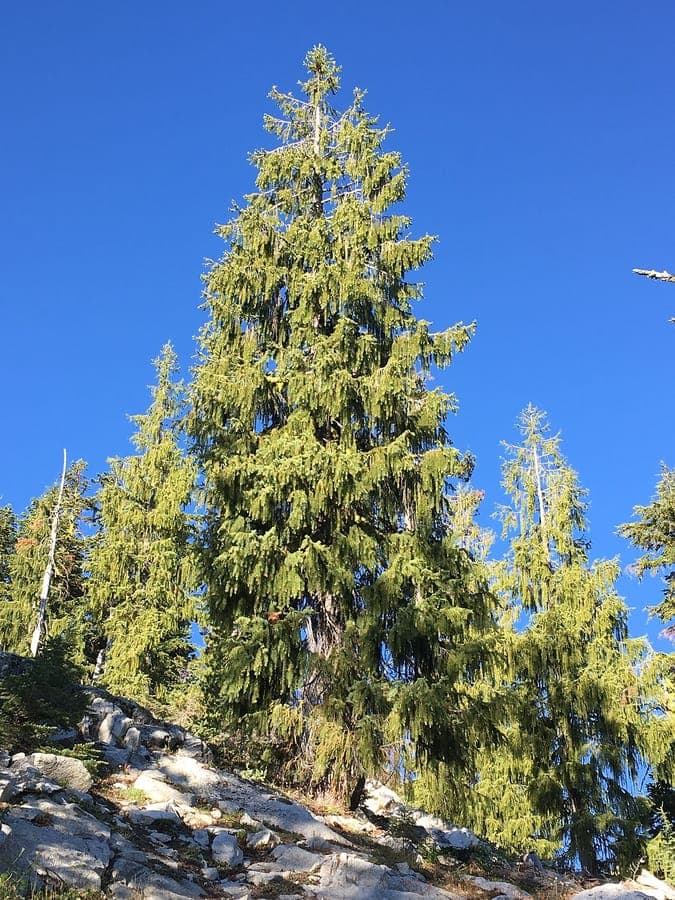
sheriff_woody_pct / CC BY 4.0, via Wikimedia Commons
Brewer Spruce: complete guide
Picea breweriana
¿Quieres ver Brewer Spruce: complete guide en tu jardín?
1 minuto, sin tarjeta de crédito
Overview
The Brewer Spruce (Picea breweriana), also called Weeping Spruce or Siskiyou Spruce, is an exceptionally rare conifer from the mountains of southwestern Oregon and northwestern California. This remarkable tree is distinguished by elegantly drooping branches that cascade waterfall-like from the central stem, creating an unmistakable silhouette. This unusual architectural form makes the Brewer Spruce a landscape sculpture of exceptional merit.
The tree grows slowly to moderate height and proves invaluable for large gardens, botanical collections, and landscape designs where its distinctive form can be properly appreciated and showcased.
Appearance and characteristics
The Brewer Spruce grows as a narrowly columnar tree, typically reaching 15-25 meters tall in cultivation (occasionally to 35 meters in ideal conditions). The central trunk remains relatively slender and upright. The visual spectacle comes from numerous fine branches that gracefully weep from the main structure, creating a distinctive cascading fountain effect.
Needles are dark green, fine and sharp, arranged in four rows around twigs. Male flowers appear reddish, female flowers purple. Seeds mature in brown cones approximately 5-7 cm long. Growth rate is slow, providing a long-lasting specimen.
Ideal location
The Brewer Spruce thrives in sunny locations with good air circulation and protection from strong winds that could damage its delicate drooping branches. This tree requires space to develop its full graceful form without crowding. Position as a focal point in large gardens where its weeping character becomes apparent. Excellent as a specimen tree where it can be admired from multiple viewpoints.
Perfect as a landscape accent in botanical gardens, estates, and large-scale landscape designs where its unique character commands respect.
Soil
The Brewer Spruce prefers well-draining, slightly acidic soils (pH 4.6-7.5) with preference toward the acidic end. Heavy clay soils require amendment with gravel and organic matter to improve drainage. The tree cannot tolerate waterlogged or poorly drained soil conditions.
In its natural habitat, it grows in rocky, skeletal soils. In cultivation, excellent drainage is absolutely essential for long-term health and vigor. Avoid areas prone to moisture accumulation or seasonal flooding.
Diseño gratis
¿Quieres ver Brewer Spruce: complete guide en tu jardín? Crea un diseño gratis ahora.
Watering
During the first several years after planting, water regularly to establish healthy root development. Once established, the Brewer Spruce requires only moderate watering during dry periods. The tree tolerates drought better than excessive moisture.
In maritime climates, rainfall typically provides adequate moisture. In drier regions, supplementary watering during drought periods supports vigor. Avoid overwatering as this encourages root rot and disease.
Pruning
The Brewer Spruce requires minimal pruning. Avoid cutting the central leader as this disrupts the natural form. Carefully remove dead, diseased, or inward-growing branches only when necessary. Young trees may be lightly pruned to guide form development, but generally this tree thrives with minimal intervention and maximum appreciation of its natural growth pattern.
Maintenance calendar
Spring: Monitor for drought stress, stake young trees if necessary. Summer: Water during dry spells, enjoy cascading branch effect. Autumn: Water through frost danger threshold, prepare for dormancy. Winter: Protect delicate branches from heavy snow damage if necessary.
Winter hardiness
The Brewer Spruce is hardy to approximately -18 degrees Celsius and survives temperate European winters unprotected. This tree is adapted to mountain climates with cold winters and cool summers. Protection from strong winds is more critical than frost hardiness.
Companion plants
The Brewer Spruce appears best as a solitary specimen where its distinctive architecture dominates attention. When combined with other plants, select carefully to avoid shading its drooping branches. Low-growing understory plants or shade-tolerant groundcovers work alongside this tree. Combine with Japanese maples for complementary weeping forms in large gardens.
Closing
The Brewer Spruce is an extraordinary rarity that can genuinely enrich large temperate gardens and estates. With proper site selection and excellent drainage, this slow-growing conifer becomes a lifetime legacy specimen. Visit gardenworld.app to discover how specialty conifers with distinctive forms enhance garden design and create architectural interest.
Available through specialized forestry nurseries and botanical suppliers.
¿Quieres ver Brewer Spruce: complete guide en tu jardín? Crea un diseño gratis ahora.
Sube una foto, elige un estilo y obtén un diseño fotorrealista con lista de plantas en menos de un minuto.
Más de 10.000 jardines diseñados
Sin tarjeta de crédito


Plantas similares
Abies delavayi: complete guide
Abies delavayi
Delavayi fir is an elegant, medium-sized coniferous tree from the Pinaceae family with dark green needles. This Asian evergreen is perfect for alpine gardens and large landscapes.
Taiwan fir: complete guide
Abies kawakamii
Discover the magnificent Taiwan fir, a rare evergreen conifer from Taiwan's mountain regions. Learn growth requirements, care tips, and why this beautiful tree is perfect for collectors of unique garden specimens.
Farges fir: complete guide
Abies fargesii
Discover the majestic Farges fir, an impressive conifer from China's mountains with elegant foliage and columnar form. Ideal for large gardens.