
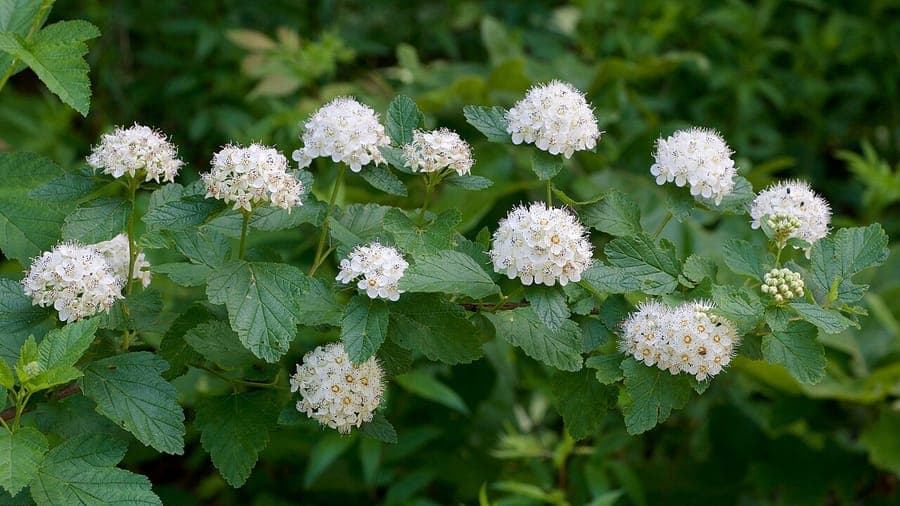
Eric Hunt / CC BY-SA 4.0, via Wikimedia Commons
Physocarpus opulifolius: complete guide
Physocarpus opulifolius
¿Quieres ver Physocarpus opulifolius: complete guide en tu jardín?
1 minuto, sin tarjeta de crédito
Overview
Physocarpus opulifolius, commonly called Ninebark, is a vigorous ornamental shrub from eastern North America. This is an excellent addition to any front garden, particularly for gardeners seeking year-round interest. The common name "Ninebark" refers to the characteristic exfoliating bark that peels away in multiple layers.
This shrub is celebrated for its dense growth habit and spectacular flowering period from May to June, when branches are covered with snow-white to pale pink flowers in flat-topped clusters. The plant typically reaches 2-3 meters tall with similar spread. Physocarpus opulifolius is extremely hardy and adaptable to various growing conditions, making it an excellent choice for Dutch gardens.
From gardenworld.app: a front garden featuring Ninebark combines classical beauty with practical benefits. The plant provides food for birds and nectar for pollinators.
Appearance and Bloom
The leaves of Ninebark are approximately 5 centimeters long, with a rough texture and deeply lobed appearance, resembling maple or ivy leaves. The foliage is arranged oppositely along the branches. Depending on the cultivar, leaves may be green, yellow-green, or even purple-tinted. Some varieties display striking colored foliage that remains ornamental throughout the growing season.
Flowers appear in May and June in dense, flat-topped clusters at the tips of young shoots. They measure approximately 8-12 millimeters across, white to light pink in color, with visible yellow stamens. After flowering, characteristic inflated seed pods develop, starting green and turning red as they ripen. These fruiting structures are quite ornamental and persist on the plant for extended periods.
The bark becomes increasingly exfoliating and irregular in color as the plant matures, ranging from brown to gray to nearly white. This textural quality adds winter interest to the garden.
Ideal Location
Physocarpus opulifolius thrives in locations receiving full sun to partial shade. The plant benefits from at least 6 hours of direct sunlight daily. In completely shaded locations, the plant will grow but flowering becomes sparse and foliage coloration is less vibrant.
Select a site with good air circulation to prevent fungal diseases. Avoid enclosed corners where humidity may stagnate. The plant is not particular about wind exposure and performs well in typical front garden conditions.
The shrub works well in group plantings, as a specimen accent, or as background planting in mixed borders. It can also be used as a hedge, though regular pruning will be necessary.
Soil Requirements
Ninebark originally grew in diverse soil types throughout North America, from clay to sand. The plant is therefore very flexible. Ideal soil is well-draining with a pH between 5.5 and 7.5. Avoid strongly acidic or highly alkaline soils.
Enrich the planting hole with organic matter (composted leaves, peat) especially in heavy clay soils. This improves both water retention and nutrient availability. Poorly drained soils can lead to root rot, so always add sand or perlite if you have heavy soil.
The plant eventually performs well even in less fertile soils, so constant fertilization is unnecessary. Annual application of composted organic matter in spring is usually sufficient.
Diseño gratis
¿Quieres ver Physocarpus opulifolius: complete guide en tu jardín? Crea un diseño gratis ahora.
Watering
Once established, Physocarpus opulifolius is remarkably drought-tolerant and requires minimal supplemental water. Young plants in their first season, however, need regular watering, especially during dry periods. Keep the soil consistently moist through the main growing season.
During very dry summers (particularly July and August), occasional supplemental watering helps, especially for young specimens. Apply water directly at the roots rather than over the foliage.
In typical Dutch garden conditions, rainfall is usually sufficient. Only during extremely dry spells is additional water necessary. Excess water in winter is detrimental, so ensure good drainage.
Pruning
An advantage of Physocarpus opulifolius is that it requires minimal pruning. The plant naturally develops an attractive form. After flowering (July) you may gently remove any wayward branches.
Every three to five years you can prune more heavily for rejuvenation. Remove approximately one-third of the oldest branches down to ground level in early spring (March-April). This promotes new growth and denser structure.
Avoid pruning in autumn as this may damage winter hardiness. Remove dead or damaged branches immediately.
Maintenance Calendar
March: Spring cleanup, remove dead wood. Apply composted organic matter. May-June: Enjoy the flowering display; no interventions needed. July: After flowering, lightly prune wayward growth. August-September: Monitor for drought stress; provide supplemental water during extended dry periods. October-November: Falling leaves support root development; no interventions needed. December-February: Winter dormancy. Enjoy the textural bark and persistent seed pods.
Winter Hardiness
Physocarpus opulifolius is extremely winter hardy, tolerating temperatures down to -30 degrees Celsius. In the Netherlands (USDA zones 8a to 8b), it is therefore fully hardy without special winter protection needed.
Young plants may experience minor frost damage to above-ground portions in their first year, but this typically recovers quickly. The root system is more resilient than the aerial portions.
Companion Plants
Physocarpus opulifolius combines well with:
- Lower-growing perennials: Heuchera, Astilbe, or Bergenia
- Predominantly green ornamental grasses: Miscanthus or Calamagrostis
- Colorful deciduous trees: choose colors that contrast with Ninebark's foliage
- Group plantings of multiple Ninebark specimens for striking effect
Avoid crowding with other vigorous growers such as certain Berberis species.
Conclusion
Physocarpus opulifolius deserves a place in more Dutch gardens. The combination of interesting leaf form, spectacular spring flowering, and ornamental seed pods makes it a true garden jewel. With minimal care requirements and extreme hardiness, it is a reliable partner for gardeners.
Seeking more inspiration for your front garden? Visit gardenworld.app for professional garden designs. Physocarpus opulifolius is available at most garden centers.
¿Quieres ver Physocarpus opulifolius: complete guide en tu jardín? Crea un diseño gratis ahora.
Sube una foto, elige un estilo y obtén un diseño fotorrealista con lista de plantas en menos de un minuto.
Más de 10.000 jardines diseñados
Sin tarjeta de crédito


Plantas similares
Siberian crab apple: complete guide
Malus x robusta
Complete guide to the Siberian crab apple (Malus x robusta): location, soil, pruning, winter hardiness and the best companion plants for your garden.
Chinese flowering crabapple (Malus x spectabilis): complete guide
Malus x spectabilis
Meet the Chinese flowering crabapple (Malus x spectabilis): a classic spring bloomer with carmine buds and pink blossom.
Potentilla crassinervia: complete guide
Potentilla crassinervia
Potentilla crassinervia, the Corsican cinquefoil, grows wild on Corsica and Sardinia's peaks. Discover how to grow this hardy alpine rock garden gem.