
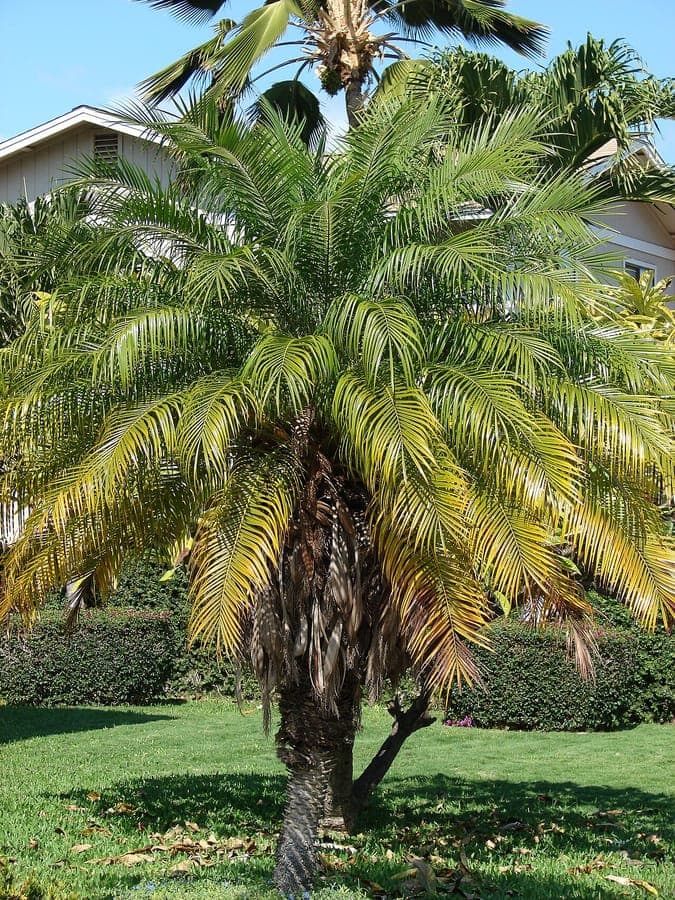
Forest & Kim Starr / CC BY 3.0, via Wikimedia Commons
Phoenix roebelenii: complete guide
Phoenix roebelenii
¿Quieres ver Phoenix roebelenii: complete guide en tu jardín?
1 minuto, sin tarjeta de crédito
Overview
Phoenix roebelenii, known as the pygmy date palm or miniature date palm, is a small, elegant palm from Southeast Asia (especially Yunnan in China and northern Indo-China). This palm from the Arecaceae family is perfect for those who want to create tropical atmosphere in relatively compact spaces. The pygmy date palm is the least cold-hardy palm, but with protection it can grow outdoors in milder climates.
Thanks to its compact growth and elegant form, Phoenix roebelenii is popular as a house and balcony plant. In warmer regions, it also grows outdoors.
Appearance and growth
Phoenix roebelenii is a small palm that can grow 2 to 4 meters tall, much lower than its larger relatives. The trunk is slender and graceful, often with the typical reticulate pattern of palms. The leaves are pinnate (feather-shaped) and up to 60 centimeters long, hanging elegantly around the trunk.
The leaves are gray-green to dark green and give the plant a very ornamental appearance. Young plants are compact, mature specimens slowly form a beautiful crown. The plant grows relatively slowly, 15 to 30 centimeters per year.
In warmer climates (zones 10-11), the plant flowers with small yellow-red flowers, followed by small brown date-like fruits.
Ideal location
Phoenix roebelenii can grow both indoors and outdoors. Indoors, the plant prefers a location with bright light but away from direct afternoon sun. Close to a window facing north, west, or east is ideal.
Outdoors, in warmer regions or in summer, give the plant partial sun to partial shade. Too much direct afternoon sun in cooler regions can cause leaf yellowing.
Provide shelter from strong wind, as palm fronds can be damaged. The plant also appreciates humidity.
Soil and potting
In pots, Phoenix roebelenii grows best in well-draining potting soil. Use 50% universal potting soil mixed with 25% palm peat mix and 25% perlite or pumice stone. This ensures good drainage.
The pot must have drainage holes. Repot every two years in spring when the plant outgrows its pot. Use a pot no more than 2-4 centimeters larger.
In garden soil, the soil must be well-draining. Add sand and compost if your soil is heavy.
Watering
Keep the potting soil evenly moist during the growing season (May to October). It should not become wet as this leads to root rot. Check moisture by inserting your finger into the pot.
In winter water much less. Let the soil dry out somewhat between waterings. In rooms with much heating, palms can dry out: then spray them regularly with lukewarm water.
Rain or distilled water is better than chalky tap water.
Diseño gratis
¿Quieres ver Phoenix roebelenii: complete guide en tu jardín? Crea un diseño gratis ahora.
Feeding
During the growing season (May to October) apply half-strength palm fertilizer every 2 to 3 weeks. No feeding in winter. Use a fertilizer with extra magnesium and iron, as palms need these trace elements.
Signs of malnutrition are yellow or spotted leaves. This can also indicate pests or too much water.
Pruning
Pruning is not necessary, but you can remove dead or damaged leaves. Never cut off the growing heart as this kills the plant! Cut leaves off close to the base of the leaf.
Even brown leaf tips are not removed because they provide protection to younger tissue.
Maintenance calendar
March: Repot in spring. Check for pests. April-May: Start regular watering. Move outside if warm enough. June-August: Regular water and feeding. Spray in dry periods. September: Carefully move indoors if frost threatens. October-November: Less water and feeding. Preparation for winter. December-February: Minimal water. Protection from cold.
Winter hardiness
Phoenix roebelenii is sensitive to frost and dies off at temperatures below minus 5 degrees Celsius. In cooler climates this palm is therefore a greenhouse or houseplant in winter. In very mild regions, against walls, it can stay outside with protection.
Protect outdoor-growing plants in November with straw, burlap, or special plant covers. Move potted plants to a warm, bright location when night temperatures drop below 10 degrees.
Pests and diseases
Phoenix roebelenii can be affected by spider mites especially in dry rooms. Regular spraying with water helps. Scale insects are also possible - remove them with a soft cloth dampened with soapy water.
Root rot from too much water is the greatest threat. Always ensure well-draining potting soil and don"t let the plant stand in water.
Yellow leaves can indicate too much water, malnutrition, or magnesium deficiency.
Companion plants
Phoenix roebelenii combines well with other tropical plants such as Monstera, Cordyline, and Stromanthe. In Mediterranean-themed gardens it looks beautiful among other small palms and Mediterranean shrubs.
In containers on the terrace, it can stand alone - its elegant form is enough. With multiple plants it also looks nice in tropical corners.
Closing
The pygmy date palm brings exotic flair to your home or garden with minimal maintenance required. With attention to humidity and no overwatering, you can enjoy this elegant palm for years. For tropical garden designs, see gardenworld.app.
Use gardenworld.app to incorporate tropical elements in your garden design with palms like Phoenix roebelenii.
¿Quieres ver Phoenix roebelenii: complete guide en tu jardín? Crea un diseño gratis ahora.
Sube una foto, elige un estilo y obtén un diseño fotorrealista con lista de plantas en menos de un minuto.
Más de 10.000 jardines diseñados
Sin tarjeta de crédito


Plantas similares
Needle palm: complete guide
Rhapidophyllum hystrix
Everything about the needle palm: the world's hardiest palm, suitable for gardens in temperate climates down to USDA zone 7b.
Saw palmetto: complete guide
Serenoa repens
A complete guide to saw palmetto (Serenoa repens), the iconic fan palm from Florida and the southeastern United States, prized for its toughness.
Puerto Rican hat palm: complete guide
Sabal causiarum
Grow Puerto Rican hat palm successfully. A majestic fan palm with tropical presence suited to sheltered Mediterranean-style gardens.