
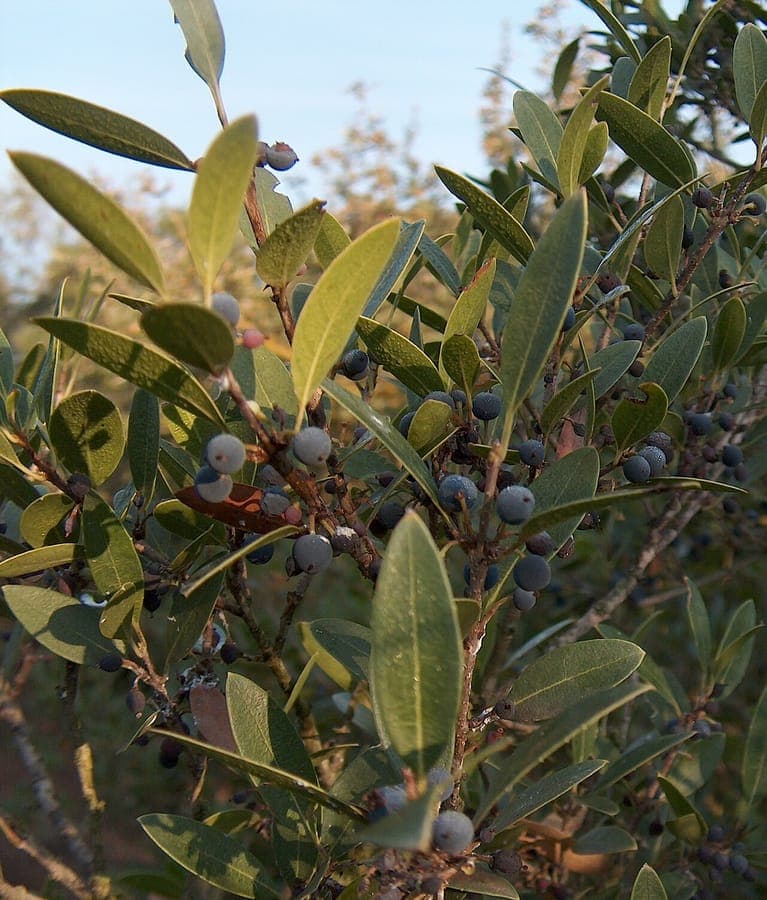
Wikimedia Commons / CC BY-SA 3.0, via Wikimedia Commons
Phillyrea angustifolia: complete guide
Phillyrea angustifolia
¿Quieres ver Phillyrea angustifolia: complete guide en tu jardín?
1 minuto, sin tarjeta de crédito
Overview
Phillyrea angustifolia, called False olive or Filaria, is a remarkable Mediterranean shrub that adapts to practically any garden situation. Though less known than its near relative the olive, it deserves far more recognition. This hardy shrub with elegantly narrow foliage and small yet aromatic white flowers offers structure, form and ease in one package.
The plant originates from the Mediterranean region where it grows on dry limestone slopes. In cooler climates, it performs excellently, especially in wind-sheltered corners and warm-facing spots. It naturally forms a handsome shape and is treasured by experienced gardeners as a privacy screen or structural plant in mixed plantings.
Appearance and Bloom
Phillyrea angustifolia forms a compact, upright shrub reaching 3-4 meters with remarkably narrow, dark green to grey-green foliage. Leaves are line-like, merely 1-2 cm long and extremely smooth with glossy upper surfaces. The plant sometimes appears more like a conifer than a deciduous shrub.
Flowers emerge March through May: tiny, white, fragrant and clustered in short spikes. While not showy, they carry a pleasant fresh fragrance. From flowers emerge grey-blue to black berries the size of peppercorns appearing in autumn and eagerly eaten by birds.
Ideal Location
Filaria loves full sun to half shade. For best form and flowering, ensure at least five to six hours of direct sunlight daily. It also tolerates shading well and grows even under other trees, though less densely.
Wind is not a problem - this plant is extremely tough. It grows beautifully against warm south or west-facing walls, against fences, and in corners where other plants fail. Protection is only needed in very severe winters for young plants.
Soil Requirements
Filaria thrives on virtually any soil type: acidic, alkaline, poor, rich, sandy, clay. It prefers chalk-containing, dry to moderately moist soils but also accepts heavier ground. Good drainage is however essential. Waterlogged feet damage roots.
For container culture use standard potting compost without added feeding. For gardens plant directly into garden soil. Soil improvement is unnecessary though a thin layer of coarse sand in clay soils is beneficial.
Diseño gratis
¿Quieres ver Phillyrea angustifolia: complete guide en tu jardín? Crea un diseño gratis ahora.
Watering
Once established (after the first growing season), Phillyrea angustifolia is extremely drought-tolerant. Supplementary water is only needed during extreme dry spells lasting more than four weeks without rain.
During the first year provide regular water to keep soil moderately moist until the plant develops deep roots. Thereafter rainfall and underground moisture reserves suffice. Excessive watering, especially in winter, causes root rot.
Pruning
Filaria is highly pruning-tolerant and can be cut back aggressively. Best prune in March-April or after flowering. Shape the plant to desired size; it tolerates cutting back to stronger branches. Plants grown as standards can be reduced to low trunks.
Removing spent flowers serves no purpose; the plant flowers only briefly anyway. Woody remnants from previous seasons can be heavily reduced in March without risk.
Maintenance Calendar
March: Prune to desired shape. April-May: White flowers appear, water regularly in dry weather. June-September: Growth, minimal care. October-November: Grey-blue berries appear, birds feed. December-February: Dormancy.
Winter Hardiness
Phillyrea angustifolia is extremely hardy to -15 degrees Celsius, sometimes to -20 degrees. Leaf loss in very severe winters is possible, but plants always regenerate from roots in spring. Protection is only necessary in extreme cold regions or for very young plants.
Good drainage in winter prevents frost damage to roots. Plant in raised beds in very wet regions.
Companion Plants
Filaria combines beautifully with other Mediterranean or drought-tolerant plants: Philadelphus, Ligustrum, Viburnum, Cornus mas and underplanting with silver-foliaged Artemisia and Santolina. In hedge planting it combines well with Buxus or Ilex.
Silver-leaved plants such as Elaeagnus support Phillyrea's grey color scheme.
Special Uses
False olive excels for hedging - it grows densely, tolerates aggressive cutting and naturally forms an attractive shape. Also suitable for topiary and formal shaping. Less known: the plant is excellent as a privacy screen or wind break because it remains evergreen and takes limited space.
Closing
When seeking a hardy, low-maintenance Mediterranean shrub that naturally forms a pleasing shape, Phillyrea angustifolia is an excellent choice. It is less fussy than olive, not as rigid as Buxus, but an ideal middle ground. In temperate zones mature specimens are available at specialized garden centers or Mediterranean plant nurseries.
At major garden centers you regularly find stock. Plant in spring or early autumn for best establishment. Enjoy years of shapeable, green beauty!
¿Quieres ver Phillyrea angustifolia: complete guide en tu jardín? Crea un diseño gratis ahora.
Sube una foto, elige un estilo y obtén un diseño fotorrealista con lista de plantas en menos de un minuto.
Sin tarjeta de crédito


Plantas similares
Rough menodora: complete guide
Menodora scabra
Full guide to Menodora scabra: a drought-tolerant desert subshrub with bright yellow flowers, ideal for rock gardens and xeriscapes.
Fraxinus dipetala: complete guide
Fraxinus dipetala
California ash or two-petal ash from southwestern USA. Beautiful spring flowers, drought-tolerant. Experimental choice for warm Mediterranean front gardens.
Syringa komarowii: complete guide
Syringa komarowii
Syringa komarowii is a striking lilac from central China with elegant flower spikes and lovely foliage. Discover the complete care guide here.