
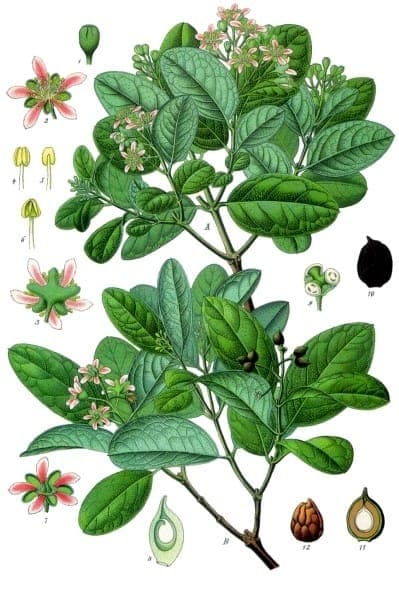
Franz Eugen Köhler, Köhler's Medizinal-Pflanzen / Public domain, via Wikimedia Commons
Boldo: complete guide
Peumus boldus
¿Quieres ver Boldo: complete guide en tu jardín?
1 minuto, sin tarjeta de crédito
Overview
Boldo (Peumus boldus) is a native shrub from the mountainous regions of Chile and South America. This is a very valuable plant for gardeners interested in medicinal and aromatic plants. The plant is known for its fragrant leaves that have traditionally been used for tea and medicine.
Boldo grows in a drought-tolerant, hardy-leafed climate and is perfect for low-maintenance gardens. The plant is evergreen and provides value year-round.
Appearance and Bloom
Boldo is a dense, compact-growing shrub that can reach 2-4 meters tall. The leaves are glossy, dark green and aromatic, with a unique scent when rubbed. The leaves have bright winged venation and are very decorative.
The flowers are small yellow flowers that appear in spring and spread a pleasant aroma. The fruits are yellow-green drupes that are very interesting for attracting birds.
Ideal Location
Boldo thrives best in full sun with at least 6 hours of direct sunlight daily. The plant can also grow in light shade but will be less compact. Choose a protected location sheltered from strong winds.
In temperate climates, boldo can grow outdoors in warm microclimates. In colder areas, it works better in a greenhouse or against a warm wall.
Soil
Boldo is not fussy and grows well in poor to moderately fertile soil. The plant is excellently adapted to dry conditions and thrives in well-draining, sandy or gravelly soil. pH can be between 5.0 and 7.5.
The main requirement is good drainage. Heavy clay should be improved with sand or gravel to prevent stagnation.
Diseño gratis
¿Quieres ver Boldo: complete guide en tu jardín? Crea un diseño gratis ahora.
Watering
Boldo is drought-tolerant once established. In the first growing season you should water regularly until it is well-rooted. After establishment, the plant needs minimal water except in extreme drought.
Overwatering can lead to root rot. Only water when the soil feels dry, especially in winter.
Pruning
Boldo doesn't need much pruning but responds well to forming. Pinch off light tops for a fuller plant. Remove dead or damaged branches in spring. Regular picking of leaves stimulates new growth.
Regular pruning also helps maintain a more compact form.
Maintenance Calendar
Spring: Light pruning for shape. Water regularly until established. Summer: Minimal care, enjoy fragrant leaves. Fall: Reduce watering. Winter: Rarely water, no feeding.
Winter Hardiness
Boldo is hardy to about -5 to -10 degrees Celsius, depending on the variety. In most areas of the UK, the plant will overwinter, though young plants need protection. In very cold areas, it works better in a greenhouse.
Companion Plants
Boldo combines well with other drought-tolerant shrubs and Mediterranean plants. Plant together with lavender, rosemary or myrtle for a Mediterranean garden. Herbaceous plant species work well underneath.
Closing
Boldo offers beauty, fragrance and medicinal value. This unique crop deserves a place in every garden. Visit gardenworld.app/en for more garden inspiration. Discover more aromatic plants at gardenworld.app/en.
¿Quieres ver Boldo: complete guide en tu jardín? Crea un diseño gratis ahora.
Sube una foto, elige un estilo y obtén un diseño fotorrealista con lista de plantas en menos de un minuto.
Más de 10.000 jardines diseñados
Sin tarjeta de crédito


Plantas similares
Acer pycnanthum: complete guide
Acer pycnanthum
Acer pycnanthum, the Japanese swamp maple, is a fast-growing tree with early red flowers and brilliant autumn color, ideal for damp garden settings.
Freeman maple: complete guide
Acer × freemanii
Everything about the Freeman maple (Acer x freemanii): a fast-growing shade tree with spectacular autumn colour for large gardens.
Silver vine: complete guide
Actinidia polygama
Discover silver vine (Actinidia polygama): a hardy climbing plant with silvery foliage, loved by gardeners and cats alike.