
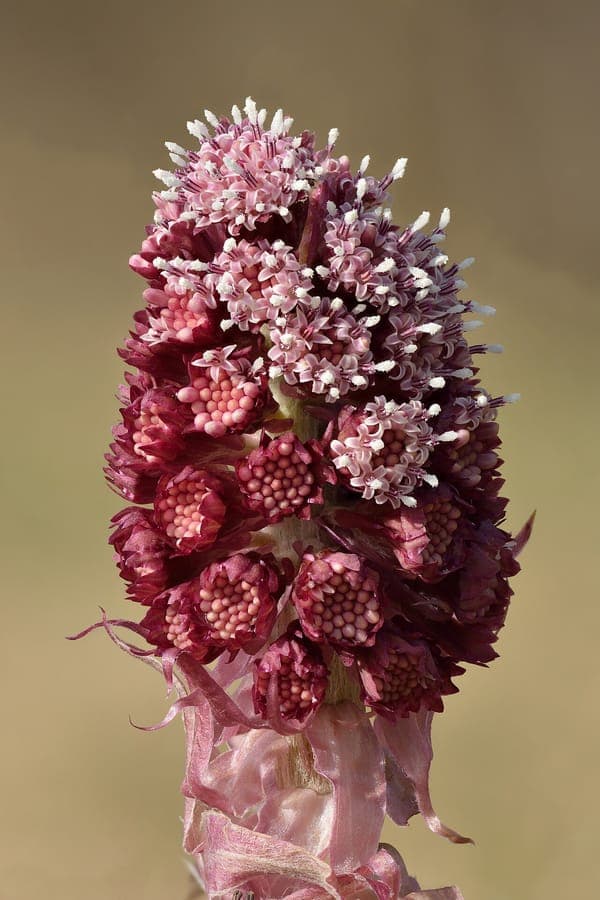
Ivar Leidus / CC BY-SA 4.0, via Wikimedia Commons
Petasites hybridus: complete guide
Petasites hybridus
¿Quieres ver Petasites hybridus: complete guide en tu jardín?
1 minuto, sin tarjeta de crédito
Overview
The Petasites hybridus, known as Giant butterbur, Purple butterbur or Umbrella plant, is a powerful grower from European waterways. This plant belongs to the Asteraceae family and distinguishes itself through colossal leaves that can reach up to two meters in diameter. With its purple flowers and enormous leaves, it is a striking presence in any garden.
Appearance and bloom
The Petasites hybridus reaches a height of 30 to 80 centimeters and appears as early as March or April with purple flowers in tight clusters on leafless flower stems. The flowers come in dense clusters and have a pleasant aroma. After flowering, gigantic heart-shaped leaves gradually appear, which can become up to 2 meters wide. These leaves give the plant its characteristic appearance.
Ideal location
This plant thrives best in locations near water or in areas with naturally moist microclimate. The Petasites hybridus prefers half-shaded to shaded locations. Full sun can make the plant grow, but preference is for more temperate conditions.
Soil
The Petasites hybridus prefers moist to wet soils with a pH of 7.5 to 8.0. The plant tolerates very wet soils and can even grow in damp zones. Sandy, dry soils are unsuitable.
Watering
After planting, the plant must receive sufficient moisture and water should be given regularly. The plant even tolerates damp zones, so extra water is usually not needed. However, in exceptionally dry summers, supplementary water may be beneficial.
Diseño gratis
¿Quieres ver Petasites hybridus: complete guide en tu jardín? Crea un diseño gratis ahora.
Pruning
The Petasites hybridus grows rapidly and can expand aggressively. Regular pruning and removal of dead leaves is necessary. Make sure the plant does not overshadow the entire climate. Pinch back where needed to keep growth in check.
Maintenance calendar
- March: Flowering period, admiration of flowers
- April-May: Leaf growth period, regular pruning
- June-July: Full growth, check for dead leaves
- August-September: Preparation for winter
- October-November: Preparation for rest period
- December-February: Winter rest, minimal activity
Winter hardiness
The Petasites hybridus is extremely winter hardy to about -25 degrees Celsius and thrives perfectly in the Netherlands, Belgium, France and Germany.
Companion plants
Combine the Petasites hybridus with other water plants such as Iris, Hosta and other moisture-loving plants. This combination creates a moisture zone garden with plenty of green abundance.
Closing
The Petasites hybridus is an impressive plant for those who love big and dramatic shapes. With good placement in moist environments, this plant grows into a true garden showpiece. For more information and plant recommendations, consult gardenworld.app/en.
For professional advice on water plants, visit gardenworld.app/en for expert garden analysis.
¿Quieres ver Petasites hybridus: complete guide en tu jardín? Crea un diseño gratis ahora.
Sube una foto, elige un estilo y obtén un diseño fotorrealista con lista de plantas en menos de un minuto.
Más de 10.000 jardines diseñados
Sin tarjeta de crédito


Plantas similares
Calendula stellata: complete guide
Calendula stellata
Complete guide to Calendula stellata, the star-flowered marigold from Sicily: location, soil, watering and companion planting tips.
Korean chrysanthemum: complete guide
Chrysanthemum x rubellum
Chrysanthemum x rubellum is a hardy autumn perennial with single pink to copper flowers from August to November. Care and combinations.
Helianthus divaricatus: complete guide
Helianthus divaricatus
Helianthus divaricatus is a North American woodland sunflower with yellow summer blooms, ideal for naturalistic borders and shady edges.