
Svdmolen / CC BY 2.5, via Wikimedia Commons
Persicaria amphibia: complete guide
Persicaria amphibia
¿Quieres ver Persicaria amphibia: complete guide en tu jardín?
1 minuto, sin tarjeta de crédito
Overview
Persicaria amphibia, known as amphibious bistort, is a remarkable plant that grows equally well in water and on dry land. The name describes this perfectly: "amphibia" means it can do both. The plant is native to the northern hemisphere, growing from subarctic regions through to Africa.
This plant is invaluable for water gardens, wetland gardens, and boggy corners. It can grow submerged, partially submerged, or establish on damp banks. The plant reaches 30-80 cm depending on growing conditions.
Appearance and flowering
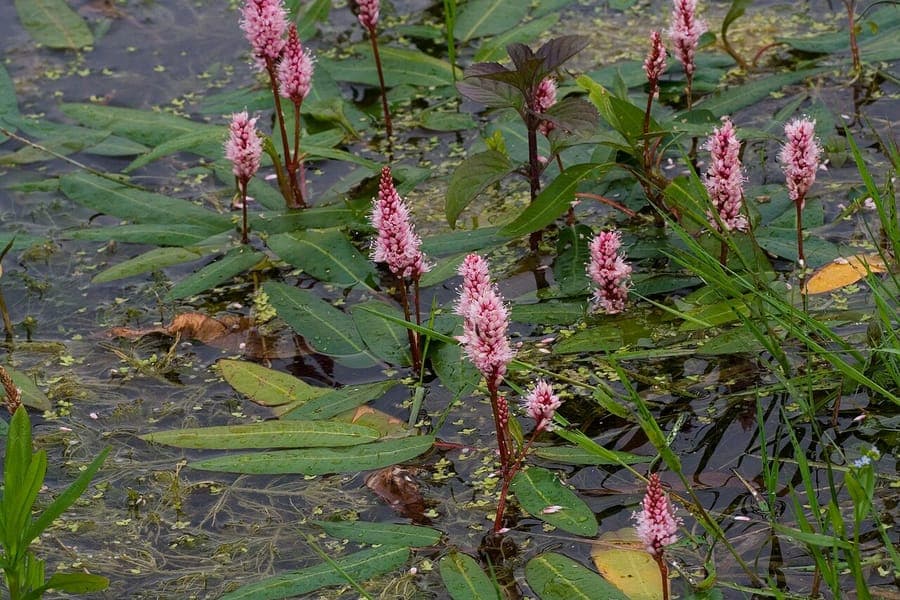
The plant grows very differently depending on whether it's in water or on land. In water it produces floating leaves lying flat on the water surface, oval and dark green. On land it has upright stems with lance-shaped leaves.
The flowers are the highlight: long, dense spikes of tiny pink flowers appear from July through September. These are highly attractive to pollinators. After flowering, small seeds develop.
The plant often shows lovely autumn colours - red and yellow tints in the foliage.
Ideal location
Amphibious bistort grows in full sun to part shade. In full sun it flowers more abundantly. The plant is extremely flexible and also grows in part-shaded locations.
The real advantage is that it can thrive in water or on land. Plant it in shallow water (5-30 cm deep) at pond edges, or on damp stream banks. It can also grow on regularly inundated grassland.
Soil/Water
In water: The plant thrives in silty, nutrient-rich substrates. Sand and stone are less suitable. Ditch bottoms and pond banks with silt are ideal.
On land: The plant grows better in damp to wet soil. Nutrient-rich soil with plenty of organic matter helps growth. The plant tolerates poorer soils however.
The pH can be anything from acidic to alkaline.
Watering
In water you don't need to water - the plant is in the water! On land you must water regularly, especially during dry periods. The plant loves "wet feet," so damp to waterlogged soil is ideal.
Important though: whilst the plant loves moisture, it can also tolerate regular periods of dryness, especially once established.
Diseño gratis
¿Quieres ver Persicaria amphibia: complete guide en tu jardín? Crea un diseño gratis ahora.
Pruning
In water: Pruning is scarcely necessary. The plant will regulate itself. Remove only dead or damaged stems.
On land: Can be cut back after flowering (October-November) or in early spring (March) to maintain control. Pruning doesn't necessarily promote more flowers, but helps prevent the plant becoming too wild.
Maintenance calendar
May: Plant enters growing period. In water, ensure it isn't overwhelmed by too many other plants. On land, water as needed.
June-July: Full growth. Flowering begins. No special care needed except watering on dry land.
August-September: Flowering in full swing. Plant may produce seedlings.
October-November: Flowering finishes. Autumn colours. Can be cut back.
December-April: Winter rest. Plant recedes. No care needed.
Winter hardiness
Amphibious bistort is extremely winter-hardy to at least -15 degrees Celsius. Throughout northern Europe, including the UK, it grows perfectly as a permanent plant. It regrows from the roots after winter.
Companion plants
At water edges: Combine with other water plants like water lilies, iris (various types), reeds, pontederia, pickerel rush, and other marginal plants. Also lovely with sedges and rushes.
On wet land: Combine with other wetland plants: Trollius (globeflower), Hosta, Cardamine (lady's smock), ferns and other moisture-loving border plants.
Closing thoughts
Persicaria amphibia is a special plant offering value at water edges, in wetland gardens, and boggy garden corners. The flowers are elegant and attractive to pollinators. It's a highly flexible plant giving you many design possibilities. Plant it at water edges or in wet soil - you'll enjoy this hardworking plant.
Young plants and potted specimens can be found at most garden centres and specialist water plant suppliers.
¿Quieres ver Persicaria amphibia: complete guide en tu jardín? Crea un diseño gratis ahora.
Sube una foto, elige un estilo y obtén un diseño fotorrealista con lista de plantas en menos de un minuto.
Más de 10.000 jardines diseñados
Sin tarjeta de crédito


Plantas similares
Crosby's wild buckwheat: complete guide
Eriogonum crosbyae
Full guide to growing Eriogonum crosbyae: ideal site, soil, watering, winter hardiness and companion plants for this rare western wild buckwheat.
Spreading buckwheat: complete guide
Eriogonum effusum
Full guide to growing Eriogonum effusum: ideal site, soil, watering, winter hardiness and companion plants for this prairie subshrub from the American West.
Tall woolly buckwheat: complete guide
Eriogonum elatum
Full guide to Eriogonum elatum: siting, soil, watering, pruning and companion plants for this elegant white-flowered buckwheat from the western United States.