
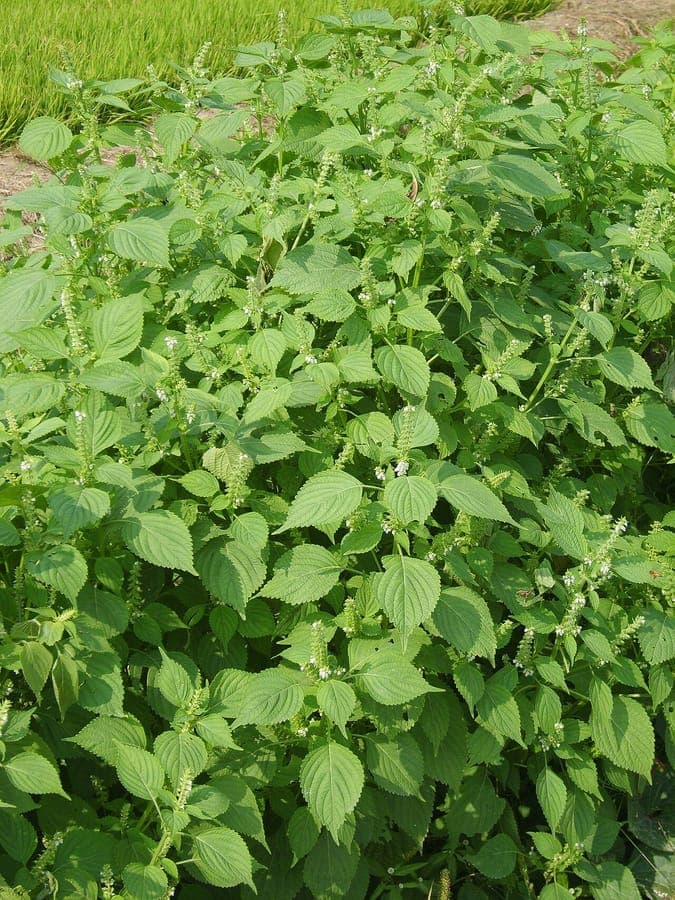
Dalgial / CC BY-SA 3.0, via Wikimedia Commons
Perilla frutescens: complete guide
Perilla frutescens
¿Quieres ver Perilla frutescens: complete guide en tu jardín?
1 minuto, sin tarjeta de crédito
Overview
Perilla frutescens, known as beefsteak mint or perilla, is a fascinating annual plant from Southeast Asia. The plant is renowned for its dark purple leaves (in certain varieties), its intriguing flavour somewhere between mint and clove, and its elegant small flowers. It's an excellent choice for adventurous gardeners wanting to try something less common.
The plant reaches 60-100 cm tall within a single season, forming a bushy shrub, and makes few demands. Being annual, you replant it each spring, making it easy to try different varieties.
Appearance and flowering
The plant forms a full, upright shrub with sturdy, square stems characteristic of the mint family. The leaves are the striking feature: oval to lance-shaped, finely toothed, and in some varieties intensely dark purple to almost black, sometimes with red undersides.
From August through October, delicate small flowers appear in long spikes or whorls. The flowers are white to pink-purple, tiny, but attractive to pollinators. The entire plant smells pleasantly aromatic, with a spicy, minty fragrance that's uniquely appealing.
Ideal location
Beefsteak mint demands full sun to grow well. Plant it in a warm, sunny spot in full sun. In part shade it grows adequately, but loses much of its characteristic dark purple colour - it becomes more green.
The plant is unfussy about wind or humidity. A little shelter helps, but isn't essential.
Soil
The plant grows well in any reasonable garden soil. It needn't be particularly rich. Sandy and clay soils are both tolerated. Well-drained soil is better than waterlogged, but the plant is fairly tolerant.
The pH can be neutral to slightly alkaline (pH 6.5-8.0). Organic matter is helpful but not essential.
Watering
Beefsteak mint is fairly drought-tolerant for an annual. Water regularly during the growing season, especially in hot weather, but allow the top layer of soil to dry between waterings. Excessive water can cause rotting.
During dry periods you can safely reduce watering - the plant tolerates water stress better than many other annuals.
Diseño gratis
¿Quieres ver Perilla frutescens: complete guide en tu jardín? Crea un diseño gratis ahora.
Pruning
Pruning can be done to keep the plant fuller and more compact. Pinch young shoots from May through July so the plant branches more. This also encourages more flowers and denser foliage.
Don't necessarily remove spent flower spikes - they look decorative when dried too and attract more pollinators.
Maintenance calendar
May: Plant after the last frost. Water cautiously until it grows.
June-July: Growing period. Pinch shoots for more branching. Water regularly in hot weather.
August-September: Flowering begins. Regular watering and feeding help flowering.
October: Plant reaches end of life cycle. Flowering finishes with frost threat.
November: Plant dies back with first frost. Remove and compost.
Winter hardiness
Beefsteak mint is not winter-hardy and dies at the first frost (around -1 to 0 degrees Celsius). This is an annual plant - replant it each year. In very warm climates (southern Spain, southern France) it may occasionally self-seed and reappear as a seedling next spring, but this isn't reliable.
Companion plants
Beefsteak mint looks lovely grouped with other annuals and herbs: basil, marigolds, sunflowers, cosmos, and other purple-leaved plants like alternanthera and iresine. Or plant it alone as a striking "herb plant" in your border.
In clusters it works well - the purple colour shows much better when you plant multiple plants together.
Closing thoughts
Perilla frutescens is a fun, unusual annual you can easily grow from seed, offering lots of visual interest. The dark purple foliage makes it a striking foliage accent in borders, and the flowers attract pollinators. Definitely try it if you love experimenting and want something different. You can buy seeds from most garden retailers.
The plant is perfect for those tired of ordinary annuals and seeking something special.
¿Quieres ver Perilla frutescens: complete guide en tu jardín? Crea un diseño gratis ahora.
Sube una foto, elige un estilo y obtén un diseño fotorrealista con lista de plantas en menos de un minuto.
Más de 10.000 jardines diseñados
Sin tarjeta de crédito


Plantas similares
Apple mint (Mentha x villosa): complete guide
Mentha x villosa
Meet apple mint (Mentha x villosa): a fruity-scented kitchen herb with woolly leaves, perfect for tea and mojitos.
Salvia peyronii: complete guide
Salvia peyronii
Discover Salvia peyronii, a rare Lebanese mountain sage. Growing tips, hardiness, and companion planting for a Mediterranean gravel garden.
Bigleaf mint (Mentha x rotundifolia): complete guide
Mentha x rotundifolia
Discover bigleaf mint: cultivation, care tips, and garden uses. Learn how to grow this aromatic herb with soft, hairy leaves.