
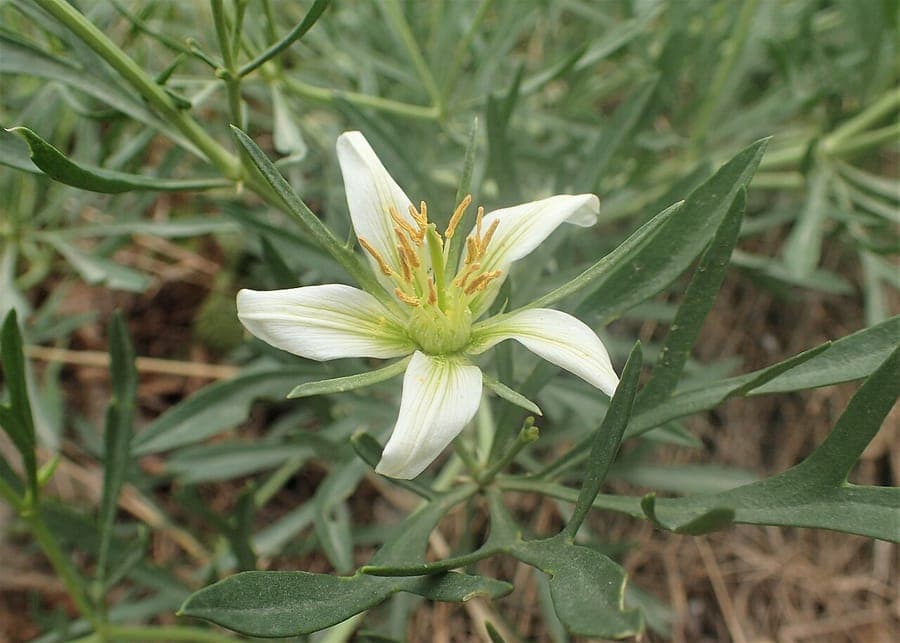
Krzysztof Ziarnek, Kenraiz / CC BY-SA 4.0, via Wikimedia Commons
Peganum harmala: complete guide
Peganum harmala
¿Quieres ver Peganum harmala: complete guide en tu jardín?
1 minuto, sin tarjeta de crédito
Overview
Peganum harmala, commonly known as Syrian rue or harmel, is a remarkable ground cover native to Mediterranean regions through to Mongolia and India. This resilient plant thrives naturally in arid, desert-like environments and has adapted brilliantly to extreme conditions over centuries. In UK gardens, it's an exotic treasure for gardeners willing to embrace something different.
The plant remains low, rarely exceeding 40-60 cm in height, and spreads to around one meter wide. It's an exceptional choice for dry borders in warm gardens or as a striking container plant on patios. Syrian rue tolerates sun and drought like few other plants.
Appearance and flowering
The plant forms a compact, springy mound with fine, greyish-green foliage. Leaves are narrow and deeply segmented, almost needle-like, giving the plant an elegant appearance. From May through August, countless tiny white flowers emerge with yellow and red accents, growing in loose clusters that create an airy, delicate effect.
Following the flowers come distinctive round, interconnected seed pods that remain decorative. The plant retains much of its foliage year-round, especially in southern climates, though it may recede below 0 degrees Celsius.
Ideal location
Syrian rue demands warmth and full sun. Any location without shade works perfectly. Choose a south-facing wall or south-facing house wall where the plant receives sun from dawn to dusk. The plant tolerates wind exposure well and thrives against warm, dry surfaces.
Don't plant harmel in the shade of trees or large shrubs - it simply won't thrive. It can handle brief, light dappled shade, provided it's for no more than a few hours daily.
Soil
The critical requirement is excellent drainage with light soil. Heavy clay is entirely unsuitable for Peganum harmala. Ideal soil is a mix of compost with sand, gravel or perlite comprising at least 30-40 percent of the volume. The plant also grows exceptionally well nestled between rocks, among stones, or in gravel planting schemes.
The pH can be neutral to slightly alkaline (pH 7.0-8.0). Organic matter isn't essential - in fact, harmel grows better in poor, mineral-rich soil than in rich, composted soils.
Diseño gratis
¿Quieres ver Peganum harmala: complete guide en tu jardín? Crea un diseño gratis ahora.
Watering
Once established, Peganum harmala is remarkably drought-tolerant. During the growing season (April-October), water moderately, less than you'd typically give other plants. Allow the top layer of soil to dry between waterings. Even in dry summers, the plant needs water only once every two weeks, and if it rains, you can rely entirely on natural rainfall.
In winter, water sparingly, particularly outdoors. Excessive moisture is the primary cause of failure with this plant.
Pruning
Pruning is scarcely necessary. The plant grows compactly and organizes itself. In early spring, remove any dead stems and foliage. If the plant becomes too wide, pinch young shoots between March and May to maintain a tighter shape. Don't deadhead spent flower clusters - they remain attractively decorative.
Maintenance calendar
January-March: Check that the plant has well-draining soil. Remove dead growth.
April-May: Plant awakens and begins flowering. Need feeding? No - harmel thrives in poor soil.
June-September: Flowering period. Maintain regular but not excessive watering. Leave flowers intact.
October-November: Flowers finish. Gradually reduce watering.
December: Winter dormancy. Minimal care required.
Winter hardiness
Harmel is frost-sensitive below -5 degrees Celsius. In northern regions it won't survive outdoors. In southern areas it may overwinter outdoors, depending on location. Ensure a very dry spot under shelter or in a cold frame.
It's wiser to move container plants indoors or into a cold greenhouse for winter. Moist conditions cause leaf drop and rot.
Companion plants
Harmel works beautifully with other drought-tolerant Mediterranean neighbours: rosemary, sage, lavender, winter savoury, sedum and sempervivum. This combination drains quickly and creates visual harmony. For added lightness, pair with grey-foliaged plants like artemisia, senecio and helichrysum.
Closing thoughts
Peganum harmala isn't a common plant in UK gardens, but for those who love hot, dry spots and enjoy experimenting, Syrian rue is a genuine treasure. The plant combines low-maintenance character with delicate flowers and year-round structure. Try it in containers on your patio or balcony - best of luck!
Intrigued by this plant? Check out offerings from garden centres for container plants. You might discover other fascinating exotics there too.
¿Quieres ver Peganum harmala: complete guide en tu jardín? Crea un diseño gratis ahora.
Sube una foto, elige un estilo y obtén un diseño fotorrealista con lista de plantas en menos de un minuto.
Más de 10.000 jardines diseñados
Sin tarjeta de crédito


Plantas similares
Acer pycnanthum: complete guide
Acer pycnanthum
Acer pycnanthum, the Japanese swamp maple, is a fast-growing tree with early red flowers and brilliant autumn color, ideal for damp garden settings.
Freeman maple: complete guide
Acer × freemanii
Everything about the Freeman maple (Acer x freemanii): a fast-growing shade tree with spectacular autumn colour for large gardens.
Silver vine: complete guide
Actinidia polygama
Discover silver vine (Actinidia polygama): a hardy climbing plant with silvery foliage, loved by gardeners and cats alike.