
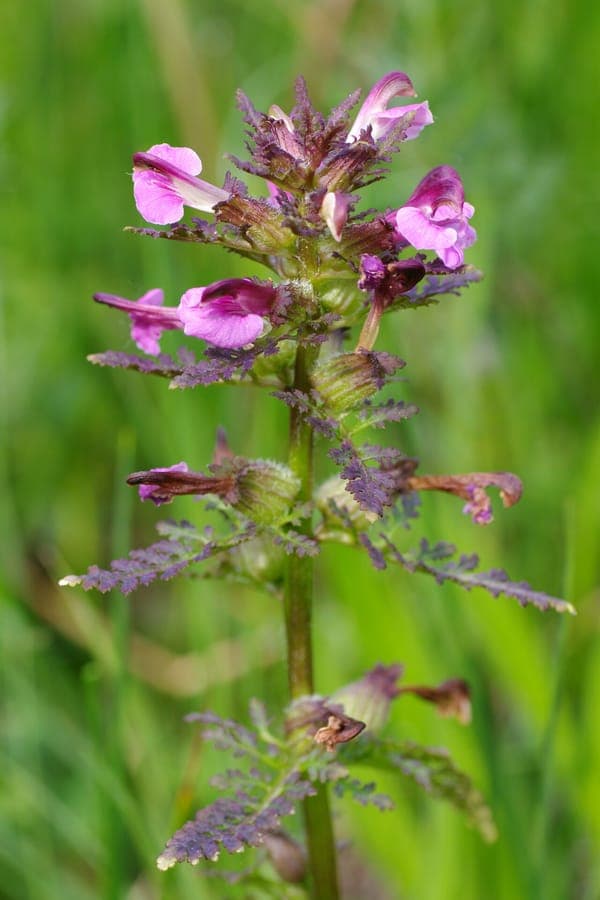
Christian Fischer / CC BY-SA 3.0, via Wikimedia Commons
Pedicularis palustris: complete guide
Pedicularis palustris
¿Quieres ver Pedicularis palustris: complete guide en tu jardín?
1 minuto, sin tarjeta de crédito
Overview
Pedicularis palustris, commonly known as Marsh Lousewort or Swamp Lousewort, is a remarkable wetland plant from the Orobanchaceae family. Native to boggy marshes and peatland throughout Europe from Scandinavia to the Mediterranean, this plant is celebrated for its striking purple flowers and ecological importance in natural wetland ecosystems.
Appearance and Bloom Time
Pedicularis palustris is an annual to biennial herb typically reaching 40 to 60 centimeters tall. The plant features finely dissected foliage giving a delicate, lacy appearance. The flowers are purple to reddish-purple, remarkably large and conspicuously arranged in dense flower clusters.
The blooming period extends from May through August, with flowers highly attractive to pollinating insects. After flowering, characteristic seed capsules develop.
Ideal Location
This plant requires wet to very wet soils. It excels in marsh areas, along ditch margins, and in low-lying moist garden sections. The plant adapts to both full sun and partially shaded locations, though full sun produces the most abundant flowering.
It is ideal for natural gardens, wet borders, and ecological water gardens.
Soil
The plant thrives only in very wet soils that remain permanently moist to waterlogged. Acidic and nutrient-poor soils are suitable. An ideal growing medium combines black peat, coarse sand, and clay. Waterlogged conditions are mandatory; the plant cannot tolerate dry or semi-dry sites.
Watering
Being a marsh and bog inhabitant, continuous moisture is essential. Ensure the planting area never dries completely. Regular water replenishment supports healthy growth. In artificial marsh gardens or containers with controlled water levels, this plant performs excellently.
Preferred water: neutral to acidic water, ideally rainwater.
Diseño gratis
¿Quieres ver Pedicularis palustris: complete guide en tu jardín? Crea un diseño gratis ahora.
Pruning
Minimal pruning is necessary. Remove spent flowers after blooming. With biennial forms, gentle pruning after the first year can encourage more compact growth.
Maintenance Calendar
- May-June: Blooming begins, maintain consistent moisture
- July-August: Continued blooming, enjoy purple flower clusters
- September: Seed development, allow some seeds to disperse naturally
- October-April: Dormancy phase, maintain minimal but consistent moisture
Winter Hardiness
Pedicularis palustris is winter hardy to very low temperatures. As an annual to biennial, the plant will not survive winter as a typical perennial but may reappear from seed or overwinter as a young rosette flowering the following season.
Companion Planting
This wetland herb pairs perfectly in natural water gardens with other marsh plants like Caltha palustris (marsh marigold), irises, and hypericum species. Purple flowers contrast beautifully with yellow blooms. In larger wetland gardens, plant in groups of five to ten specimens.
Closing Thoughts
Pedicularis palustris offers a rare opportunity to recreate a genuine natural wetland ecosystem in your own garden. With attention to permanent moisture and proper soil conditions, this remarkable plant rewards you with years of color and natural beauty. Discover with gardenworld.app how to design an ecological water garden.
With gardenworld.app, you can design your complete front garden with professional guidance. Learn how to create a thriving natural water garden and receive expert recommendations for wet terrain plantings.
¿Quieres ver Pedicularis palustris: complete guide en tu jardín? Crea un diseño gratis ahora.
Sube una foto, elige un estilo y obtén un diseño fotorrealista con lista de plantas en menos de un minuto.
Más de 10.000 jardines diseñados
Sin tarjeta de crédito


Plantas similares
Northwestern Indian paintbrush: complete guide
Castilleja angustifolia
All about Castilleja angustifolia, the northwestern Indian paintbrush from dry western US steppes. Growing, care, and companion plant advice.
Wavyleaf Indian paintbrush: complete guide
Castilleja applegatei
Everything about Castilleja applegatei, the wavyleaf paintbrush from Oregon and California. Host plants, care, location, and garden use covered.
Bushy bird's-beak: complete guide
Cordylanthus ramosus
Complete guide to Cordylanthus ramosus, the hemiparasitic annual of western US steppes: ecology, host plants, cultivation and uses.