
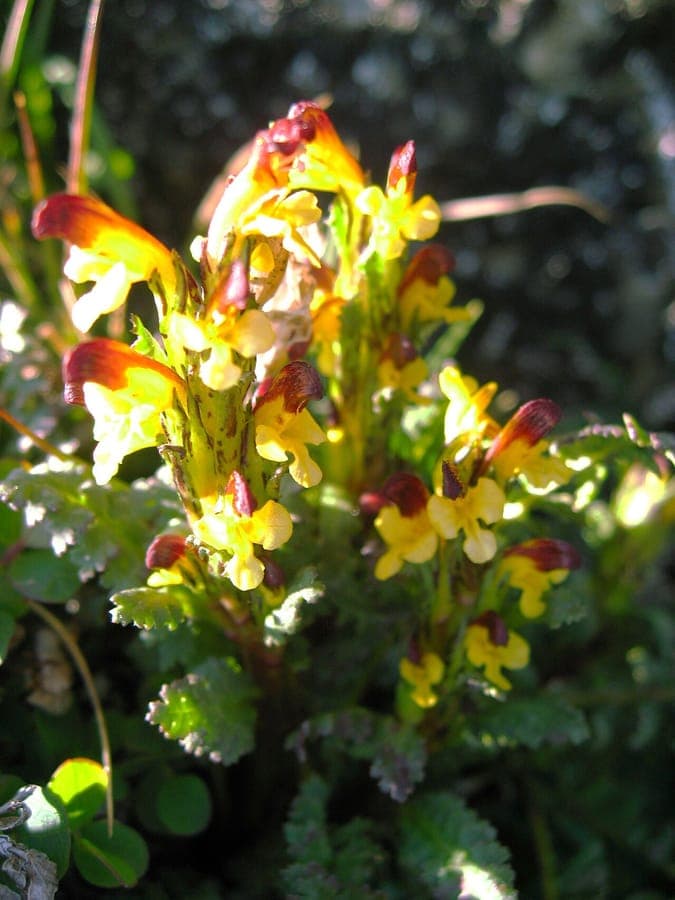
Kim Hansen / CC BY-SA 3.0, via Wikimedia Commons
Pedicularis flammea: complete guide
Pedicularis flammea
¿Quieres ver Pedicularis flammea: complete guide en tu jardín?
1 minuto, sin tarjeta de crédito
Overview
Pedicularis flammea, known as red rattle or flame-coloured lousewort, is an enchanting alpine plant naturally occurring in subarctic and arctic regions of North America, Scandinavia, and northern Europe. This rare alpine specialist thrives on mountain meadows and alpine zones, particularly around the polar circle. The plant is renowned for its intriguing red-orange flowers that stand out magnificently against the green mountain landscape. For gardenworld.app, this plant offers a unique opportunity for those wanting to create a true alpine garden with authentic mountain flora.
Appearance & bloom cycle
Pedicularis flammea is a herbaceous plant reaching 20-50 centimeters in height. The leaves are elongated, divided, and dark green, very characteristic of the Pedicularis family. The famous flowers appear from July to August and are the highlight of this plant. They measure about 1-2 centimeters long, bright red to orange-red, and grow in densely packed spikes atop the stems. Each flower has a curved upper lip - a characteristic 'crest' that gives the plant its name ('rattle'). After blooming, small seed capsules form. The plant typically dies back after seed ripening, characteristic of biennial alpine plants.
Ideal location
Red rattle thrives best in locations with plenty of light, though fine shade works well too. This is a plant that loves cool summer temperatures and cool, clear air. For Dutch gardens, it performs better in higher elevations or shadier locations that don't get too hot in summer. Full sun in southern Europe is too warm; the plant prefers partial shade. It naturally grows on sloping terrain where water drains well. For home gardens, it works well on a shaded rock garden or in alpine troughs.
Soil requirements
Red rattle is not picky about soil composition as long as drainage is good. Heavy, moisture-rich soils are not needed. The plant prefers well-draining, moderately nutrient-rich soil with sand and stones mixed in. Alpine soil mix, such as used for rock gardens, is ideal - roughly 50% coarse sand, 30% leaf mold, and 20% fine stones. Acidic to neutral soil with pH 5.5-7 is good. The plant does not tolerate very nutrient-rich soil well; it grows weaker in excessively fertile soils.
Diseño gratis
¿Quieres ver Pedicularis flammea: complete guide en tu jardín? Crea un diseño gratis ahora.
Watering
Pedicularis flammea needs regular water during the growing season but should not be kept waterlogged. In pot culture, check 2-3 times weekly and water if the top centimeter feels dry. Outdoors in alpine gardens, regular rainfall usually suffices; extra watering is rarely needed. Stagnant water must be avoided - this quickly leads to root problems. During dry summers, check daily. After blooming, gradually reduce watering.
Pruning
Red rattle requires minimal pruning. Best to let the plant maintain its natural form. Remove only dead leaves and withered flower clusters to keep the plant tidy. After seed pod ripening (August-September), the entire plant can be removed since it almost always dies after seed dispersal. Young plants need no pruning.
Maintenance calendar
May: young plants grow quickly, water regularly. June: blooming approaches, plant becomes increasingly beautiful. July: peak bloom period, flowers at their finest. August: blooming midway, first seed capsules ripen. September: seed-bearing plants can be removed after seed dispersal. October-April: plant rests or develops in second year.
Winter hardiness
Pedicularis flammea is very winter-hardy in temperate to cold climates. In the UK it grows well through USDA zone 3. Two-year-old specimens may survive hard winters with light protection, but usually die after seed dispersal anyway. Seeds are easy to propagate in autumn or early spring on nutrient-poor soil mix with cooling required. This is more a plant for alpine plant enthusiasts than a traditional garden.
Companion plants
Red rattle combines excellently with other alpine plants such as edelweiss, silene, alpine phlox, and small forget-me-nots. For rock gardens, combine with saxifrages, geraniums, and lavender. In alpine troughs, it works well with small sedums and sempervivums. For visual effect, place red rattle next to lighter-flowering plants to achieve contrast. Grouping with other red/orange-flowering alpine plants creates dramatic effect.
Closing thoughts
Pedicularis flammea is for those who truly love alpine plants. Its flame-red flowers give any alpine garden intensity. Growing from seed at home is the most reliable method. Get seeds and plant in cool-location soil mix until first blooming - then you really have something special in your garden. For gardenworld.app, red rattle ranks high on the wish list for alpine gardening ambitions.
¿Quieres ver Pedicularis flammea: complete guide en tu jardín? Crea un diseño gratis ahora.
Sube una foto, elige un estilo y obtén un diseño fotorrealista con lista de plantas en menos de un minuto.
Más de 10.000 jardines diseñados
Sin tarjeta de crédito


Plantas similares
Northwestern Indian paintbrush: complete guide
Castilleja angustifolia
All about Castilleja angustifolia, the northwestern Indian paintbrush from dry western US steppes. Growing, care, and companion plant advice.
Wavyleaf Indian paintbrush: complete guide
Castilleja applegatei
Everything about Castilleja applegatei, the wavyleaf paintbrush from Oregon and California. Host plants, care, location, and garden use covered.
Bushy bird's-beak: complete guide
Cordylanthus ramosus
Complete guide to Cordylanthus ramosus, the hemiparasitic annual of western US steppes: ecology, host plants, cultivation and uses.