
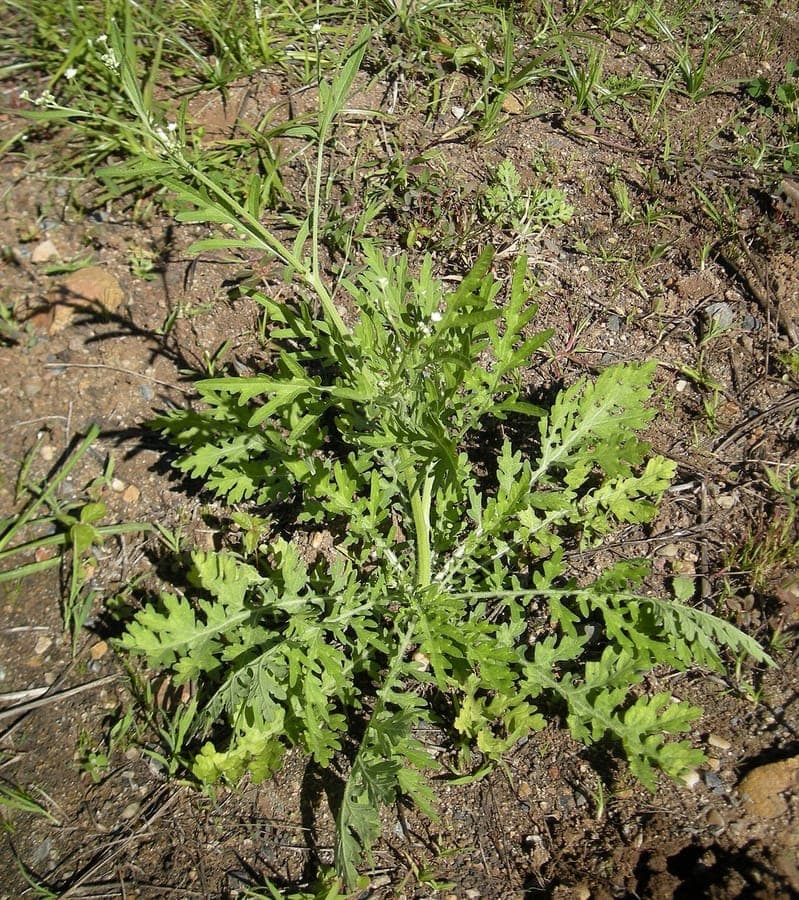
Ethel Aardvark / CC BY 3.0, via Wikimedia Commons
Parthenium hysterophorus: complete guide
Parthenium hysterophorus
¿Quieres ver Parthenium hysterophorus: complete guide en tu jardín?
1 minuto, sin tarjeta de crédito
Overview
Parthenium hysterophorus, known as santa maria, wild feverfew, or feverfew-weed, is a versatile herb originating from tropical and subtropical America. This member of the Asteraceae family is especially known in Europe from South America and India, where it is widely used for medicinal purposes. The plant grows rapidly and produces enormous amounts of seed. In European front-garden contexts, it requires careful handling due to possible ecological impact. Nevertheless, the plant offers interesting medicinal and horticultural potential.
Appearance and Bloom
Parthenium hysterophorus grows as an upright, finely-branched plant from 30 to 100 centimeters height. The leaves are two to three times divided, very fine and feathery, giving the plant a light, airy appearance. The flowers are small, white to creamy yellow, grouped in spherical flower heads. Blooming occurs from July to October. The plant produces tremendous amounts of seed that remains viable for long periods. Scent is characteristically bitter-herbaceous.
Ideal Location
Parthenium hysterophorus thrives optimally in full sun and open locations. The plant feels at home in warm-dry conditions, though it also grows in temperate climates. It prefers areas with minimal shade. In front-garden designs, it works well in neglected corners, along paths, or in drought-tolerant garden schemes. The plant is highly adaptable and grows in almost all soils.
Soil
Parthenium hysterophorus grows in practically any soil, from very poor sand to heavy clay. The plant tolerates acidic, neutral, and alkaline soils without specific preference. Strong growth occurs in nutrient-rich soil; however, the plant also thrives in very poor soils. Special drainage cultivation is unnecessary; the plant can even tolerate drought better than excessive moisture.
Watering
Parthenium hysterophorus is very drought-tolerant once established. Water regularly during the first growing season to support root development; thereafter the plant needs minimal water. In pot culture, water more frequently; the plant grows faster in moist conditions. Overwatering must be avoided as it can cause fungal disease.
Diseño gratis
¿Quieres ver Parthenium hysterophorus: complete guide en tu jardín? Crea un diseño gratis ahora.
Pruning
Parthenium hysterophorus requires no regular pruning from an aesthetic perspective. However, it is very important to remove flower heads before seed-set to prevent uncontrolled self-seeding. This is a biological safety measure. Young plants can be limited in height by pinching off the stem. The plant responds well to pruning through increased branching.
Maintenance Calendar
Spring (March-May): Plant seed or add young plants. Water regularly. No feeding needed in early phase.
Summer (June-August): Blooming begins. Water during dry periods. Very important: monitor flower heads and remove before seed-set!
Autumn (September-October): Blooming peaks. Carefully remove flower heads. Seed suppression is critical.
Winter (November-March): Plant dies back in cold climates. In warmer zones it can overwinter. Frozen plants can be removed.
Winter Hardiness
Parthenium hysterophorus is annual to perennial depending on climate. In temperate zones to -5 degrees Celsius it can survive, but usually the plant dies at first frost. In warmer climates it is perennial. In European contexts, it must usually be treated as an annual plant or with protection overwinter as a perennial specimen.
Companion Plants
Parthenium hysterophorus combines well with other South American herbs and heat-loving plants. It works well in Mediterranean garden schemes and together with Echinacea, Rudbeckia, and other thick, drought-tolerant perennials. The plant can, however, become dominant due to rapid growth and seed production; limit combinations to avoid ecological disruption.
Conclusion
Parthenium hysterophorus is a plant for experimentally-minded gardeners who appreciate medicinal herbs. With care against seed dispersal, regular flower-head suppression, and respect for possible ecological impact, this plant can be an interesting addition to warm, sunny gardens. Plant carefully and manage responsibly.
Parthenium hysterophorus seed is available at seed suppliers. Consult gardenworld.app for more medicinal herb designs. Gardenworld.app helps you design healing herb gardens full of potential.
¿Quieres ver Parthenium hysterophorus: complete guide en tu jardín? Crea un diseño gratis ahora.
Sube una foto, elige un estilo y obtén un diseño fotorrealista con lista de plantas en menos de un minuto.
Más de 10.000 jardines diseñados
Sin tarjeta de crédito


Plantas similares
Calendula stellata: complete guide
Calendula stellata
Complete guide to Calendula stellata, the star-flowered marigold from Sicily: location, soil, watering and companion planting tips.
Korean chrysanthemum: complete guide
Chrysanthemum x rubellum
Chrysanthemum x rubellum is a hardy autumn perennial with single pink to copper flowers from August to November. Care and combinations.
Helianthus divaricatus: complete guide
Helianthus divaricatus
Helianthus divaricatus is a North American woodland sunflower with yellow summer blooms, ideal for naturalistic borders and shady edges.