
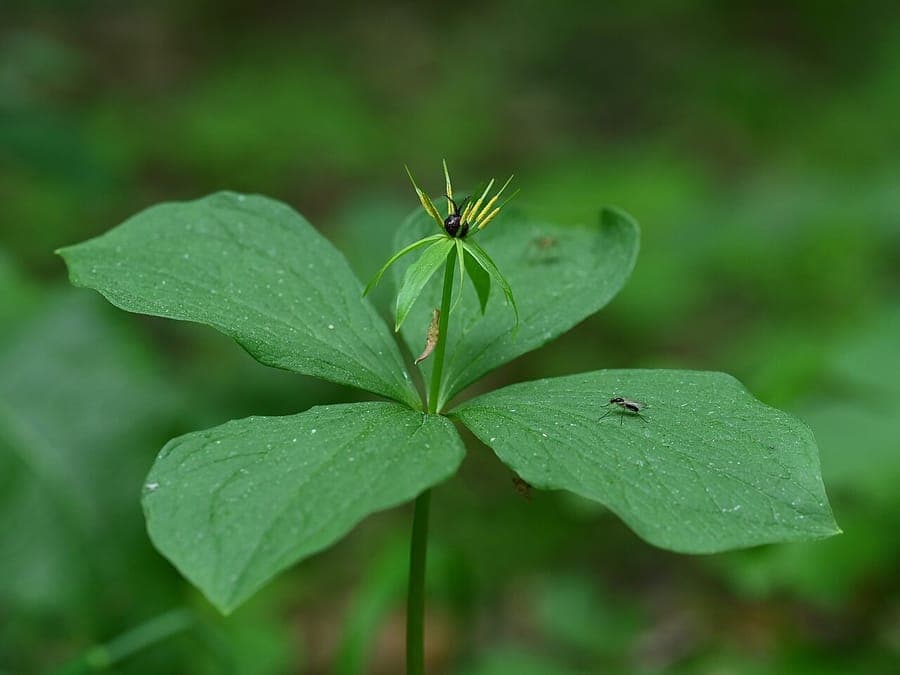
Krzysztof Ziarnek, Kenraiz / CC BY-SA 4.0, via Wikimedia Commons
Paris quadrifolia: complete guide
Paris quadrifolia
¿Quieres ver Paris quadrifolia: complete guide en tu jardín?
1 minuto, sin tarjeta de crédito
Overview
Paris quadrifolia, known as herb-paris or four-leaved herb, is one of Europe's most remarkable shade plants. This member of the Melanthiaceae family grows naturally in forest areas from Europe to the Mongolian grasslands. The scientific name references the four leaves that grow at right angles to each other. This is not a plant for casual gardeners; Paris quadrifolia requires specific conditions and deserves full appreciation. In modern front garden designs with shaded elements, it offers dramatic visual impact.
Appearance and Bloom
Paris quadrifolia grows from a slowly advancing root system. Each yearly shoot bears characteristically four narrow, lance-shaped leaves in a regular cross, each reaching 12 centimeters long. From above this four-leaf platform grow two flower structures: first a small greenish-brown flower (May-June), followed by a striking blue-black stalk with four red stigmas - the true spectacle. The plant reaches 30 to 50 centimeters height. After blooming follows a toxic blue-black berry.
Ideal Location
Paris quadrifolia belongs in dense shade, preferably in deciduous and mixed forests. In a front garden context, it works perfectly in the shadow of large shrubs, under orchards, or on the coldest north side of the house where little direct sunlight falls. The plant cannot tolerate much sun; more than three hours of direct sunlight causes leaf burn. Locations with constantly cool temperatures are well-tolerated.
Soil
Paris quadrifolia demands moisture-rich, humus-laden forest soil. Heavy acidic earth is well-tolerated; chalky soil leads to growth retardation. The plant grows optimally in deeper soil layers where the rotting process occurs; shallow soil will produce less favorable results. Add abundant rotting leaf matter when planting. The plant feels at home in ecological milieus where bacterial life remains intact.
Watering
Paris quadrifolia tolerates no drought. The soil must remain moist during the growing season (April-October), but not waterlogged. Rainwater is better than tap water because it is softer. In the first year water regularly; thereafter depending on natural precipitation. The plant grows much slower in dry years. Mulching with leaf matter helps moisture retention.
Diseño gratis
¿Quieres ver Paris quadrifolia: complete guide en tu jardín? Crea un diseño gratis ahora.
Pruning
Paris quadrifolia actually requires no pruning in the traditional sense. Remove dead leaves carefully and cautiously by section. The plant grows slowly and only dead material that disturbs beauty can be removed. Drastic pruning is not recommended as this can lead to years-long plant recovery.
Maintenance Calendar
Spring (March-May): Plant emerges from rest. Ensure consistent moisture levels. Carefully add leaf matter as mulch.
Summer (June-August): Maintaining proper moisture requirements is critical. Monitor shade; no sun-exposure. Enjoy the unique blooming and fruit development.
Autumn (September-November): Plant begins rest. Leaf-matter mulch can be helpful. Stop feeding.
Winter (December-February): Plant rests completely. Minimal attention needed. Protect against extreme frost fluctuations.
Winter Hardiness
Paris quadrifolia is very frost-hardy to -20 degrees Celsius. In Northwest Europe it can remain outdoors without protection. However, the plant grows very slowly in continental zones with extreme winter fluctuations. Protection with leaf-matter mulch is beneficial in very severe winters.
Companion Plants
Paris quadrifolia combines well with other forest plants such as Convallaria majalis (lily of the valley), Anemone nemorosa, and Asarum europaeum. In shady corners, fine ferns work well. Avoid vigorous ground covers that would suppress this delicate plant. Other Melanthiaceae relatives work well in the same habitat.
Conclusion
Paris quadrifolia is a plant for patient gardeners who value subtlety and botanical rarity. This plant requires more attention than easy-care plants but will reward you with dramatic beauty in dark corners. Plant it where others grow nothing, and let it work its ancient forest magic.
Paris quadrifolia is not a common garden plant; seek specialized nurseries. Visit gardenworld.app for more forest planting ideas. Gardenworld.app helps you transform shady spaces into magical woodlands.
¿Quieres ver Paris quadrifolia: complete guide en tu jardín? Crea un diseño gratis ahora.
Sube una foto, elige un estilo y obtén un diseño fotorrealista con lista de plantas en menos de un minuto.
Más de 10.000 jardines diseñados
Sin tarjeta de crédito


Plantas similares
California false hellebore (Veratrum californicum): complete guide
Veratrum californicum
Full guide to Veratrum californicum, the imposing native perennial from western North America. Toxicity warning, site, soil, watering and bold companion plant ideas.
Beargrass: complete guide to growing Xerophyllum tenax
Xerophyllum tenax
Xerophyllum tenax is a dramatic perennial with fine grass-like leaves and tall white flower plumes, ideal for dry, sunny gardens and naturalistic border designs.
Anticlea elegans: complete guide
Anticlea elegans
Anticlea elegans, commonly called white camas or mountain death camas, is an elegant alpine plant with delicate white-yellow flowers and distinctive blue-tinged foliage. Perfect for rock and alpine gardens.