
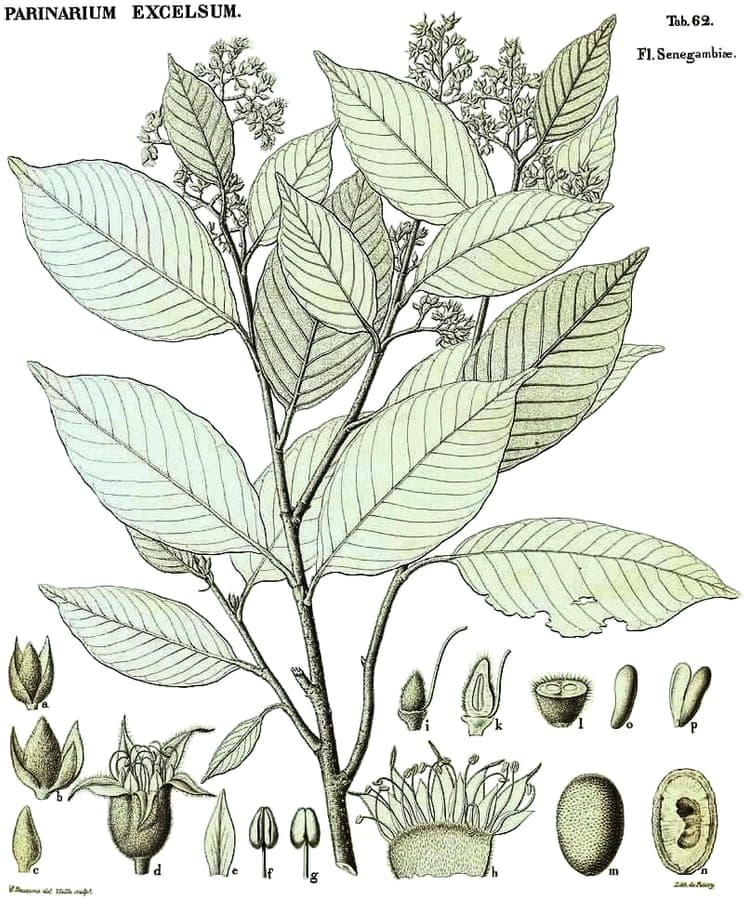
J. Decaisne del.[i.e. delineavit / draughtsman] Vielle sculpt [i.e. engraver]. Lith de Roissy [i.e. lithographer], in Guillemin, J.B.A., Perrottet, S. (1833) / Public domain, via Wikimedia Commons
Guinea-plum: complete guide
Parinari excelsa
¿Quieres ver Guinea-plum: complete guide en tu jardín?
1 minuto, sin tarjeta de crédito
Guinea-Plum: Complete Guide
The Guinea-plum (Parinari excelsa), also called Grey Plum in English, is a medium to large tropical fruit tree from the tropical regions of Africa and South America. The tree belongs to the family Chrysobalanaceae. This plant is known for its nutritional value in traditional African and South American agriculture. The tree grows wild from West Africa (Senegal, Guinea, Sierra Leone) to East Africa (Tanzania, Uganda) and also in central South America (Venezuela, Guyana, Brazil).
Appearance, Growth and Occurrence
Parinari excelsa grows into a large tree of 15 to 30 meters height in wild state; in cultivation usually 8 to 15 meters. The tree has a powerful, impressive root system and densely leafed crown. The leaves are large, oval to lance-shaped, dark green, 10 to 20 cm long, with fine-veined texture. The flowers appear in bundles (panicles), small about 8 to 12 mm, pale yellow to white, very fragrant. Flowering usually occurs in the dry season (December to March in Africa, May to July in South America). The fruits ripen to yellow-orange, approximately 3 to 5 cm in diameter, with a single large seed inside. The flesh is yellow, juicy, sweet, with a slightly nutty taste. Ripening takes 3 to 6 months after flowering.
Climate
Guinea-plum is a strictly tropical tree. It grows from USDA zone 10 to 11 (minimum 10 to 15 degrees Celsius in winter, ideally 18 to 30 degrees Celsius permanently). This means:
- Not suitable for: Northern Europe, temperate USA, temperate Australia.
- Suitable for: South Florida, South California, Hawaii, Southern Spain (Malaga region), Southern Italy, South Africa, subtropical Australia (Queensland, N.S.W. coast), Southern Brazil, Mexico (Veracruz), Canary Islands (zone 10).
It tolerates dry periods better than many tropical trees, but grows better with regular rain. Frost-free climate is mandatory.
Soil
Guinea-plum is flexible. It grows in sandy, clay to moisture-retaining soils, as long as drainage is acceptable. Ideal pH: neutral to slightly acidic (6.0 to 7.5). Deep groundwater helps: the tree prefers sites not constantly waterlogged. Ground preparation: ensure at least 60 cm of fertile, well-drained soil. Heavy clay land must be gradually improved with sand and compost.
Watering
In cultivation: regular water during growth period (spring to early fall). Very young trees (first two years) prefer moist soil without waterlogging. Adult trees tolerate drought well, especially in native habitat. Irrigation helps in dry seasons, especially during fruit setting (May to September). Mulch (5 to 10 cm organic material around tree base) helps moisture retention.
Feeding and Care
Make good compost. During flowering period (January-March) apply NPK 10:30:10 fertilizer (phosphate-rich for flowering). During growth period 12:12:17 or similar general formula. No over-feeding: excessive nitrogen gives lots of leaf, less fruit. Annual maintenance fertilizer: slow-release organic fertilizer (compost meal, ground bones) in October.
Diseño gratis
¿Quieres ver Guinea-plum: complete guide en tu jardín? Crea un diseño gratis ahora.
Pruning and Shaping
Minimal pruning needed. In the first 3 to 4 years after planting, focus on strong trunk formation: gently remove lower side branches up to 1.5 to 2 meters height. This ensures impressive crown formation. After establishment: prune only dead, damaged or crossing branches. Guinea-plum forms neat shape naturally. Avoid heavy pruning: it disrupts fruit production.
Maintenance Calendar (For Subtropical Climates)
October-November: Preparation for next season. Apply maintenance fertilizer. Inspect branches.
December-January: Flowering underway. Daily watering in dry periods. No fertilizer during flowering.
February-March: Peak flowering. Light spraying against insects (non-toxic means).
April-May: Fruits setting. Begin feeding with NPK 10:30:10.
June-August: Fruit growth in full swing. Regular watering. Spray against flies (tropical fruit fly problematic).
September: Harvest preparation. Reduce watering.
September-October: First fruits ripen. Harvest when yellow-orange color is reached. Do not pick overripe: fruits do not travel well on long transport.
Propagation
Possible from seed. Sow seeds immediately after harvest in moist seed bed (20 to 25 degrees Celsius). Germination time: 2 to 3 weeks. Seedlings grow quickly. First flowering usually year 5 to 7 after sowing.
Propagation via semi-hardwood cuttings is difficult; enzymatic auxin (growth hormone) is sometimes needed. Vegetative propagation is standard among professionals for selected clones.
Diseases and Pests
In native habitat very healthy. In cultivation:
- Tropical fruit fly: Serious problem in South America and African tropics. Control: good hygiene (remove rotten fruits), net protection, or closed systems.
- Anthracnose fungus: In wet climates. Prevention: good ventilation, dry foliage.
- Aphids: Rarely; spray water off.
Food Value and Harvest
The fruits are nutrient-rich: vitamins C, A, some B-vitamins, minerals (copper, iron, magnesium). The flesh is sweet-sour. Raw consumption, or processed into jam, juice, distilled liqueur. In Africa traditionally valued. Fruit weight: 30 to 100 grams per fruit. Yields of mature tree: 50 to 200 kg per season in favorable conditions.
Interesting Facts
Parinari excelsa is botanically considered a "keystone" species in many African wetlands: it is important for bird feeding and habitat formation. Traditional use in African medicine (fruits against worm infection). The tree also acts as a nitrogen-fixer in symbiosis with soil bacteria, useful in agroforestry systems.
Conclusion
Guinea-plum is a versatile tropical fruit tree, worthy for subtropical gardens where temperature reliably stays above 10 degrees Celsius. Its tolerance for drought and relatively low maintenance needs make it attractive. However, frost is fatal; climate history must be carefully verified. Suitable for South Florida, Hawaii, coasts of Southern Spain and Southern Australia. For temperate gardens: greenhouse or greenhouse cultivation as an ornamental plant, little chance of fruit production outside tropics.
Availability: Very limited in standard garden retailers. South Africa: sometimes in specialized tropical nurseries. Brazil and South America: easily available. Online seed suppliers from tropical regions are the best source for seed or young trees.
¿Quieres ver Guinea-plum: complete guide en tu jardín? Crea un diseño gratis ahora.
Sube una foto, elige un estilo y obtén un diseño fotorrealista con lista de plantas en menos de un minuto.
Más de 10.000 jardines diseñados
Sin tarjeta de crédito


Plantas similares
Acer pycnanthum: complete guide
Acer pycnanthum
Acer pycnanthum, the Japanese swamp maple, is a fast-growing tree with early red flowers and brilliant autumn color, ideal for damp garden settings.
Freeman maple: complete guide
Acer × freemanii
Everything about the Freeman maple (Acer x freemanii): a fast-growing shade tree with spectacular autumn colour for large gardens.
Silver vine: complete guide
Actinidia polygama
Discover silver vine (Actinidia polygama): a hardy climbing plant with silvery foliage, loved by gardeners and cats alike.