
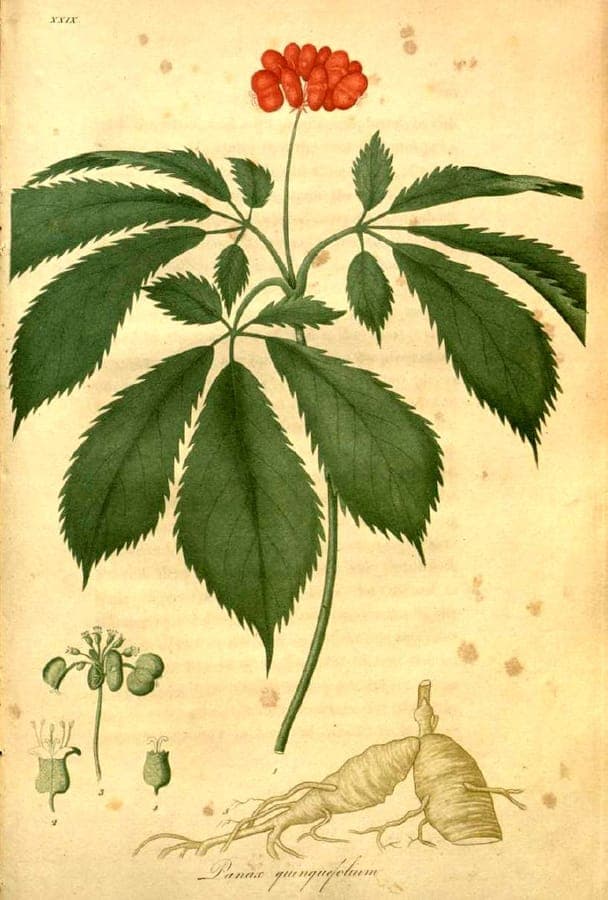
Jacob Bigelow (1786-1879), text and coloured engravings / Public domain, via Wikimedia Commons
American ginseng: complete guide
Panax quinquefolius
¿Quieres ver American ginseng: complete guide en tu jardín?
1 minuto, sin tarjeta de crédito
Overview
Panax quinquefolius, commonly known as American ginseng or Ginseng, is a valuable medicinal plant from the deciduous forests of eastern North America. This plant belongs to the Araliaceae family (similar to ivy family) and is known for its adaptogenic properties.
American ginseng has been heavily harvested from the wild and is one of the most sought-after medicinal plants. Growing your own ginseng is a long but very rewarding undertaking.
Appearance and bloom
American ginseng grows to about 30-50 cm tall and prefers shady places. The plant has five-leafed foliage (hence "quinquefolius") with serrated edges and a green, greyish underside.
The flowers are small, greenish-yellow, and appear in May-June in small flower clusters. The plant forms red berries in August-September. The roots grow very slowly and may take 5-10 years before being ready for harvest.
Ideal location
American ginseng grows ideally in densely shaded to semi-shaded forest conditions. The plant does NOT thrive in full sun. A spot under deciduous trees is ideal.
Ensure plenty of shade (around 70-80% shade). The plant is best grown in temperate climates in a leaf-covered forest area.
Soil
American ginseng requires very specific soil requirements. The plant needs loose, humus-rich, well-drained soil with lots of leaf mold. A pH between 4.5 and 6 is ideal.
Work large amounts of leaf mold and rotted organic material in. The soil should be moister but must not be waterlogged. Mixed seed and seed soil must be handled very carefully in the early phase.
Diseño gratis
¿Quieres ver American ginseng: complete guide en tu jardín? Crea un diseño gratis ahora.
Watering
American ginseng prefers moister soil, especially in the first year. Water regularly, especially during dry periods. The plant does not tolerate wet soil well.
Mulching with leaf mold helps prevent moisture loss and reproduces forest floor conditions. In later years, water carefully.
Pruning
American ginseng requires very little pruning. Let the plant grow naturally. If you want to harvest seed berries, you can carefully bend some branches without breaking them.
Remove dead leaves or damaged parts carefully. Avoid disturbing the soil around the plant.
Maintenance calendar
Fall: Sowing of stratified seeds (seeds that have been chilled over winter). Spring (year 2+): Growth begins, keep soil moister. May-June: Bloom, water carefully. August-September: Seeds ripen, can be harvested for sowing. Fall: Plant sleeps, minimal maintenance.
Winter hardiness
American ginseng is very winter-hardy and is native to cold climates with frost. The plant sleeps completely during winter. Protect young plants in their first year from extreme frost.
The plant requires winter chilling for proper growth and flowering.
Companion plants
American ginseng grows well in forest conditions with:
- Trillium
- Bluebells
- Hosta
- Ferns
- Other shade-loving plants
Avoid competition with strong growers. The plant grows slowly and competes poorly.
Closing remarks
American ginseng is a project for patient gardeners. The plant requires patience, specific conditions, and can take years before roots are harvest-ready. However, growing your own medicinal ginseng is a very rewarding experience.
In temperate forest gardens you can experiment with this interesting medicinal herb. Be aware of regulations regarding ginseng harvesting in your area.
More information on gardenworld.app/en and gardenworld.app/nl.
¿Quieres ver American ginseng: complete guide en tu jardín? Crea un diseño gratis ahora.
Sube una foto, elige un estilo y obtén un diseño fotorrealista con lista de plantas en menos de un minuto.
Más de 10.000 jardines diseñados
Sin tarjeta de crédito


Plantas similares
American marsh pennywort: complete guide
Hydrocotyle americana
Everything about Hydrocotyle americana: location, soil, moisture and winter care. A delicate groundcover for shaded pond edges and boggy garden borders.
Devil's club: complete guide
Oplopanax horridus
Full guide to growing Oplopanax horridus: ideal site, soil, watering, and care for this dramatic spiny woodland shrub.
Water pennywort: complete guide
Hydrocotyle umbellata
Everything about Hydrocotyle umbellata: ideal location, soil, watering, winter care and pond planting. A versatile aquatic plant for garden ponds and boggy spots.