
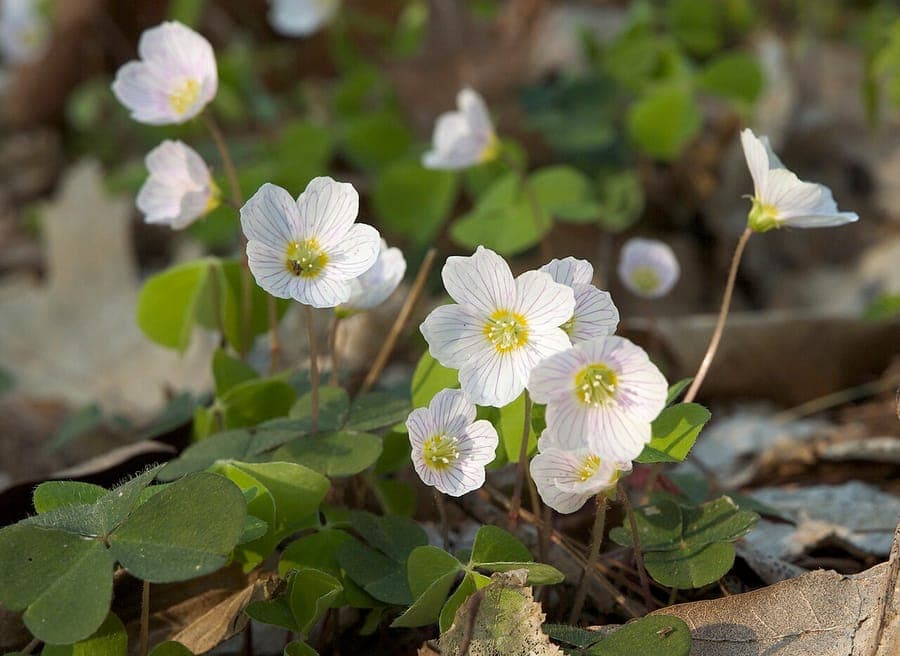
Jörg Hempel / CC BY-SA 3.0 de, via Wikimedia Commons
Oxalis acetosella: complete guide
Oxalis acetosella
¿Quieres ver Oxalis acetosella: complete guide en tu jardín?
1 minuto, sin tarjeta de crédito
Overview
Oxalis acetosella, better known as Irish shamrock, wood sorrel, or shamrock, is a delicate low-growing plant from the Oxalidaceae family. This plant grows naturally in temperate forests from Europe to Japan and North Africa. In Ireland, it is the national symbol and is often used in folklore and traditions.
Oxalis acetosella distinguishes itself through its characteristic three-lobed leaves, which resemble a three-leaf clover. The plant is very slow-growing and forms dense mats in shaded woodland areas. The bloom is delicate and elegant, with white or soft pink flowers. It's a perfect plant for shade gardens and forest understory.
Appearance and Bloom
The leaves of Oxalis acetosella are wavy and have three distinct lobes, each with a characteristic heart shape. They are dark green and sometimes speckled with red or purple tints. The leaves are also photosensitive: they fold closed when it gets dark or if you touch them.
Flowering takes place from April to May. The flowers are small, about 1 centimeter across, with five white or pale pink petals and dark veins. After flowering, small seed pods form, which explosively open when ripe, which is an interesting phenomenon.
Ideal Location
Oxalis acetosella grows perfectly in full shade to partial shade. The plant prefers locations under trees, in woodland environments, or on the north side of buildings. The plant grows best with less than two hours of direct sunlight. In too-sunny spots, the plant will suffer.
The plant grows naturally in woodland environments with plenty of humus and moist soil, so place it where you want to create a natural forest environment.
Soil
Oxalis acetosella grows on slightly acidic soil, rich in organic matter. A pH of 5.5 to 6.5 is ideal. The soil should be moisture-retaining but not waterlogged. Add plenty of humus or peat moss. Heavy clay soil should be worked with sand and organic matter.
Preparation: Mix in at least 30% organic matter, such as peat moss, leaf mold, or rotted leaves. This imitates the natural forest floor where Oxalis thrives.
Diseño gratis
¿Quieres ver Oxalis acetosella: complete guide en tu jardín? Crea un diseño gratis ahora.
Watering
Keep the soil evenly moist, especially during the growing season (March to September). During dry periods, you can water weekly. Ensure the soil never dries out completely. In winter, it can be slightly drier, but not completely dry.
Avoid waterlogging. A mulch layer of several centimeters helps improve moisture retention.
Pruning
Oxalis acetosella requires no pruning. The plant grows slowly and naturally forms neat, dense mats. Carefully remove dead leaves in spring. This is really all that's needed.
The plant will die back to ground level in winter, which is normal. Remove dead parts in spring.
Maintenance Calendar
Spring (March-May): Plant awakens from winter dormancy. Add mulch. Water regularly. Summer (June-August): Enjoy the bloom. Ensure constant moisture. Autumn (September-October): Plant enters dormancy. Gradually reduce water. Winter (November-February): Plant is dormant. Give minimal water. Protect from snow if needed.
Winter Hardiness
Oxalis acetosella is extremely winter-hardy. The plant can withstand temperatures down to -30 degrees Celsius. In almost all of Europe, it grows without protection. The plant will die back to ground level in winter, but the root system remains alive and returns every spring.
Companion Plants
Oxalis acetosella combines well with other woodland plants such as ferns, anemones, and other low-growing forest understory. The plant also grows well with moss, creating a natural forest effect.
Oxalis acetosella attracts insects and provides food for certain animals. It is valuable for the forest ecosystem.
Conclusion
Oxalis acetosella is a special plant for years of shade enjoyment. With its charming flowers and fascinating leaves, it deserves a place in any woodland-style garden. It grows well in almost all of Europe and requires minimal maintenance.
Want to read more guides? Visit gardenworld.app for comprehensive information about diverse woodland plants and shade-lovers.
Visit gardenworld.app for more plant guides and gardening tips. Discover thousands of plant profiles and make your garden dreams come true.
¿Quieres ver Oxalis acetosella: complete guide en tu jardín? Crea un diseño gratis ahora.
Sube una foto, elige un estilo y obtén un diseño fotorrealista con lista de plantas en menos de un minuto.
Más de 10.000 jardines diseñados
Sin tarjeta de crédito


Plantas similares
Oxalis incarnata: complete guide
Oxalis incarnata
Discover the charming lilac oxalis for your front garden. Full growing guide, care tips and design ideas for this delicate summer bloomer.
Oxalis valdiviensis: complete guide
Oxalis valdiviensis
Learn how to grow Chilean yellow-sorrel with location, soil, watering and care tips. An elegant yellow-flowering ornamental.
Lifeplant: complete guide
Biophytum sensitivum
Lifeplant is a fascinating houseplant with sensitive leaves that fold when touched. Discover how to grow this tropical wonder and where to find it.