
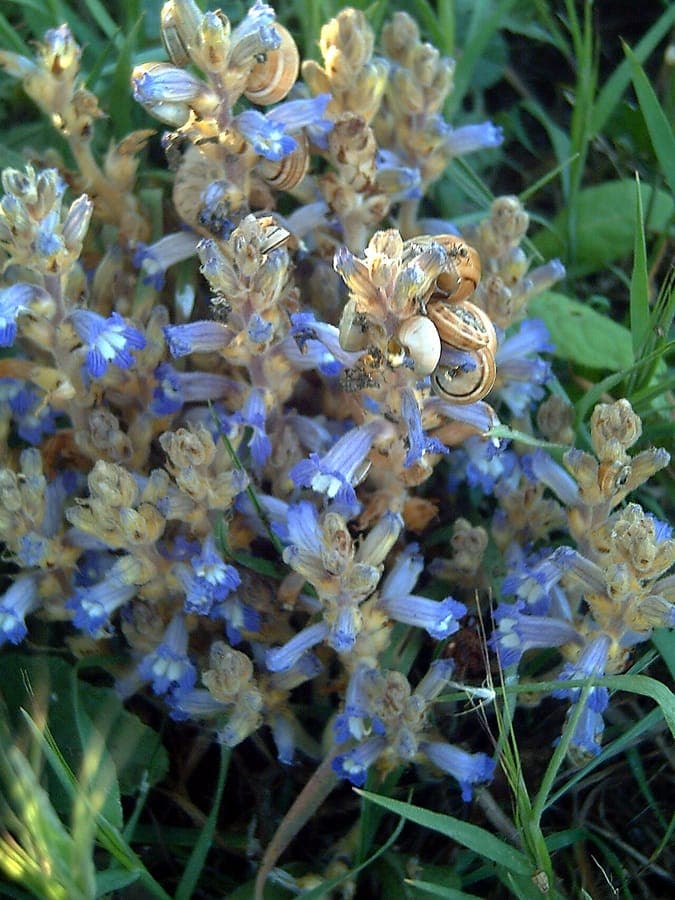
Javier martin / Public domain, via Wikimedia Commons
Hemp broomrape: complete guide
Orobanche ramosa
¿Quieres ver Hemp broomrape: complete guide en tu jardín?
1 minuto, sin tarjeta de crédito
Overview
Hemp broomrape (Orobanche ramosa) is a remarkable parasitic plant native to Mediterranean regions and North Africa. This unique organism reaches 20-40 centimeters in height and lives entirely as a root parasite on host plants. A fascinating study in plant ecology and evolutionary adaptation.
Appearance and Bloom
The plant completely lacks chlorophyll and displays pale to yellowish-brown coloration. It has no true leaves, only scale-like structures along the stems. Flowers appear May through July, densely arranged in a spike-like inflorescence. The small flowers range from yellow to brownish with purple tinges. Seed capsules contain thousands of minute seeds.
Ideal Location
Hemp broomrape naturally occurs wherever suitable host plants grow. In wild situations, it parasitizes hemp, flax, and other cultivated crops. Best observed in natural vegetation where wildness prevails, for botanical study purposes.
Soil
As a parasite, this plant has no direct soil preference but follows host plant requirements. Warm, well-draining soils with basic pH favor host establishment. Light sandy soils with limestone content provide optimal conditions for observation.
Diseño gratis
¿Quieres ver Hemp broomrape: complete guide en tu jardín? Crea un diseño gratis ahora.
Watering
Watering is not applicable as this is a parasitic organism. The plant extracts all water through haustorial connections from the host plant. Soil moisture regulation affects both organisms simultaneously.
Pruning
Pruning is impossible and undesirable. As a wild plant, its natural growth cycle should be respected. After flowering and seed production, above-ground parts naturally wither.
Maintenance Calendar
APRIL-MAY: Seed germination against host root. MAY-JULY: Flowering and reproduction. AUGUST-SEPTEMBER: Seed dispersal. OCTOBER-MARCH: Winter dormancy in soil.
Winter Hardiness
Hemp broomrape survives temperate winters through dormant seeds in soil. In the UK and northern Europe, growth occurs where host plants naturalize. Fully natural populations remain uncommon.
Companion Plants
In natural contexts, parasitizes flax, hemp, and brassica-family plants. No true companion relationships exist, but ecological interactions are fundamental. Observable in wildflower reserves and untended gardens.
Closing
Hemp broomrape represents a botanical curiosity and framework for understanding parasitism in the plant kingdom. Its unique ecology makes it of great interest to naturalists. Discover more about unusual plant ecology on gardenworld.app.
¿Quieres ver Hemp broomrape: complete guide en tu jardín? Crea un diseño gratis ahora.
Sube una foto, elige un estilo y obtén un diseño fotorrealista con lista de plantas en menos de un minuto.
Más de 10.000 jardines diseñados
Sin tarjeta de crédito


Plantas similares
Northwestern Indian paintbrush: complete guide
Castilleja angustifolia
All about Castilleja angustifolia, the northwestern Indian paintbrush from dry western US steppes. Growing, care, and companion plant advice.
Wavyleaf Indian paintbrush: complete guide
Castilleja applegatei
Everything about Castilleja applegatei, the wavyleaf paintbrush from Oregon and California. Host plants, care, location, and garden use covered.
Bushy bird's-beak: complete guide
Cordylanthus ramosus
Complete guide to Cordylanthus ramosus, the hemiparasitic annual of western US steppes: ecology, host plants, cultivation and uses.