
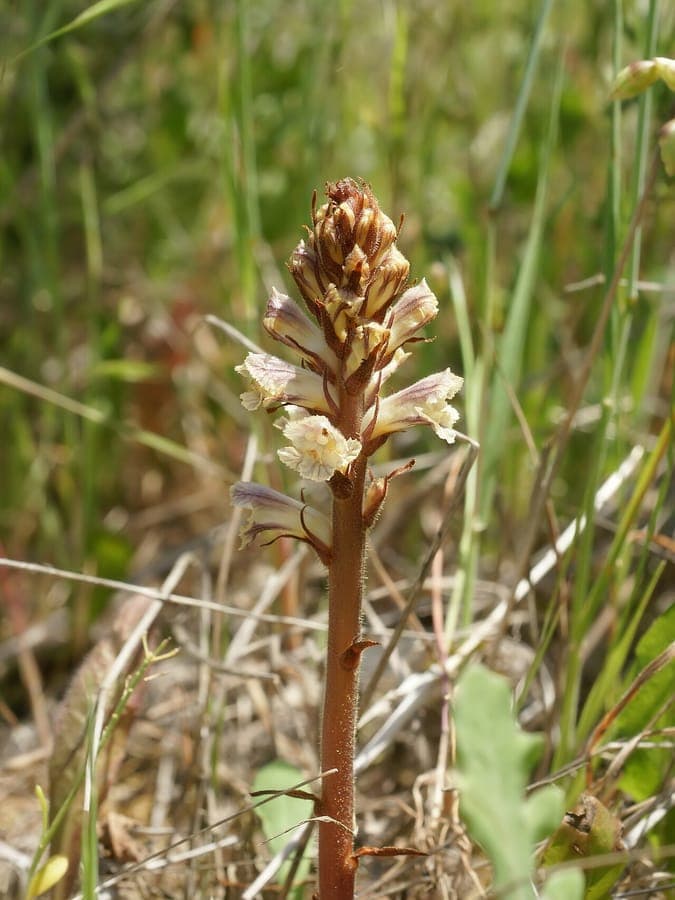
(Hans Hillewaert) / CC BY-SA 3.0, via Wikimedia Commons
Orobanche crenata: complete guide
Orobanche crenata
¿Quieres ver Orobanche crenata: complete guide en tu jardín?
1 minuto, sin tarjeta de crédito
Overview
Orobanche crenata, commonly known as bean broomrape or crenate broomrape, is a fascinating parasitic plant from the Orobanchaceae family. Unlike normal plants, this species is completely dependent on host plants such as beans, legumes and other crops. Although it has no green pigmentation (no photosynthesis), it is botanically interesting and has agricultural significance.
This plant grows naturally in the Mediterranean region and is considered a significant problem in agricultural areas. In wild garden contexts, however, it is an ecologically interesting phenomenon that is part of complex plant ecosystems.
Appearance and bloom
Orobanche crenata is a remarkable plant that emerges from the soil through the roots of host plants. The plant usually reaches 30-50 centimeters in height and has a yellow-brown to purplish color with no green parts - a characteristic consequence of its parasitic nature.
The stem is stiff, succulent and covered with scale-like leaves. The flowers are the most striking feature - small, cream-white to slightly purplish flowers, approximately 10-15 millimeters long, grouped in cluster-like inflorescences at the top of the plant. They bloom from April to June.
Host plants
Orobanche crenata parasitizes various host plant species, with Vicia faba (broad beans) being the most susceptible. Other hosts include peas, lentils, alfalfa and various legumes. The plant senses the chemical signals of the host and grows toward it.
Once connected with the host, the parasite extracts water and nutrients from the host's root system, resulting in weak growth and reduced yield.
Diseño gratis
¿Quieres ver Orobanche crenata: complete guide en tu jardín? Crea un diseño gratis ahora.
Prevention and management
In agricultural contexts, prevention is better than management. Practices to avoid Orobanche crenata include growing resistant crops, crop rotation, and using clean seed. Where the plant is present, manual pulling can help, although this is labor-intensive.
From an ecological perspective: in wild habitats, this plant is part of the plant community and contributes to biodiversity, although it is not a desirable plant in gardens where legumes are grown.
In horticulture
For home gardeners, Orobanche crenata is usually not problematic unless you grow beans, peas or lentils intensively. Where it does appear, it can be removed by carefully digging out host plants, carefully removing all roots.
Rotation to non-host crops for 1-2 years can reduce populations.
Evolutionary significance
Orobanche crenata shows fascinating evolutionary adaptations. The plant can remain dormant underground for thousands of years as a seed bank, waiting for the right host. When a suitable host grows nearby, the seed germinates.
Garden ecology
Although not suitable for normal gardening purposes, Orobanche crenata is interesting to researchers and botanists studying ecosystem complexity and plant interactions. In botanical gardens it can be studied under controlled conditions.
Conclusion
Orobanche crenata is a unique plant that reminds us of the complexity of plant ecosystems and parasitic relationships. For most gardeners, familiarity with this plant is more of an academic interest than a practical concern. In agricultural areas where beans are grown, prevention and monitoring are important. At gardenworld.app, we can help identify parasitic plant problems and recommend appropriate management strategies.
¿Quieres ver Orobanche crenata: complete guide en tu jardín? Crea un diseño gratis ahora.
Sube una foto, elige un estilo y obtén un diseño fotorrealista con lista de plantas en menos de un minuto.
Más de 10.000 jardines diseñados
Sin tarjeta de crédito


Plantas similares
Northwestern Indian paintbrush: complete guide
Castilleja angustifolia
All about Castilleja angustifolia, the northwestern Indian paintbrush from dry western US steppes. Growing, care, and companion plant advice.
Wavyleaf Indian paintbrush: complete guide
Castilleja applegatei
Everything about Castilleja applegatei, the wavyleaf paintbrush from Oregon and California. Host plants, care, location, and garden use covered.
Bushy bird's-beak: complete guide
Cordylanthus ramosus
Complete guide to Cordylanthus ramosus, the hemiparasitic annual of western US steppes: ecology, host plants, cultivation and uses.