
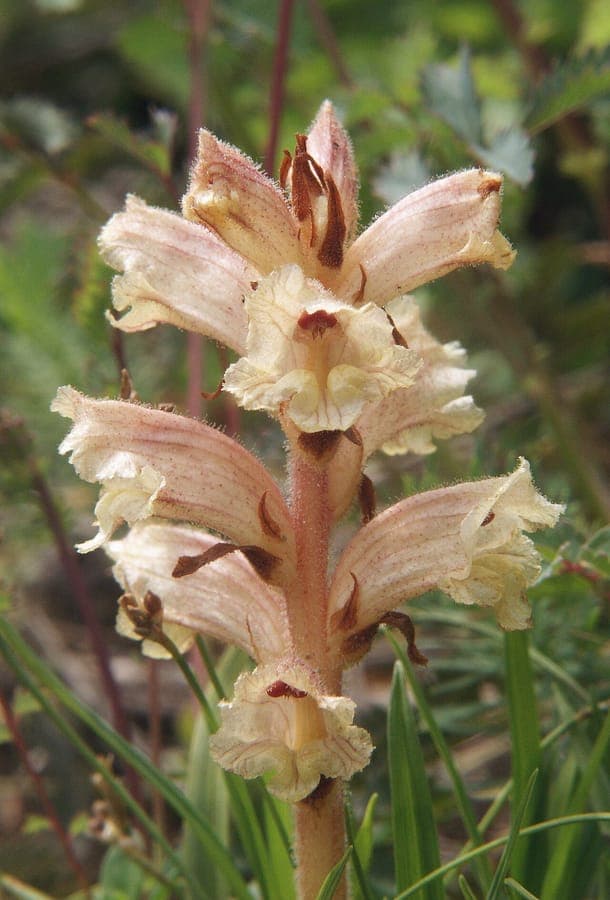
Bernd Haynold / CC BY 2.5, via Wikimedia Commons
White broomrape: complete guide
Orobanche alba
¿Quieres ver White broomrape: complete guide en tu jardín?
1 minuto, sin tarjeta de crédito
Overview
White broomrape (Orobanche alba) is a fascinating parasitic plant from Europe through the Himalayas to China. This member of the Orobanchaceae family blooms from May through June with delicate, cream-white to light pink flowers featuring red details.
The plant is no ordinary green plant - it's completely parasitic on host plant roots, especially thyme (Thymus) and thistles (Cirsium). As it lacks chlorophyll, it's a remarkable botanical rarity for specialized botanical enthusiasts.
Appearance & bloom
White broomrape is unusual: a leafless shoot consisting of stems growing directly from the ground. The plant reaches 15 to 50 centimeters tall with a light brownish, fleshy appearance.
Flowers are small, delicately cream-white to light pink with red spots and pistil details. They appear in loose, spike-like clusters. Flowering spans May through June. This plant lives entirely on parasitic host plant roots, forming no independent green parts.
Ideal location
White broomrape grows where host plants (thyme, thistles) occur. The plant flowers better in sunny, warm locations with abundant thyme or wild thistles nearby.
Do not plant it directly - the plant establishes itself naturally where host plant roots provide sustenance. Natural heathlands and dry grasslands with abundant thistles are ideal habitats.
Soil
White broomrape makes minimal soil demands, provided host plants are present. Dry, lean soil is preferred, where thyme and thistles thrive.
Sand, gravel, and light, nutrient-poor soils are ideal. The plant struggles on heavy, fertile clay where parasitic establishment is difficult.
Watering
Watering white broomrape itself makes no sense - the parasitic plant derives all moisture from host plants. Ensure healthy thyme and thistles through regular maintenance.
Watering host plants during dry periods indirectly supports white broomrape growth. Once established, the plant requires no extra care.
Diseño gratis
¿Quieres ver White broomrape: complete guide en tu jardín? Crea un diseño gratis ahora.
Maintenance
Maintaining white broomrape primarily means protecting its host plants. Ensure thyme and thistles remain healthy.
Remove other parasites or diseases affecting host plants. Leave faded flowers to enable seed development. The plant spreads naturally.
Maintenance calendar
January-April: Seed can germinate on host plants May-June: Flowering on parasites June-July: Seed formation July-August: Seed set complete August-September: Plant dies back October-December: Seeds overwinter in soil Year-round: Monitor host plant health
Winter hardiness
White broomrape is hardy to -20 degrees Celsius. Seeds survive all European winters easily. Once established, the plant returns reliably year after year.
The parasite occurs throughout Europe, from the Netherlands through Russia to the Himalayas.
Companion plants
White broomrape almost exclusively infects thyme (Thymus vulgaris, T. serpyllum) and wild thistles (Cirsium vulgare). The parasite strongly selects these hosts.
In natural heathlands and grasslands with wild thyme and thistles, it cares for itself. The parasite helps maintain natural balance in host populations.
In conclusion
White broomrape (Orobanche alba) is a botanical rarity and parasite occurring naturally in dry, lean terrains with thyme and thistles. Those interested in unusual parasitic plants can observe this species in wild heathlands.
Directly purchasing white broomrape seed may be difficult due to its obligate parasitic nature. It establishes spontaneously where host plants are abundant. Visit gardenworld.app for ideas on natural gardens featuring wild parasites.
Directly purchasing white broomrape seed may be difficult due to its obligate parasitic nature. It establishes spontaneously where host plants are abundant. Visit gardenworld.app for ideas on natural gardens featuring wild parasites.
¿Quieres ver White broomrape: complete guide en tu jardín? Crea un diseño gratis ahora.
Sube una foto, elige un estilo y obtén un diseño fotorrealista con lista de plantas en menos de un minuto.
Más de 10.000 jardines diseñados
Sin tarjeta de crédito


Plantas similares
Northwestern Indian paintbrush: complete guide
Castilleja angustifolia
All about Castilleja angustifolia, the northwestern Indian paintbrush from dry western US steppes. Growing, care, and companion plant advice.
Wavyleaf Indian paintbrush: complete guide
Castilleja applegatei
Everything about Castilleja applegatei, the wavyleaf paintbrush from Oregon and California. Host plants, care, location, and garden use covered.
Bushy bird's-beak: complete guide
Cordylanthus ramosus
Complete guide to Cordylanthus ramosus, the hemiparasitic annual of western US steppes: ecology, host plants, cultivation and uses.