
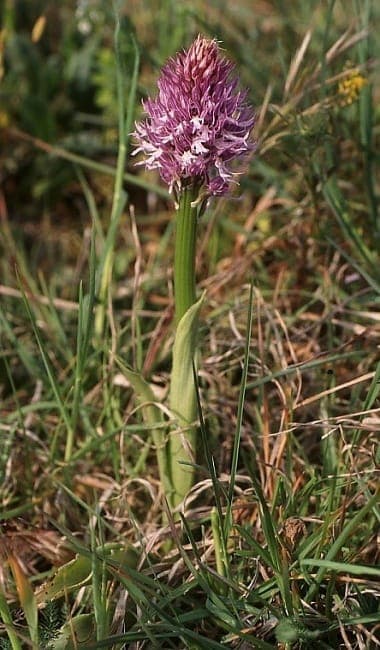
Wikimedia Commons / CC BY-SA 3.0, via Wikimedia Commons
Italian Orchid: complete guide
Orchis italica
¿Quieres ver Italian Orchid: complete guide en tu jardín?
1 minuto, sin tarjeta de crédito
Overview
The Italian Orchid (Orchis italica) is an enchanting terrestrial orchid native to Mediterranean regions of southern Europe, North Africa, and the Middle East. This plant is famous for its unusual flowers that resemble naked human figures with waving arms and legs. These are terrestrial orchids that grow on dry slopes and rocky ground.
Orchis italica belongs to the Family Orchidaceae and is a horticultural treasure for those experimenting with wild orchids. This plant creates a truly spectacular focal point in spring gardens.
Appearance and Bloom
The plant reaches up to 60 centimeters with narrow, grey-green leaves arranged in basal rosettes. The flowers are the most spectacular feature: they are pink to purple with subtle white markings that resemble human figures. Each flower has two long, thin projections resembling arms.
The blooming period lasts from March to May, depending on region and weather. The flowers are erect and vertically arranged in dense spikes. After flowering, the plant produces seed pods containing thousands of tiny seeds.
This orchid is tuberous and exhibits strong seasonal dormancy. In summer, the plant becomes dormant and loses all above-ground parts.
Ideal Location
Orchis italica grows best in sunny, open spots with good drainage. The plant loves slopes and rocky surfaces. Full sun for at least 6 hours daily is essential.
The plant is very hardy and thrives on bare, dry locations. In Mediterranean gardens, place this orchid on open hillsides or in rock gardens. Avoid shading from trees or shrubs.
On gardenworld.app we suggest combining this plant with other drought-loving species. Plant on sloping terrain where water drains quickly.
Soil
Orchis italica demands well-draining, mineral-rich soil. The plant prefers poor soils (not nutrient-rich). A mixture of stone, gravel, and some potting soil works perfectly.
The ideal pH range is between 6.0 and 7.5. Do not add organic matter unless absolutely necessary. The plant requires extremely good drainage; water must never pool around tubers.
When planting in containers, use specialist orchid mix with plenty of gravel and perlite. Ensure pots have drainage holes for optimal drainage.
Diseño gratis
¿Quieres ver Italian Orchid: complete guide en tu jardín? Crea un diseño gratis ahora.
Watering
Watering is critical: too much water causes tuber rot. Water only when soil feels dry. In summer when the plant is dormant, give virtually no water.
During the growing period (October to March), water carefully, only when needed. The plant prefers drier conditions than most other garden plants. Water at the base, not on foliage.
On gardenworld.app we warn that Orchis italica is very sensitive to overwatering. This is usually the cause of failure.
Pruning
This orchid does not require pruning. After flowering, the plant naturally disappears back underground. Remove dead flower stems carefully in summer.
Handle the plant gently to avoid damaging the underground tuber. Do not cut anything hard; let foliage naturally die back.
Maintenance Calendar
January-March: Peak bloom time. Monitor for pests. Do not fertilize. April-May: Blooming ends. Begin reducing water. June-September: Plant is fully dormant. Almost no water. Protect tubers. October-December: Growth begins again. Water slowly.
Winter Hardiness
Orchis italica is very hardy to -15 degrees Celsius. The tubers can stay outside and survive severe winters in Northern Europe. In very cold regions protect tubers with mulch against extreme frost damage.
A thick layer of dry leaves or gravel over the planting bed helps insulate. The plant grows well only after experiencing a cold winter period. This is essential for flowering.
Companion Plants
Combine Orchis italica with other Mediterranean wildflowers such as Tulipa, Narcissus, and Fritillaria. These combinations create beautiful spring displays.
On gardenworld.app we recommend planting this orchid with succulents and grey-leaved plants. Ensure good drainage around all plants.
Closing
The Italian Orchid is an enchanting, uncommon orchid for those who love something unique. Although it has specific care needs, it is likely worth it for the beautiful flowers. With proper drainage and underwatering habits, you will successfully grow this rare orchid.
Find wildflower seeds through specialized suppliers. Try this fascinating plant today on gardenworld.app!
¿Quieres ver Italian Orchid: complete guide en tu jardín? Crea un diseño gratis ahora.
Sube una foto, elige un estilo y obtén un diseño fotorrealista con lista de plantas en menos de un minuto.
Más de 10.000 jardines diseñados
Sin tarjeta de crédito


Plantas similares
Ram's-head lady's slipper: complete guide
Cypripedium arietinum
Everything you need to know about growing Cypripedium arietinum, a rare woodland orchid for cool, moist garden settings. Soil, care and planting tips.
Sparrow's-egg lady's slipper: complete guide
Cypripedium passerinum
Everything about growing Cypripedium passerinum, a cold-hardy subarctic orchid suited to cool, moist, shaded garden spots. Soil, care and companion plants.
Algerian Butterfly-orchid: complete guide
Platanthera algeriensis
Everything about Platanthera algeriensis, the rare Mediterranean orchid with greenish flowers native to Algeria, Morocco, Corsica and Spain.