
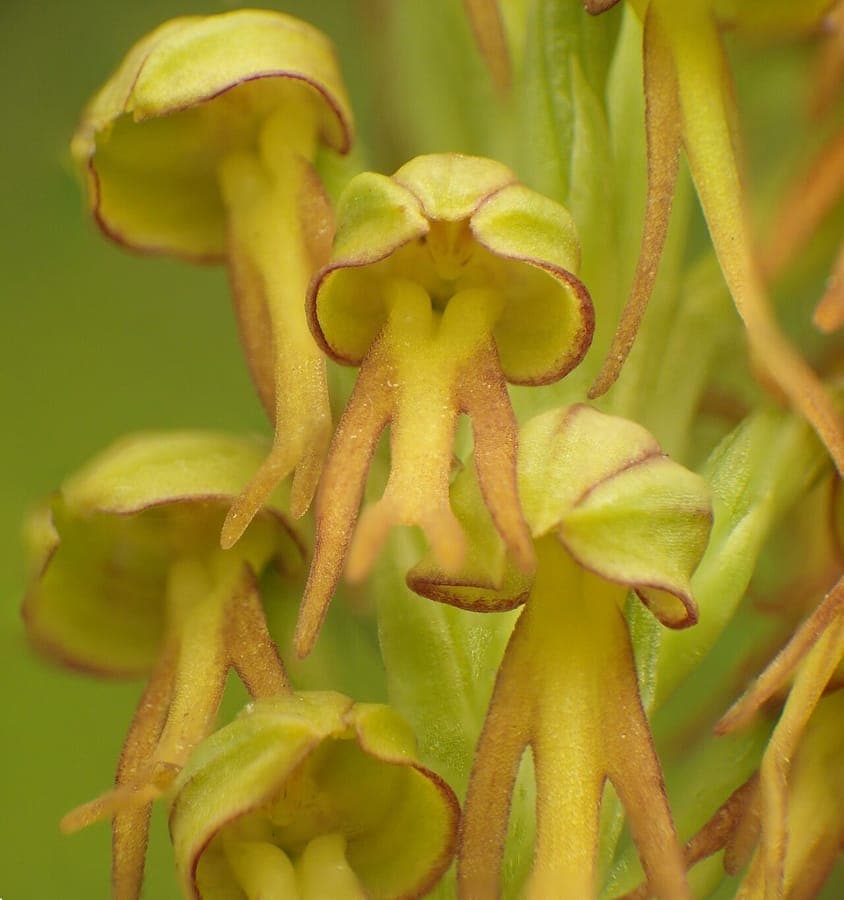
ErwinMeier / CC BY-SA 3.0, via Wikimedia Commons
Orchis anthropophora: complete guide
Orchis anthropophora
¿Quieres ver Orchis anthropophora: complete guide en tu jardín?
1 minuto, sin tarjeta de crédito
Overview
Orchis anthropophora, commonly known as the man orchid, man-in-the-ground orchid or human orchid, is an extraordinary and completely unique wild orchid of the genus Orchis. This orchid belongs to the Orchidaceae family and grows naturally in dry, lime-rich grasslands from western Europe to the Mediterranean region. The plant owes its name to the fact that its individual flowers bear a remarkable resemblance to human figures - at least in the eyes of nature-loving garden designers.
The man orchid is unique among orchids for its very special flower structure: rather than having single large flowers on a stem, this orchid bears dense clusters of many small flowers that together form a human-like silhouette. This phenomenon, which reaches to mythological meanings in garden history, makes the man orchid a botanical curiosity of the highest order.
On gardenworld.app you can easily design a unique wildflower garden where this mythologically fascinating orchid takes centre stage alongside other Mediterranean native plants.
Appearance and bloom
Orchis anthropophora is a relatively small orchid from 15 to 40 centimetres tall. The plant grows from underground tubers and initially forms a compact rosette of green leaves. The leaves are lanceolate to elongate, approximately 8 to 15 centimetres long, and form an attractive basal rosette in the first growing year.
What truly makes the man orchid unique is its inflorescence. Rather than having single large flowers, the plant bears a dense, compact cluster of very many small flowers packed closely together. Each individual flower is small, only a few millimetres, but the cluster together forms a silhouette that very closely resembles a stylised human figure: the top of the cluster represents the head and arms, while the lower flowers represent the legs.
The flowers have a subtle colour, usually reddish-brown to purplish-brown with some lighter spots. Blooming occurs from April to May.
Ideal location
Orchis anthropophora thrives best in sunny to semi-shaded locations with at least 4 to 6 hours of direct sunlight. The plant grows on dry, open grasslands with well-drained soil. Half-shade is tolerated, but full shade is not suitable.
In a garden you look for warm, sunny spots on slopes or in places where water drains well. The plant feels at home in Mediterranean-like locations with plenty of sunlight.
Soil requirements
The man orchid is very lime-loving and thrives best on neutral to highly lime-rich soils. The plant grows poorly on acidic soils. Ideal soils are dry, lime-rich grassland soils with plenty of stones or sand mixture. The plant feels at home on nutrient-rich soils, but fertiliser overdose can disrupt blooming.
Perfect drainage is essential. Moisture-rich soils are unsuitable for this plant.
Diseño gratis
¿Quieres ver Orchis anthropophora: complete guide en tu jardín? Crea un diseño gratis ahora.
Watering
Orchis anthropophora is a very drought-tolerant plant. Once established, the plant requires virtually no supplementary water. The plant has a deep root system and can survive long periods without water. In the first growing year some extra water can be beneficial until the plant is well established.
However, ensure the soil never becomes wet or waterlogged; this significantly increases the risk of root rot.
Pruning and maintenance
Orchis anthropophora is very low-maintenance. After flowering, faded flower clusters can be carefully cut off at the base of the plant. After the growing season the above-ground foliage dies back, which happens naturally.
The underground tubers remain in the soil for the next season. The plant requires no further pruning or maintenance.
Maintenance calendar
March-April: Young leaf rosettes appear. April-May: Flowering; enjoy the unique flower clusters. June-September: Foliage shedding; foliage yellows and disappears. October-February: Winter dormancy; little activity.
Winter hardiness
Orchis anthropophora is very hardy down to approximately -15 to -20 degrees Celsius. The underground tubers survive heavy frosts without problem. The plant is adapted to normal European winters and requires no protection.
Plant companions
The man orchid combines well with other native, drought-tolerant wildflowers. Perfect partners include:
- Sanguisorba minor (small salad burnet): same lime-rich preference
- Veronica incana (silver speedwell): same dry environment
- Origanum vulgare (oregano): same Mediterranean-like preference
- Helianthemum nummularium (sun-rose): same dry location
- Poterium sanguisorba (blood-drop-embilic): similar architecture
A Mediterranean-style wildflower garden design works ideally for this orchid.
Propagation
Propagation from seed is very difficult in cultivation; seed requires special mycorrhizal fungi. Most enthusiasts obtain plants from specialised nurseries.
Tuber division is possible but is not recommended as it damages the plant.
Closing
Orchis anthropophora is an extraordinary special wild orchid that deserves more attention in careful garden design. With its unique, human-like flower clusters, the man orchid forms a true curiosity and a classic botanical reference.
Want to include the man orchid in your garden? On gardenworld.app you can easily design a unique Mediterranean wildflower garden where this fascinating orchid takes centre stage.
¿Quieres ver Orchis anthropophora: complete guide en tu jardín? Crea un diseño gratis ahora.
Sube una foto, elige un estilo y obtén un diseño fotorrealista con lista de plantas en menos de un minuto.
Más de 10.000 jardines diseñados
Sin tarjeta de crédito


Plantas similares
Ram's-head lady's slipper: complete guide
Cypripedium arietinum
Everything you need to know about growing Cypripedium arietinum, a rare woodland orchid for cool, moist garden settings. Soil, care and planting tips.
Sparrow's-egg lady's slipper: complete guide
Cypripedium passerinum
Everything about growing Cypripedium passerinum, a cold-hardy subarctic orchid suited to cool, moist, shaded garden spots. Soil, care and companion plants.
Algerian Butterfly-orchid: complete guide
Platanthera algeriensis
Everything about Platanthera algeriensis, the rare Mediterranean orchid with greenish flowers native to Algeria, Morocco, Corsica and Spain.