
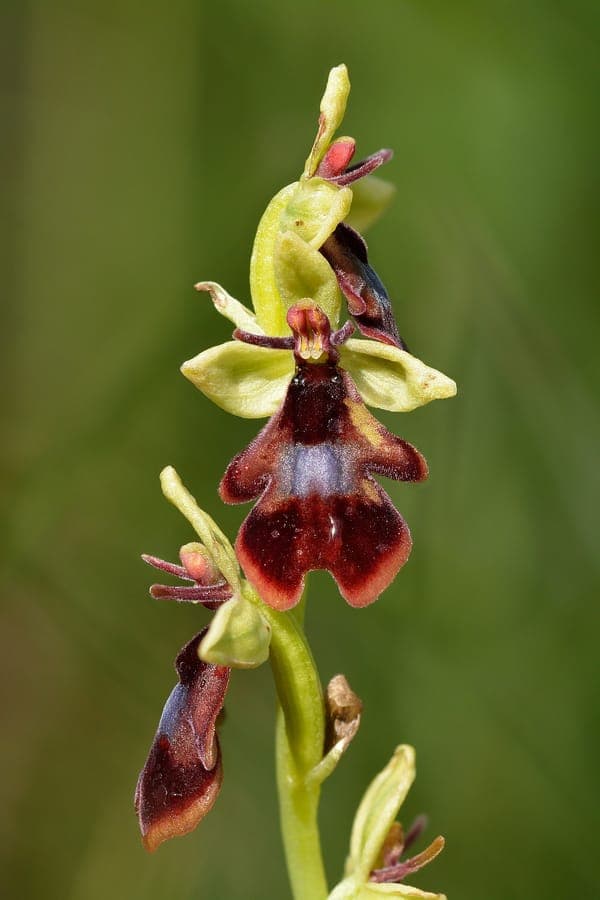
Ivar Leidus / CC BY-SA 4.0, via Wikimedia Commons
Ophrys insectifera: complete guide
Ophrys insectifera
¿Quieres ver Ophrys insectifera: complete guide en tu jardín?
1 minuto, sin tarjeta de crédito
Overview
Ophrys insectifera, commonly known as the fly orchid or insect-bearing orchid, is an elegant and intriguing small wild orchid that grows in dry, lime-rich grasslands and slopes across Europe. This orchid belongs to the same genus as the better-known bee orchid, but uses a completely different biological trick: rather than mimicking bees, this plant imitates female flies of the genus Empis to attract its pollinators.
The fly orchid is a subtler and more delicate orchid than its bee-pollinating cousin. With its slender growth form, fine flower structure and fascinating pollination mechanism, the fly orchid forms a true jewel for nature-loving garden designers. On gardenworld.app you can easily design a wildflower garden where this special orchid thrives alongside other native flowering plants.
Appearance and bloom
Ophrys insectifera is a small, slender orchid from 15 to 40 centimetres tall. Like other Ophrys species, the plant grows from an underground tuber and initially forms only a leaf rosette before flowering. The leaves are linear to lanceolate, approximately 8 to 12 centimetres long, dark green and form a compact basal rosette.
The inflorescence bears only a few, usually 2 to 8 flowers that are widely spaced on a thin, elegant flower stem. This gives the plant a very refined and graceful appearance. The flowers themselves are small, only about 10 to 12 millimetres, with green to reddish-brown sepals. The labellum (the lip) is dark brown to black, with a glossy surface that suggests an insect-like sheen, and has two yellow or white spots at the base.
Blooming occurs from April to June, depending on location and altitude.
Ideal location
Ophrys insectifera thrives best in sunny locations with at least 6 hours of direct sunlight per day. The plant grows on open, dry grasslands and slopes where the soil can drain well. Half-shade is tolerated, but full shade is not suitable.
In a garden you look for warm, sunny spots with well-drained soil. Walls or buildings facing south can provide extra warmth that the plant likely appreciates. The plant is very drought-tolerant and feels at home in warm, steep locations.
Soil requirements
The fly orchid is very lime-loving and grows best on neutral to lime-rich soils. The plant thrives poorly on acidic soils. Ideal soils are dry, lime-rich grassland soils with lots of scree or gravel. Moisture-rich soils are not suitable; the plant requires perfect drainage.
The plant grows on nutrient-rich soils, but too much fertiliser stimulates leaf growth at the expense of flowering. A mixture of sand, gravel, lime and some leaf mould works ideally.
Diseño gratis
¿Quieres ver Ophrys insectifera: complete guide en tu jardín? Crea un diseño gratis ahora.
Watering
Ophrys insectifera is a very drought-tolerant plant. Once established, the plant requires virtually no supplementary water. The plant has a deep root system and can survive long periods without water. In the first growing year some extra water can be beneficial until the plant is well established, but ensure the soil never becomes waterlogged.
In fact, too much water is more harmful than beneficial for this plant; it significantly increases the risk of root rot.
Pruning and maintenance
Ophrys insectifera is very low-maintenance. After flowering, faded inflorescences can be carefully cut off. After the flowering growing season, the foliage naturally dies back, and this need not be cut until it is completely withered.
The plant does not form runners or unwanted growth and requires no pruning. The underground tuber remains undisturbed in the soil.
Maintenance calendar
March-April: Young leaf rosettes appear. May-June: Flowering; enjoy the elegant blooms. July-October: Foliage shedding; foliage disappears. November-February: Winter dormancy; no activity.
Winter hardiness
Ophrys insectifera is very hardy down to approximately -20 degrees Celsius. The underground tuber completely survives heavy frosts. The plant is adapted to cold winters and requires no protection in typical Dutch and Belgian winters.
Plant companions
The fly orchid combines well with other native, drought-tolerant grassland plants. Perfect partners are:
- Festuca glauca (blue fescue): blue-grey colour contrasts nicely
- Sesleria caerulea (blue mountain grass): same dry preference
- Stipa pennata (feather grass): slender structure, same height
- Thymus serpyllum (wild thyme): same dry, sunny location
- Crocus vernus: early spring colour
- Colchicum autumnale: autumn blooms for seasonal interest
Propagation
Propagation of Ophrys insectifera from seed is very difficult in cultivation. Seed requires special mycorrhizal fungi to grow. Most people buy plants from specialised nurseries or observe the plant in its natural habitat.
Tuber division is possible but damages the plant and is not recommended.
Closing
Ophrys insectifera is an elegant and fascinating wild orchid that deserves more attention in careful garden designs. With its subtle flowers and refined form, this orchid adds botanical elegance to any garden where dry, lime-rich conditions exist.
Want to include the fly orchid in your garden? On gardenworld.app you can easily design a natural wildflower garden where this and other native orchids thrive.
¿Quieres ver Ophrys insectifera: complete guide en tu jardín? Crea un diseño gratis ahora.
Sube una foto, elige un estilo y obtén un diseño fotorrealista con lista de plantas en menos de un minuto.
Más de 10.000 jardines diseñados
Sin tarjeta de crédito


Plantas similares
Ram's-head lady's slipper: complete guide
Cypripedium arietinum
Everything you need to know about growing Cypripedium arietinum, a rare woodland orchid for cool, moist garden settings. Soil, care and planting tips.
Sparrow's-egg lady's slipper: complete guide
Cypripedium passerinum
Everything about growing Cypripedium passerinum, a cold-hardy subarctic orchid suited to cool, moist, shaded garden spots. Soil, care and companion plants.
Algerian Butterfly-orchid: complete guide
Platanthera algeriensis
Everything about Platanthera algeriensis, the rare Mediterranean orchid with greenish flowers native to Algeria, Morocco, Corsica and Spain.