
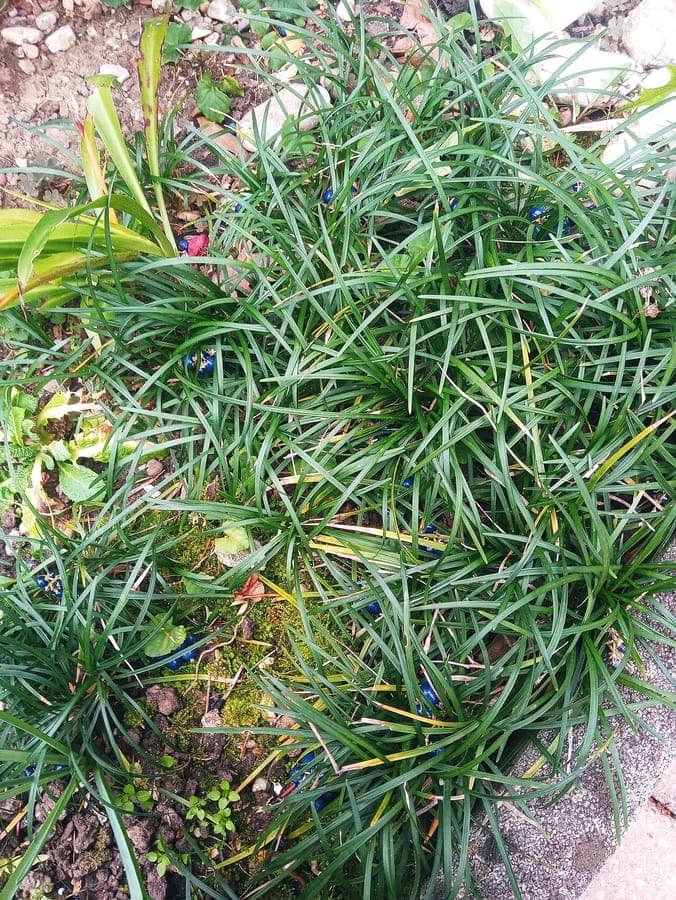
Shabicht / CC0, via Wikimedia Commons
Japanese lilyturf: complete guide for shaded ground covers
Ophiopogon japonicus
¿Quieres ver Japanese lilyturf: complete guide for shaded ground covers en tu jardín?
1 minuto, sin tarjeta de crédito
Japanese lilyturf (Ophiopogon japonicus) is a low ground cover originating from East Asia to Vietnam. This plant is renowned for its small, black fruits and its ability to grow in shade where many other plants struggle.
Overview
Ophiopogon japonicus is a dwarf plant naturally occurring from central and southern China to Vietnam. The plant grows only 20-30 cm tall and forms compact ground cover. It is an ideal choice for shady corners where nothing else grows.
Appearance and Blooming
The plant grows with narrow, grass-like, dark green leaves arranged in clusters. In spring, small lilac or white flowers appear on short stems. These flowers are followed by characteristic black fruits that provide excellent aesthetic value.
Ideal Location
This plant grows best in partial to full shade. It tolerates full sun but leaves can scorch in hot summers. Ideal for shady corners under trees or along hedges where little else grows.
Soil Composition
Ophiopogon japonicus grows optimally in humus-rich, well-draining soil. The plant tolerates diverse soil types but thrives best in slightly acid to neutral soil. Add compost for better growth.
Diseño gratis
¿Quieres ver Japanese lilyturf: complete guide for shaded ground covers en tu jardín? Crea un diseño gratis ahora.
Watering
Once established, this plant needs little water. Water regularly during the first growing season. Thereafter, water only in extreme drought. Excessive water must be avoided as it can cause root rot.
Pruning and Maintenance
Minimal pruning needed. Remove dead or damaged leaves in spring. The plant slowly spreads via underground rhizomes and naturally forms a dense carpet. Leave gnarled leaves intact for winter protection.
Maintenance Calendar
Spring: Clean dead leaves, add compost. Summer: Enjoy low growth and fruits. Autumn: Nothing special, plant grows slower. Winter: Plant stays green, no care needed.
Winter Hardiness
Ophiopogon japonicus is hardy to about -15 degrees Celsius. In milder climates, the plant stays green year-round. In colder regions, leaves may die and regrow in spring.
Companion Plants
Pair well with other shade plants like heartleaf and hostas. For texture: sedge and other ornamental grasses. Also combine with flowering shade plants like astilbe and heuchera for color contrast.
Closing Thoughts
Japanese lilyturf is the solution for difficult shady spots. This ground cover requires minimal care and looks interesting year-round. Find young plants at garden centers. Discover inspiration on gardenworld.app for shaded gardens with decorative ground covers and design ideas.
¿Quieres ver Japanese lilyturf: complete guide for shaded ground covers en tu jardín? Crea un diseño gratis ahora.
Sube una foto, elige un estilo y obtén un diseño fotorrealista con lista de plantas en menos de un minuto.
Sin tarjeta de crédito


Plantas similares
Narrow-leaved dracaena: complete guide
Dracaena angustifolia
Everything about Dracaena angustifolia - the narrow-leaved dracaena: location, care, overwintering and use as a houseplant or patio plant.
Chaparral yucca: complete guide to Hesperoyucca whipplei
Hesperoyucca whipplei
Hesperoyucca whipplei (Our Lord's candle) is a dramatic rosette-forming plant from California that produces a towering flower spike, ideal for dry and gravel gardens.
False lily-of-the-valley: complete guide
Maianthemum dilatatum
Everything about Maianthemum dilatatum, the false lily-of-the-valley. Care, shade location, propagation and garden combinations for this popular shade ground cover.