
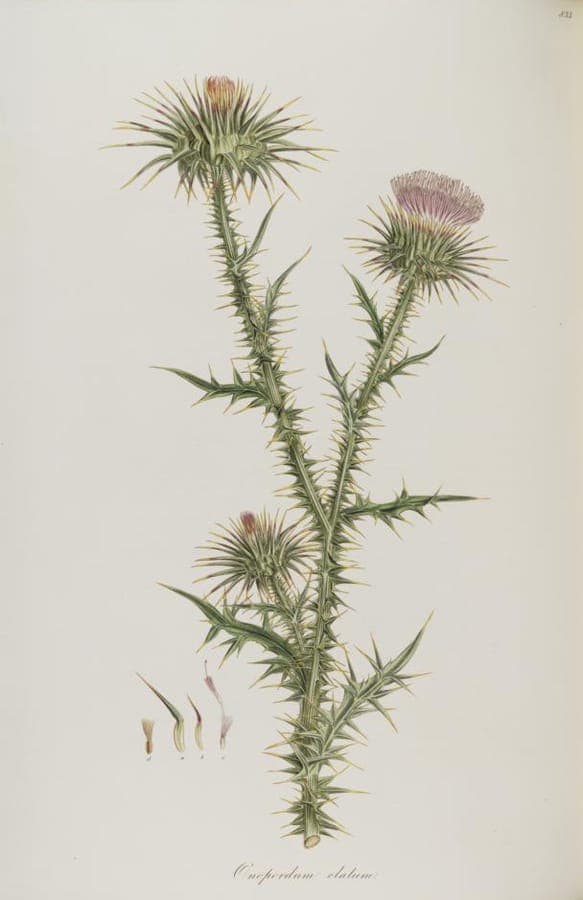
Oceancetaceen - Alice Chodura / Public domain, via Wikimedia Commons
Taurian thistle: complete guide for striking garden accents
Onopordum tauricum
¿Quieres ver Taurian thistle: complete guide for striking garden accents en tu jardín?
1 minuto, sin tarjeta de crédito
The Taurian thistle (Onopordum tauricum) is an impressive biennial plant originating from Europe to Turkey. This plant is renowned for its large, silvery leaves and striking purple flowers that attract many insects.
Overview
Onopordum tauricum is a robust biennial plant naturally occurring from Europe to Turkey. In the first year, the plant forms a leafy rosette; in the second year, a tall, branched flower stem rises that can reach 2 meters tall. This plant self-seeds prolifically.
Appearance and Blooming
The plant first grows low with large, silvery gray leaves. In the second year, tall stems form with many small purple flowers. Flowers appear from June to July. After flowering, the blooms produce numerous seeds.
Ideal Location
Choose a fully sunny spot with good visibility. The plant grows to 2 meters tall and makes a striking impression. Provide adequate space as the plant becomes quite broad. Protect from strong wind by planting near other plants.
Soil Composition
The Taurian thistle grows in virtually any soil type but thrives best in well-draining soil. The plant tolerates poor soil well and actually flowers better in less rich soils. Waterlogging must be avoided.
Diseño gratis
¿Quieres ver Taurian thistle: complete guide for striking garden accents en tu jardín? Crea un diseño gratis ahora.
Watering
Once established, this plant needs little water. Water only in extreme drought. The plant is very drought tolerant and tolerates poor moisture better than excessive wetness.
Pruning and Maintenance
Minimal care needed. The plant self-seeds prolifically, so remove spent flowers if you don't want much self-seeding. In subsequent years, self-seeding can be removed if unwanted.
Maintenance Calendar
Year 1, spring: Sow seeds or plant young plants. Summer: Water regularly during drought. Autumn: Plant continues growing. Year 2, spring: No maintenance needed. Summer: Enjoy flowers, seeds can drop. Autumn: Plan next generation.
Winter Hardiness
Onopordum tauricum is hardy to about -10 to -15 degrees Celsius, depending on shallow frost. The plant can survive mild winters but dies back in frost zones.
Companion Plants
Pair well with low-growing perennials like cat-tail and hollyhocks. The height makes this plant suitable as background. For color: sage, lavender, and other gray-leaved plants.
Closing Thoughts
The Taurian thistle is a statement plant that makes a striking impression in the garden. This biennial grows quickly and adds dimension. Find seeds of this architectural plant at garden centers. Discover inspiration on gardenworld.app for botanical gardens with such impressive silhouettes.
¿Quieres ver Taurian thistle: complete guide for striking garden accents en tu jardín? Crea un diseño gratis ahora.
Sube una foto, elige un estilo y obtén un diseño fotorrealista con lista de plantas en menos de un minuto.
Más de 10.000 jardines diseñados
Sin tarjeta de crédito


Plantas similares
Calendula stellata: complete guide
Calendula stellata
Complete guide to Calendula stellata, the star-flowered marigold from Sicily: location, soil, watering and companion planting tips.
Korean chrysanthemum: complete guide
Chrysanthemum x rubellum
Chrysanthemum x rubellum is a hardy autumn perennial with single pink to copper flowers from August to November. Care and combinations.
Helianthus divaricatus: complete guide
Helianthus divaricatus
Helianthus divaricatus is a North American woodland sunflower with yellow summer blooms, ideal for naturalistic borders and shady edges.