
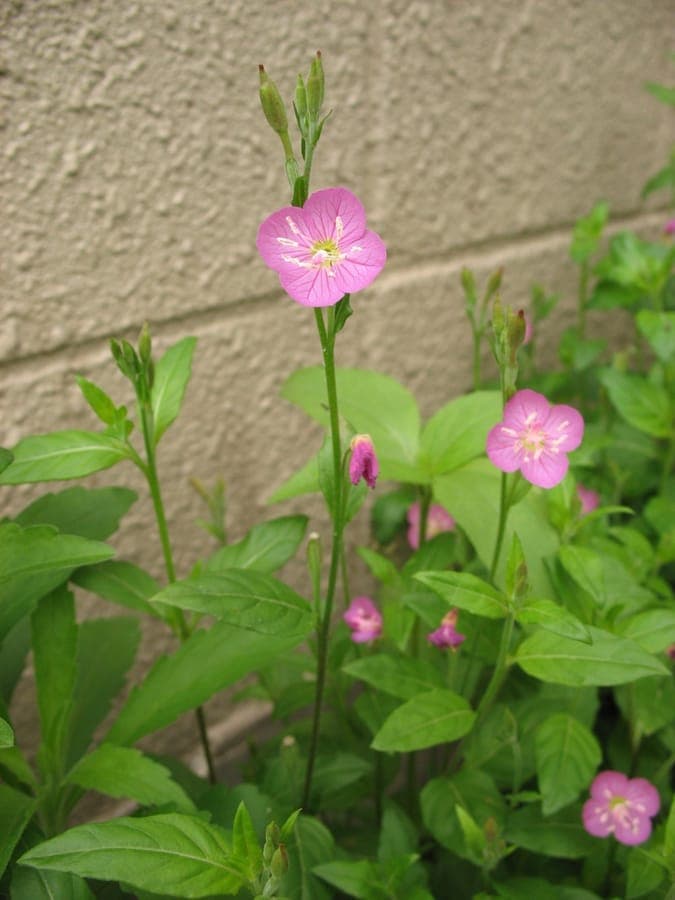
Sphl / CC BY-SA 3.0, via Wikimedia Commons
Rose evening primrose: complete guide
Oenothera rosea
¿Quieres ver Rose evening primrose: complete guide en tu jardín?
1 minuto, sin tarjeta de crédito
Overview
Rose evening-primrose (Oenothera rosea) is a graceful, compact perennial with lovely pink to magenta flowers. This plant is excellent for dry, sunny locations and requires virtually no maintenance once established. With its long flowering period from May to October and attractive low growth habit, this plant is a fantastic choice for gardens requiring minimal upkeep.
Originally from South America (Andes region), this plant is extremely drought-tolerant and adapted to diverse growing conditions.
Appearance and Bloom
Oenothera rosea grows to about 20-40 cm tall, depending on growing conditions. It is a compact, mostly spreading plant with elegant, slender stems. The leaves are small, linear to elongated.
The flowers are the real attraction: they are approximately 2-3 cm in diameter, pink to magenta in color, and appear continuously from May to October. The flowers usually open in the evening, though they may also remain open during the day. When planted in groups, this plant creates a beautiful, soft pink carpet.
Ideal Location
Rose evening-primrose thrives in full sun. A minimum of 6 hours of direct sunlight daily is required. In partial shade, the plant will grow taller and with fewer flowers.
Wind: This plant is very wind-resistant and grows well even in windy locations.
Drainage: Well-drained soil is essential. This plant cannot tolerate wet feet.
Soil
Oenothera rosea thrives in virtually all soil types, from sand to clay, as long as they are well-drained. It is actually a plant that prefers poor, lean soils.
PH: Very flexible; grows well in acidic (pH 5-6) to neutral (pH 7-8) and even slightly basic (pH 8-9) soils.
Nutrients: This plant needs very little nutrition. Too much feeding can lead to lush growth with fewer flowers.
Watering
Oenothera rosea is extremely drought-tolerant once established. Almost no regular watering is needed after the first season.
Young plants: During the first growing season, young plants should be watered regularly.
Summer: Water only in extreme drought.
Winter: No water needed; plant is usually evergreen.
Diseño gratis
¿Quieres ver Rose evening primrose: complete guide en tu jardín? Crea un diseño gratis ahora.
Pruning
Oenothera rosea requires virtually no pruning. The plant naturally maintains a compact, elegant form.
Flower removal: Remove spent flowers (deadheading) to encourage continuous blooming.
Winter cleanup: In spring, dead stems can be removed.
Formative pruning: This is not really necessary for this plant.
Maintenance Calendar
Spring (March-April): Check for dead wood, remove gently. Plant will emerge from winter.
Late Spring (April-May): Begin regular watering for young plants. No feeding needed.
Summer (May-October): Enjoy continuous blooming. Deadhead regularly if desired. Water only in extreme drought.
Autumn (October-November): Plant will slowly go dormant.
Winter (December-February): Plant is dormant or semi-dormant. Minimal maintenance.
Winter Hardiness
Oenothera rosea is reasonably winter hardy in temperate climates. In most regions, it survives winter without protection.
In very severe winters, mortality may occur, but the plant often self-sows.
In very cold regions, protective measures may be needed.
Propagation
Oenothera rosea usually self-sows. After flowering, seed pods fall to the ground and germinate in spring.
Pre-sowing: Seed can be sown outside in spring by pressing it lightly into the soil.
Cuttings: Can also be grown from cuttings, though self-seeding is easier.
Companion Plants
Rose evening-primrose combines beautifully with:
Other pink flowers: Gaura, other Oenothera species, Penstemon
Silver-leaved plants: Artemisia, Senecio, Santolina
Ornamental grasses: Festuca, Stipa, Bouteloua
Rock and alpine plants: Sedum, Sempervivum, Dianthus
Ground covers: Lavender, Thyme
Conclusion
Rose evening-primrose is an excellent choice for sunny, dry gardens where you want to add elegant, pink tones. This plant offers long-lasting blooms with minimal effort. Once established, it is virtually a maintenance-free plant.
Acquire your Rose evening-primrose from specialized garden centers. This plant also self-sows easily. Discover more on gardenworld.app for inspiration and design ideas.
¿Quieres ver Rose evening primrose: complete guide en tu jardín? Crea un diseño gratis ahora.
Sube una foto, elige un estilo y obtén un diseño fotorrealista con lista de plantas en menos de un minuto.
Más de 10.000 jardines diseñados
Sin tarjeta de crédito


Plantas similares
Shortfruit evening primrose: complete guide
Oenothera brachycarpa
Everything about Oenothera brachycarpa - the shortfruit evening primrose from the American Southwest. Growing tips, placement and care for your garden.
Sundrops (Oenothera tetragona): complete guide
Oenothera tetragona
Everything about Oenothera tetragona - the cheerful daytime-blooming sundrops perennial. Growing tips, placement, pruning and care for a long summer display.
Seabeach evening primrose: complete guide
Oenothera humifusa
Full guide to Oenothera humifusa, the seabeach evening primrose native to the US Atlantic coast. Yellow blooms, silvery foliage, drought-tolerant.