
Jan Kops / Public domain, via Wikimedia Commons
Oenanthe lachenalii: complete guide
Oenanthe lachenalii
¿Quieres ver Oenanthe lachenalii: complete guide en tu jardín?
1 minuto, sin tarjeta de crédito
Overview
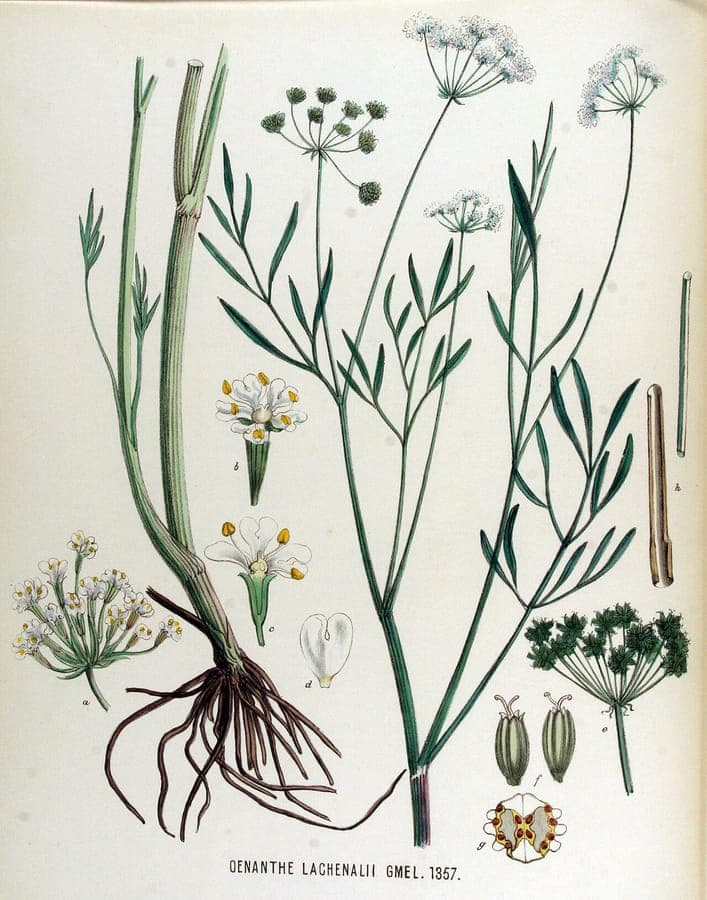
Oenanthe lachenalii, commonly known as parsley water-dropwort or water parsley, is a graceful aquatic plant from the carrot family (Apiaceae). This species is native to Europe and North Africa, thriving in wet, marshy habitats. It establishes itself elegantly in shallow water and along pond and canal margins. The delicate foliage and fine flowers make it a valuable addition to natural water and garden landscapes.
This plant is highly valued for ecological gardens and wetland management. Parsley water-dropwort attracts various bird species and serves as food for specific insects. Its growth contributes to natural water purification and erosion control along water margins.
Appearance and bloom
Parsley water-dropwort is a medium-sized herbaceous plant reaching 30-60 cm in height. Stems are hollow, somewhat weak, and grow upright from the water. The leaves are finely divided with a delicate, lacy appearance. They are dark green and linearly segmented, creating an elegant waving effect underwater.
Flowers appear from May to August in compact, white or very pale pink umbels at the tip of long stems. Each flower is small, approximately 2-3 mm across, but gathered in numerous florets forming an attractive spherical inflorescence. After pollination, brown, elongated fruits with ridges develop.
Ideal location
Parsley water-dropwort thrives in full sun to partial shade. The plant requires a minimum of 4-6 hours of direct sunlight daily to achieve optimal growth and abundant flowering. In warm climates, some afternoon shade can be beneficial to reduce excessive water evaporation.
Position this plant in shallow water areas, along pond edges, or in marshy ground where water is permanent or regularly returns. The species excels in natural ponds, rainwater basins, and ecological garden designs. Avoid locations where water becomes stagnant and foul without water exchange.
Soil
Parsley water-dropwort prefers rich, nutrient-dense aquatic substrates with abundant organic matter. Silty soil with high organic content is ideal. In ponds, it works well in plant baskets filled with horticultural potting soil enriched with compost.
The plant thrives in slightly acidic to neutral soils with pH between 5.5 and 6.5. The substrate must always remain moist to saturated. Avoid highly acidic or alkaline soils that can impede nutrient uptake. Well-decomposed compost or garden peat worked into the planting area promotes healthy roots.
Diseño gratis
¿Quieres ver Oenanthe lachenalii: complete guide en tu jardín? Crea un diseño gratis ahora.
Watering
As an aquatic plant, Oenanthe lachenalii requires permanent water. This is not a species that tolerates dry periods. Keep the substrate consistently moist to marshy and ensure roots never dry out.
In gardens, this is achieved by regularly introducing water or placing the plant in a water reservoir or pond. In containers outside the pond, daily watering is necessary, especially during hot, dry periods. A minimum of 2-3 cm of water above the soil must be maintained.
Pruning and maintenance
Parsley water-dropwort is a low-maintenance plant. Remove dead and damaged leaves regularly to keep the plant healthy. After flowering, misshapen or worn flower stems can be cut back to encourage new growth.
Remove accumulated dead plant material from the plant base annually to prevent water contamination and fungal growth. Thin out regularly to prevent overcrowding, especially in small ponds. Cut back regrowing stems in early spring before the new growing season begins.
Maintenance calendar
February-March: Cleaning, pest and disease inspection. Add compost. April-May: Growth begins, regularly remove dead parts. June-August: Full bloom, ensure constant water supply. September-October: Natural seed dispersal. Remove plant material. November-January: Dormancy period. Protection against freezing in cold winters.
Winter hardiness
Oenanthe lachenalii is winter hardy in temperate climates to USDA zone 5-6 (-15 to -10 degrees Celsius). The plant easily survives mild winters. In severe winters, protection may be needed by preventing the water surface from freezing solid.
In regions with very cold winters, insulation with silt or mulch layers can be helpful. If water freezes solid from January to March, ensure the process occurs slowly so plants are not damaged by ice formation.
Companion plants
Excellent plant companions for parsley water-dropwort include other aquatic herbs such as water violet (Hottonia palustris), water mint (Mentha aquatica), and marsh marigold (Caltha palustris). These plants share the same ecological preferences and naturally grow together in wetlands.
Caution is advised with vigorous spreading plants like water lilies that occupy considerable space. Maintain ecological balance in your water gardens with these combinations.
Conclusion
Parsley water-dropwort is an elegant and ecologically valuable addition to aquatic gardens and natural ponds. With attention to water management and regular maintenance, this plant reaches its full potential. The delicate foliage and gentle flowers create a soothing waterscape that attracts birds and insects.
For gardeners seeking to create natural water gardens, Oenanthe lachenalii is an excellent choice. Available at garden centers and nurseries throughout Europe. Consult local retailers for availability.
More information is available on gardenworld.app with thousands of plant knowledge articles and garden design ideas.
¿Quieres ver Oenanthe lachenalii: complete guide en tu jardín? Crea un diseño gratis ahora.
Sube una foto, elige un estilo y obtén un diseño fotorrealista con lista de plantas en menos de un minuto.
Más de 10.000 jardines diseñados
Sin tarjeta de crédito


Plantas similares
Whorled carrot: complete guide
Daucus involucratus
Daucus involucratus is a Mediterranean umbellifer with white flower heads framed by lacy bracts. Growing this gravel garden gem.
Daucus muricatus: complete guide
Daucus muricatus
Daucus muricatus, the spiny wild carrot, grows wild on Mediterranean coasts. Discover sowing, June-July bloom, and wildflower meadow use.
Daucus pumilus: complete guide
Daucus pumilus
Daucus pumilus is a dwarf wild carrot relative with white lacy umbels, thriving on dunes and coastal rock in poor, fast-draining soil.