
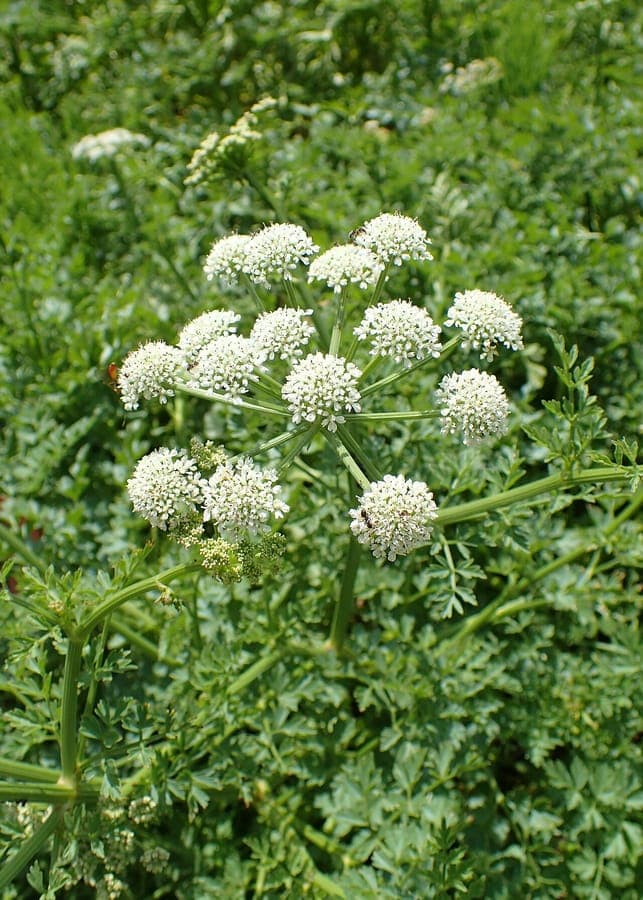
Krzysztof Ziarnek, Kenraiz / CC BY-SA 4.0, via Wikimedia Commons
Hemlock water-dropwort: complete guide
Oenanthe crocata
¿Quieres ver Hemlock water-dropwort: complete guide en tu jardín?
1 minuto, sin tarjeta de crédito
Overview
Hemlock water-dropwort (Oenanthe crocata), also known as saffron water-dropwort or dead tongue, is an extraordinarily toxic water plant from the Apiaceae family. This plant grows naturally from Western Europe to the Western Mediterranean region, particularly in marshy habitats and along watercourses. Hemlock water-dropwort is infamous for containing exceptionally poisonous alkaloids, especially in its roots and root tubers.
Appearance and bloom
Hemlock water-dropwort features delicate feathery foliage that grows submerged and extends above water. The plant reaches heights of 30-100 cm with thick hollow-like stems. From May to June, it produces small white flowers arranged in umbrella-shaped clusters. The flowers are relatively inconspicuous but attractive. However, the roots are most dangerous - thick root tubers containing extremely potent toxic alkaloids.
Ideal location
Hemlock water-dropwort grows along watercourses, in marshlands and shallow water areas. The plant thrives in full sun to partial shade. It prefers locations with high water tables near the surface. In gardens, this plant requires extreme caution due to its dangerous toxicity.
Soil
Hemlock water-dropwort grows in rich wet soils. The plant demands high moisture and humus content. Muddy and silty substrates are ideal. The plant cannot survive in dry soil and requires constantly high moisture levels.
Diseño gratis
¿Quieres ver Hemlock water-dropwort: complete guide en tu jardín? Crea un diseño gratis ahora.
Watering
Hemlock water-dropwort demands permanently saturated substrate. The plant cannot withstand even brief drying. In garden situations, constant water or very high soil moisture is essential for survival. Regular watering during the growing season is necessary.
Pruning
PRUNING IS STRONGLY DISCOURAGED DUE TO TOXICITY! All parts of hemlock water-dropwort are extremely poisonous and can cause severe skin reactions upon exposure. Pruning or handling this plant without extreme precautions is dangerous. Gloves are insufficient; it is preferable not to prune this plant at all.
Maintenance calendar
Spring: Check water levels around the plant. Summer: Observe flowering. NO HANDLING. Autumn: Be cautious around seed production. Winter: Plant dormant; NO HANDLING WITHOUT EXTREME PRECAUTIONS.
Winter hardiness
Hemlock water-dropwort is winter hardy across Western Europe. The plant regrows from rhizomes in spring, even after severe frost.
Companion plants
Hemlock water-dropwort must not be placed near children's play areas, pets or other food plants. Only suitable for highly specialized wetland garden situations. Appropriate only for wildlife habitats where human or animal contact can be minimized.
Closing thoughts
HEMLOCK WATER-DROPWORT IS EXTREMELY TOXIC. This guide is purely informational. Planting hemlock water-dropwort in gardens is NOT RECOMMENDED unless you are a wetland specialist. If you discover this plant in your garden, professional removal is strongly advised. Children and pets must be kept away. For safe alternatives for garden water zones, visit gardenworld.app.
¿Quieres ver Hemlock water-dropwort: complete guide en tu jardín? Crea un diseño gratis ahora.
Sube una foto, elige un estilo y obtén un diseño fotorrealista con lista de plantas en menos de un minuto.
Más de 10.000 jardines diseñados
Sin tarjeta de crédito


Plantas similares
Whorled carrot: complete guide
Daucus involucratus
Daucus involucratus is a Mediterranean umbellifer with white flower heads framed by lacy bracts. Growing this gravel garden gem.
Daucus muricatus: complete guide
Daucus muricatus
Daucus muricatus, the spiny wild carrot, grows wild on Mediterranean coasts. Discover sowing, June-July bloom, and wildflower meadow use.
Daucus pumilus: complete guide
Daucus pumilus
Daucus pumilus is a dwarf wild carrot relative with white lacy umbels, thriving on dunes and coastal rock in poor, fast-draining soil.