
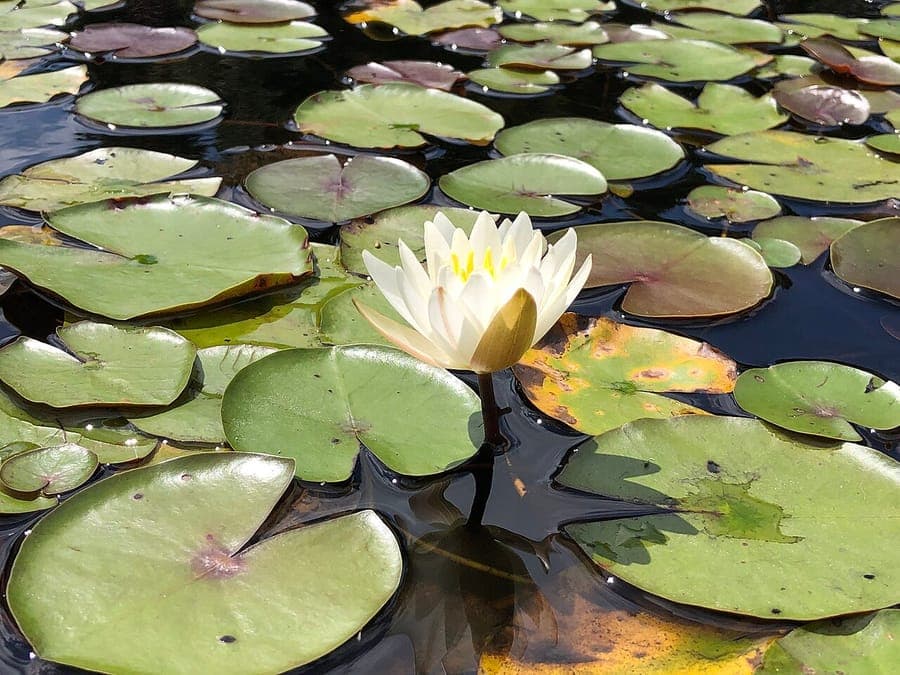
Famartin / CC BY-SA 4.0, via Wikimedia Commons
Fragrant Water-lily: complete guide
Nymphaea odorata
¿Quieres ver Fragrant Water-lily: complete guide en tu jardín?
1 minuto, sin tarjeta de crédito
Overview
Fragrant water-lily (Nymphaea odorata), also known as American water-lily or sweet-scented water-lily, is a very popular aquatic plant from the water-lily family (Nymphaeaceae), originating from North America from Canada to Nicaragua. This plant is a classic choice for ponds and water gardens because of its very pleasant fragrance, beautiful flowers, and reliable growth. The plant blooms continuously from June to September with flowers that protrude above the water surface and have one of the most pleasant scents in the garden world.
Nymphaea odorata can adapt very easily to different water conditions and grows well in both shallow and deep ponds. The plant is also very hardy and can survive unhindered in temperate climates.
Appearance and bloom
Nymphaea odorata has large, heart-shaped floating leaves that are green with sometimes red tints on the underside. The leaves reach 10 to 20 centimeters in diameter. The flowers are the star of this plant - they reach 7 to 13 centimeters in diameter and are usually white, though pink and red cultivars are also available. The flowers have many petals arranged in spiral patterns around yellow stamens.
The flowers open in the morning (usually around sunrise) and close in the afternoon, making it interesting to observe this plant. All flowers have a very pleasant scent that is strong at sunrise and diminishes as the day progresses.
Ideal location
Nymphaea odorata grows best in full sun with at least 6 to 8 hours of direct sunlight daily. The plant can also grow in partial shade, though blooming will be less abundant and fragrance may be weaker. In very shaded ponds, nymphaea odorata will grow very slowly and bloom weakly.
The plant grows in water depths of 0.3 to 1.5 meters. It can also grow in very shallow waters (20 centimeters) in containers. In very deep waters (over 2 meters), growth will be more limited.
Water quality requirements
Nymphaea odorata is very flexible about water quality. The pH can range between 6.5 and 8.0, though it grows best around pH 7.0. Water temperature can be from very cold (around freezing) to about 30 degrees Celsius. This plant is very hardy and can survive under ice.
The plant grows in both soft and hard waters. Nutrient enrichment helps growth and bloom - in nutrient-poor waters, blooming can be weaker. The plant itself helps reduce water pollution by absorbing nutrients.
Diseño gratis
¿Quieres ver Fragrant Water-lily: complete guide en tu jardín? Crea un diseño gratis ahora.
Planting requirements
Nymphaea odorata grows best in water soil containing organic matter. Planting containers are recommended - use large baskets (at least 45 liters) filled with water soil mixed with heavy clay and nutrients. The rhizomes should be planted horizontally.
If planted directly in pond soil, ensure soil depth is at least 30 centimeters with good nutrient content.
Maintenance and growth control
Nymphaea odorata requires minimal maintenance once established. The plant grows reasonably vigorously but not aggressively. Remove dead or diseased leaves regularly. If planted in baskets, divide the plant every 2 to 3 years by digging up and dividing rhizomes.
If overgrowth occurs, cut back leaves - dead leaf surface of about 25 to 33 percent of pond surface is optimal for bloom and water oxygenation.
Maintenance calendar
April to May: Plant begins growth. Plant in pond or containers around 15 to 20 degrees water temperature. Water regularly.
June to August: Plant blooms continuously. Fragrance is strongest in mornings. Remove dead leaves. Check for disease or insect problems.
September to October: Bloom begins to decline. Plant prepares for winter dormancy.
November to March: Plant rests underwater/under ice. No maintenance needed except in very shallow ponds.
Winter hardiness
Nymphaea odorata is very hardy and can survive under ice in temperate climates to zone 4. In very shallow ponds, enough water must be present so rhizomes do not freeze. In zones warmer than 9, the plant can continue blooming all year.
Special combinations
Nymphaea odorata combines beautifully with other aquatic plants. Plant it together with nuphar species for bloom position variety - water lilies have flowers that open flat on the surface while nuphar flowers position closer to water. Add underwater vegetation like Myriophyllum or floating plants like Eichhornia.
In small water features, nymphaea odorata can be used as the only plant for focal effect. In larger ponds, group different water-lily cultivars together for color variety.
Closing thoughts
Fragrant water-lily is one of the most rewarding water plants for temperate climates. With its beautiful flowers, pleasant fragrance, and reliable growth, it offers immediate joy in water ponds and small water features. Plant it in full sun in adequate water depth and enjoy its bloom each year. At gardenworld.app you will find more guides for water gardens and water-lily selection.
¿Quieres ver Fragrant Water-lily: complete guide en tu jardín? Crea un diseño gratis ahora.
Sube una foto, elige un estilo y obtén un diseño fotorrealista con lista de plantas en menos de un minuto.
Más de 10.000 jardines diseñados
Sin tarjeta de crédito


Plantas similares
Rocky Mountain pond-lily: complete guide
Nuphar polysepala
Everything about Rocky Mountain pond-lily (Nuphar polysepala): pond placement, soil, water care, pruning and winter hardiness tips.
Dotleaf Waterlily: complete guide
Nymphaea ampla
Nymphaea ampla, known as Dotleaf Waterlily, is a tropical aquatic plant from the Americas. Learn how to cultivate and maintain this beautiful water lily in your pond.
Roundleaf Waterlily: complete guide
Nymphaea conardii
Nymphaea conardii is a unique tropical waterlily with distinctive round leaves from Central and South America. Discover care tips for this specialized aquatic plant.