
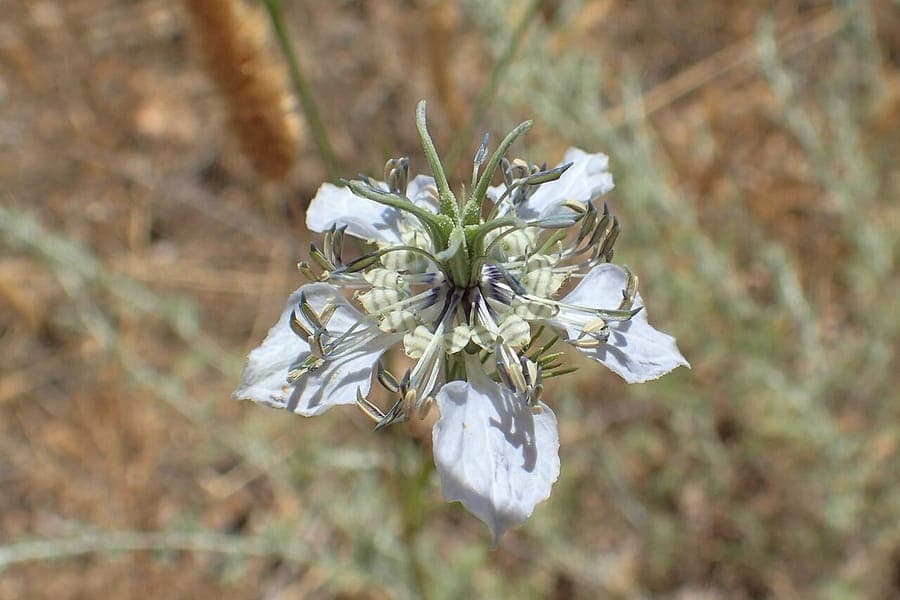
Krzysztof Ziarnek, Kenraiz / CC BY-SA 4.0, via Wikimedia Commons
Nigella arvensis: complete guide to growing wild fennel
Nigella arvensis
¿Quieres ver Nigella arvensis: complete guide to growing wild fennel en tu jardín?
1 minuto, sin tarjeta de crédito
Overview
Nigella arvensis, known as wild fennel, is a delicate annual plant from the Ranunculaceae family. This plant originates from Europe and especially from the region around the Mediterranean. In Northern Europe, this plant grows more wild than cultivated, although it is becoming increasingly popular in gardens because of its filigree flowers and attractive seed capsules.
The wild fennel distinguishes itself through its fine, hair-like leaves and charming light blue to blue flowers. After flowering, it forms interesting, intricately structured seed capsules that are decorative and can be used for dried bouquets. This plant grows to about 40-60 centimeters in height and has an airy, natural appearance.
Appearance and bloom
Nigella arvensis grows as an upright plant with strongly branched stems covered with fine, hair-like leaves. The leaves are very delicate and give the plant an airy, almost filigree appearance. The plant has an elegant, wildflower character.
The flowers are small to medium, about 2-3 centimeters in diameter, and have a soft blue to blue-green color. They appear along the stems and are provided with long, hair-like stamens that give the flower an interesting structure. After flowering, striking seed capsules form with long, ornamental beaks that overlap like a spider web.
Ideal location
Nigella arvensis grows best in a sunny location that receives at least six hours of direct sunlight per day. The plant tolerates light partial shade but blooms better in full sun. An open, well-lit spot is important for optimal growth.
Make sure the plant has enough space for its full, hairy growth. Good air circulation helps prevent disease. The plant is robust and adaptable to different locations. Do not plant this in full shade, where it will become etiolated and produce fewer flowers.
Soil
Nigella arvensis is very adaptable to different soil types and grows even in poor, dry soils. The plant prefers well-draining, light soil but also tolerates heavier soils. A neutral to slightly acidic pH (6.0-7.5) is preferred.
The plant requires no special preparation - it grows in virtually all garden soils. For pot culture, you can use standard potting soil. Good drainage is important, although the plant can grow somewhat wetter than many other Ranunculaceae.
Diseño gratis
¿Quieres ver Nigella arvensis: complete guide to growing wild fennel en tu jardín? Crea un diseño gratis ahora.
Watering
Nigella arvensis has moderate water requirements and can tolerate some drought. Water when the top layer of soil feels dry, usually once a week. The plant can grow in normal years with rainfall without extra water.
Avoid waterlogging, especially in winter. Water preferably at the base of the plant. In very dry periods, more watering may be needed, especially for young plants. Once established, this plant is quite self-sufficient in water management.
Pruning
Actually, pruning is not necessary for this naturally growing plant. However, remove spent flowers if you want to stimulate more blooms - although the natural character will be lost. Leave some flowers if you want to collect seeds for next year.
Regularly remove dead or damaged parts. At the end of the season, when the plant has shed its seeds, you can remove it. The plant will likely self-seed.
Maintenance calendar
In spring (April-May), sow seeds directly in the garden on the final growing location. The plant grows quickly and blooms from June to August. In August, you begin to form seed capsules. In September, the seeds ripen.
In October, when the seeds have dropped, you can remove the plant. The seeds will likely self-seed and grow again next year.
Winter hardiness
This is an annual plant that is not winter-hardy. Nigella arvensis dies after freezing temperatures. In Northern Europe, this plant does not overwinter outdoors in normal years. However, the plant propagates itself through self-seeding.
For intentional seed saving: collect ripe seeds in September-October and store them in a cool, dry place until next spring.
Companion plants
Nigella arvensis combines beautifully with other delicate, wildflower-like plants. Suitable combinations: Cornflower (Centaurea), Poppy (Papaver), Bachelor's button, Love-in-a-mist, other Nigella species, Linaria, Xerophyllum.
The plant works well in natural garden schemes and cottage gardens. The delicate leaves contrast nicely with fuller-growing plants.
Closing
Nigella arvensis is a charming, delicate plant that adds naturalness and wildflower character to the garden. With minimal care - sun, good drainage and occasional water - you will enjoy this plant. The attractive seed capsules make it valuable for dried flowers.
For more information, visit gardenworld.app. For seeds, try your local garden center or online seed suppliers.
Visit gardenworld.app for more plant information and garden advice.
¿Quieres ver Nigella arvensis: complete guide to growing wild fennel en tu jardín? Crea un diseño gratis ahora.
Sube una foto, elige un estilo y obtén un diseño fotorrealista con lista de plantas en menos de un minuto.
Más de 10.000 jardines diseñados
Sin tarjeta de crédito


Plantas similares
Drummond's anemone: complete guide
Anemone drummondii
Discover Drummond's anemone (Anemone drummondii): a silvery-grey mountain plant for cool rock gardens and alpine troughs.
Korean clematis: complete guide
Clematis serratifolia
Clematis serratifolia is a hardy climber with fragrant yellow bell flowers in August-September. Pruning group 3, location and care tips.
Aquilegia brevistyla: complete guide
Aquilegia brevistyla
Discover Aquilegia brevistyla, the elegant North American columbine. Growing tips, shade tolerance, and design ideas for woodland and shadowed gardens.