
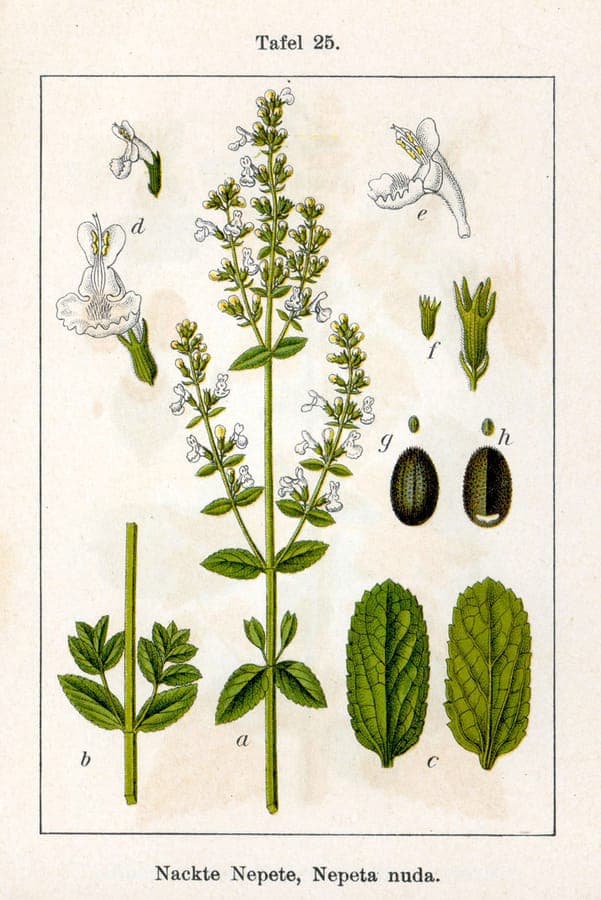
Johann Georg Sturm (Painter: Jacob Sturm) / Public domain, via Wikimedia Commons
Hairless catmint: complete guide
Nepeta nuda
¿Quieres ver Hairless catmint: complete guide en tu jardín?
1 minuto, sin tarjeta de crédito
Overview
Hairless catmint (Nepeta nuda) is an elegant, flower-rich perennial from Europe and Asia, distributed from France to Xinjiang. The plant belongs to the Lamiaceae family (mint family) and is closely related to the better-known Nepeta cataria (common catnip).
The name 'nuda' refers to the smooth (hairless) character of the plant.
Appearance and blooms
Hairless catmint grows as a compact, upright plant reaching 40-60 cm in height. The stems are smooth, not particularly hairy. The leaves are small, lance-shaped, gray-green, slightly aromatic.
The flowers are bright blue to purple-blue, very abundant and bloom from June to September. The plant is extremely attractive to bees, bumble bees and butterflies.
Ideal location
This catmint grows best in full sun. Minimum 6-8 hours of direct sun daily is ideal. The plant also tolerates light shade but flowers more abundantly in full sunlight.
Use in summer borders, combined with roses, in dry gardens, or in large pots. Excellent for naturalistic garden style and wildflower gardens.
Soil
Hairless catmint is not fussy and grows in virtually all soils. Preference is for well-draining soils; heavy clay soils must be improved. Ideal pH range: 7.5-8.0 (neutral to alkaline).
The plant grows well in lean to moderately fertile soils. Excessive feeding can promote vigorous growth.
Diseño gratis
¿Quieres ver Hairless catmint: complete guide en tu jardín? Crea un diseño gratis ahora.
Watering
Once established, hairless catmint is very drought-tolerant. Water regularly the first season; thereafter practically no supplemental water is needed.
The plant forms deep roots and extracts water from deeper soil layers. Avoid stagnant water.
Pruning
Pruning is optional. Remove spent flowers (deadheading) to encourage longer blooming. In fall or early spring, stems can be cut short (to 20 cm) to encourage compact growth.
Maintenance calendar
March-April: Cut old stems short; feed lightly.
May-September: Flowering period; deadhead for longer blooms; water during extreme drought.
October-February: Winter dormancy; no maintenance needed.
Winter hardiness
Hairless catmint is winter-hardy in USDA zones 4-8. The plant tolerates temperatures down to -25C without issues. The plant dies back above ground in winter but regrows from the base.
Companion plants
Combine with other flowering plants:
- Salvia species (sage)
- Allium species (ornamental onion)
- Achillea species (yarrow)
- Coreopsis species
- Hypericum species
- Lavandula species (lavender)
Also pairs well with roses.
In closing
Hairless catmint is a highly valuable plant for those wanting drought-tolerant, pollinator-friendly flowers without much maintenance. A perfect plant for modern, naturalistic gardens.
Availability: Intratuin, Gamma (Netherlands); OBI, Hornbach (Germany); Truffaut, Jardiland (France).
More information: gardenworld.app/en, gardenworld.app/nl
¿Quieres ver Hairless catmint: complete guide en tu jardín? Crea un diseño gratis ahora.
Sube una foto, elige un estilo y obtén un diseño fotorrealista con lista de plantas en menos de un minuto.
Más de 10.000 jardines diseñados
Sin tarjeta de crédito


Plantas similares
Apple mint (Mentha x villosa): complete guide
Mentha x villosa
Meet apple mint (Mentha x villosa): a fruity-scented kitchen herb with woolly leaves, perfect for tea and mojitos.
Salvia peyronii: complete guide
Salvia peyronii
Discover Salvia peyronii, a rare Lebanese mountain sage. Growing tips, hardiness, and companion planting for a Mediterranean gravel garden.
Bigleaf mint (Mentha x rotundifolia): complete guide
Mentha x rotundifolia
Discover bigleaf mint: cultivation, care tips, and garden uses. Learn how to grow this aromatic herb with soft, hairy leaves.