
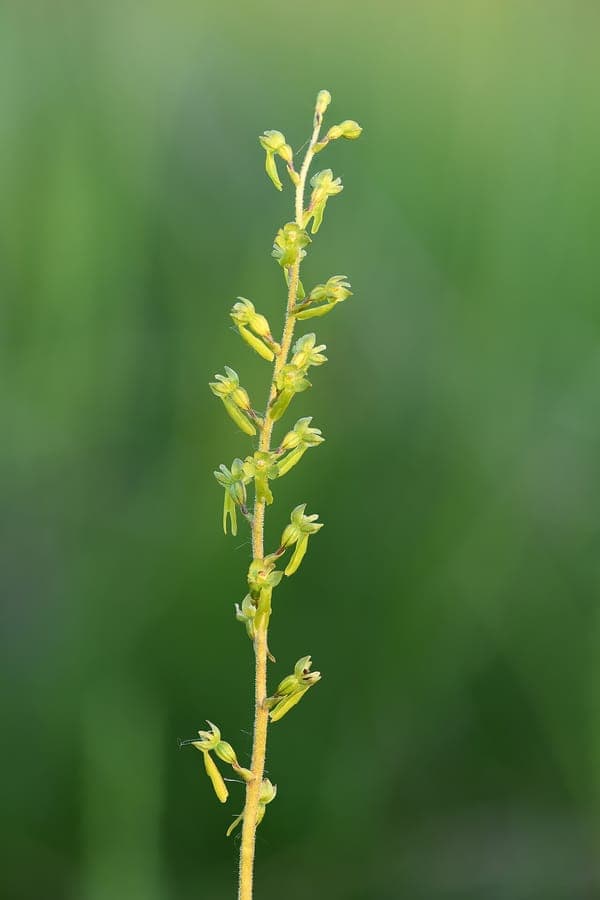
Ivar Leidus / CC BY-SA 4.0, via Wikimedia Commons
Common twayblade: complete guide
Neottia ovata
¿Quieres ver Common twayblade: complete guide en tu jardín?
1 minuto, sin tarjeta de crédito
Overview
The common twayblade, scientifically known as Neottia ovata, is the more approachable cousin of the bird's-nest orchid. Named for its distinctive pair of large, ovoid basal leaves, this native European orchid grows in moist woodland margins, along stream banks, and in damp meadows. Unlike its rarer relative, the common twayblade tolerates more varied growing conditions and adapts reasonably well to cultivation in appropriate settings. This orchid is symbiotic with mycorrhizal fungi, depending on these underground partners for nutrient absorption, though less exclusively than the saprophytic bird's-nest orchid.
The common twayblade is distributed across the entire European continent extending eastward to the Himalaya Mountains, demonstrating its broad ecological tolerance. Throughout its range, populations are declining, and the species appears on threatened plant lists in many European countries including the Netherlands, Belgium, and the United Kingdom. Conservation of moist woodland margins and grassland habitats is essential for maintaining healthy populations. This elegant orchid thrives in the transition zones between forest and open habitats.
Appearance and bloom cycle
The common twayblade typically reaches heights between 20 and 50 centimeters, with considerable variation depending on growing conditions and plant vigor. The plant's most distinctive feature is its pair of prominent, oval-shaped basal leaves, each measuring 3 to 7 centimeters long. These leaves are deep green, leathery, and conspicuously veined, functioning as the primary photosynthetic engine of the plant. Several much smaller, scale-like leaves clasp the flowering stem above the basal leaf pair.
The inflorescence is a characteristic, unbranched spike containing 20 to 40 small flowers arranged in a dense raceme. Individual flowers measure approximately 0.7 to 1.2 centimeters across and emit a pleasant, subtle musky fragrance most pronounced in warm weather. Flower coloration varies from greenish-brown to reddish-brown depending on the population and local conditions. The flowering season spans May through July, with peak bloom in June. Flowers appear as the plant reaches full leaf development, creating a graceful combination of foliage and bloom.
Ideal location
The common twayblade thrives in woodland margins, stream banks, and damp grasslands under partial shade conditions. The plant tolerates considerably more light than the bird's-nest orchid, requiring approximately 40 to 70 percent shade for optimal growth. This makes it far more practical for garden cultivation than its rare relation. The plant flourishes in USDA hardiness zones 4 through 8, with possibility of cultivation in warmer regions if moisture remains constant.
Temperature preferences favor cool to mild conditions. The plant tolerates winter freezes to minus 20 degrees Celsius without harm, though it strongly dislikes prolonged summer heat. In its native habitats, summer temperatures rarely exceed 20 to 25 degrees Celsius.
Diseño gratis
¿Quieres ver Common twayblade: complete guide en tu jardín? Crea un diseño gratis ahora.
Soil requirements
The common twayblade grows in moist, moderately fertile soils with pH ranging from 5.5 to 7.0. Constant soil moisture is essential, though waterlogging must be avoided. Peaty or marshy soils with high water tables are particularly suitable. The plant forms mycorrhizal associations with woodland fungi but is less dependent on these relationships than the saprophytic bird's-nest orchid.
Soil composition can be less rich in organic matter than required for bird's-nest orchid cultivation. A mixture of moist garden soil combined with coarse sand and gravel provides excellent drainage and structure. Organic matter should be regularly replenished with leaf mold and compost.
Watering
The common twayblade requires consistent moisture throughout the growing season. Watering is best performed in early morning or evening to prevent foliar damage. The plant prefers relative humidity between 50 and 80 percent. During the dormant winter period, soil should be kept just barely moist, never waterlogged.
Pruning
No pruning is required. After flowering, the entire stem should remain intact until completely senescent, as the plant requires this tissue for seed development and underground energy reserves. Basal leaves may be removed in autumn after they have completely died back.
Maintenance calendar
May-June: Strong growth and flowering July-August: Seed maturation September-October: Seed dispersal and above-ground senescence November-April: Complete dormancy and underground development
Winter hardiness
The common twayblade is very winter-hardy through USDA zone 4, with potential cultivation through zone 8 in temperate maritime climates. No winter protection is required in Netherlands or Belgian conditions. The plant overwinters as an underground tuber-like structure.
Companion plants
The common twayblade grows excellently alongside other moisture-loving plants including the broad-leaved helleborine, marsh marigold, and sedges. Native ferns and other woodland margin plants create a natural, diverse habitat. Creating these combinations results in beautiful, ecologically meaningful garden compositions. Explore gardenworld.app for designs incorporating moisture-loving orchids and native wetland species.
Closing
The common twayblade is considerably more tractable for garden cultivation than the bird's-nest orchid, though it still requires moist, partially shaded conditions. Gardeners interested in woodland and wetland plants will find detailed cultivation information on gardenworld.app. For additional resources on native orchid growing and habitat design, consult gardenworld.app for expert guidance and regional recommendations.
¿Quieres ver Common twayblade: complete guide en tu jardín? Crea un diseño gratis ahora.
Sube una foto, elige un estilo y obtén un diseño fotorrealista con lista de plantas en menos de un minuto.
Más de 10.000 jardines diseñados
Sin tarjeta de crédito


Plantas similares
Ram's-head lady's slipper: complete guide
Cypripedium arietinum
Everything you need to know about growing Cypripedium arietinum, a rare woodland orchid for cool, moist garden settings. Soil, care and planting tips.
Sparrow's-egg lady's slipper: complete guide
Cypripedium passerinum
Everything about growing Cypripedium passerinum, a cold-hardy subarctic orchid suited to cool, moist, shaded garden spots. Soil, care and companion plants.
Algerian Butterfly-orchid: complete guide
Platanthera algeriensis
Everything about Platanthera algeriensis, the rare Mediterranean orchid with greenish flowers native to Algeria, Morocco, Corsica and Spain.