
Velela / CC BY 2.5, via Wikimedia Commons
Lesser Twayblade: complete guide
Neottia cordata
¿Quieres ver Lesser Twayblade: complete guide en tu jardín?
1 minuto, sin tarjeta de crédito
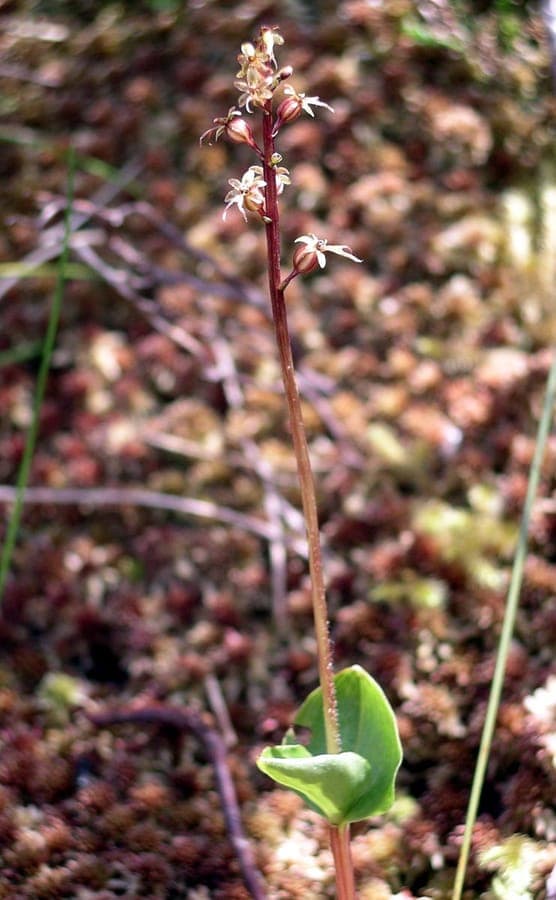
Lesser Twayblade, scientifically designated Neottia cordata, is a miniature European orchid. This very small native plant is valuable for nature gardens with woodland soil and specialist plant collectors. The plant reaches only 6-15 cm height and is characterized by two distinctly heart-shaped basal leaves and a fine, inconspicuous flowering panicle with green flowers.
Appearance and bloom
Lesser Twayblade presents itself as the least conspicuous of all European orchids - a very small plant easily overlooked in its natural woodland habitat. The two basal leaves are unusual for orchids: they are heart-shaped, 1-2 cm long and wide, dark green with distinctly visible veins. The flower stem is leafless, very thin and green, approximately 8-15 cm tall. From May through July, a very small flowering panicle appears with only 4-8 very small green flowers, each just 2-3 mm in diameter. The flowers are so small and dark that they are easily overlooked. The plant is a bird-native insect, not pollinated by butterflies.
Ideal location
Lesser Twayblade grows exclusively in woodland habitats with moist, humus-rich soil conditions. The plant grows in forest soil under leaf litter and conifer trees, often in partially shaded to dark locations. At least 30-40% shade is required, but the plant can also grow in fully shaded locations. Open, sunny sites are unsuitable.
Soil and planting hole
Lesser Twayblade requires very humus-rich, acidic forest soil with abundant dead leaves and organic matter. The pH must be between 4.5 and 5.5. Plant in locations where soil is covered with leaf litter and where humus accumulation occurs. In gardens, you can employ the plant by adding forest soil, refined peat and dead leaves. Do not plant deeply - the basal leaves should sit just above ground.
Water management
Lesser Twayblade must be kept moist but should not grow in waterlogged situations. The plant naturally grows in woodland environments where water is continually present but drains well through the organic-rich substrate. In dry periods, water carefully.
Diseño gratis
¿Quieres ver Lesser Twayblade: complete guide en tu jardín? Crea un diseño gratis ahora.
Pruning and maintenance
Lesser Twayblade requires virtually no pruning or maintenance. Avoid all fertilization and chemical input. Leave dead leaves around the plant - this is food and protection.
Maintenance calendar
March to April: awaken after winter rest, check moisture. May through July: flowering period, minimal care. August through October: seed ripening. November through February: quiet period.
Winter hardiness
Lesser Twayblade is fully hardy and grows naturally in woodlands across much of Europe - Great Britain, Scandinavia, Poland, France, Germany and to the Alps. The plant survives temperatures to minus 20 Celsius without protection.
Ecological value
Lesser Twayblade is highly valuable for woodland garden restoration and native plant composition. The plant is especially valuable for bird insects - small flies pollinate the flowers. It is also a food plant for certain insects.
Cultivation difficulties
Lesser Twayblade is very difficult to cultivate outside its natural woodland habitat. It requires very specific conditions: constant moisture level, forest soil, partial shade, and likely symbiosis with certain fungi (mycorrhiza). In gardens it can only be maintained with great difficulty.
Companion plants
Lesser Twayblade naturally grows with other woodland plants such as nightshade families, small ferns, and dead leaf-decomposing fungi. In gardens it grows best when other woodland plants are present.
Availability
Lesser Twayblade is very rarely available in garden trade. The plant must not be collected from the wild - it is protected in most countries. Ask for cultivated plants from specialized orchid growers. Very limited availability.
Closing remarks
Lesser Twayblade is especially interesting for nature lovers and very specialized plant collectors with woodlands. The plant is highly valuable for ecological restoration of woodland plant composition. However, cultivation outside its natural habitat is very challenging.
¿Quieres ver Lesser Twayblade: complete guide en tu jardín? Crea un diseño gratis ahora.
Sube una foto, elige un estilo y obtén un diseño fotorrealista con lista de plantas en menos de un minuto.
Más de 10.000 jardines diseñados
Sin tarjeta de crédito


Plantas similares
Ram's-head lady's slipper: complete guide
Cypripedium arietinum
Everything you need to know about growing Cypripedium arietinum, a rare woodland orchid for cool, moist garden settings. Soil, care and planting tips.
Sparrow's-egg lady's slipper: complete guide
Cypripedium passerinum
Everything about growing Cypripedium passerinum, a cold-hardy subarctic orchid suited to cool, moist, shaded garden spots. Soil, care and companion plants.
Algerian Butterfly-orchid: complete guide
Platanthera algeriensis
Everything about Platanthera algeriensis, the rare Mediterranean orchid with greenish flowers native to Algeria, Morocco, Corsica and Spain.